


Keeping cloud servers cool is a major headache. Vast amounts of chillers are needed to keep data centers humming. On Earth.
But in space, that’s another story. Entrepreneur Rob DeMillo, CEO of Sophia Space, formerly of NASA Jet Propulsion Laboratory and MIT Lincoln Laboratory, with a portfolio of seven acquisitions and IPOs out of nine companies, said cooling servers in orbit is not a concern. Thermal management is the chief architectural constraint, he said.
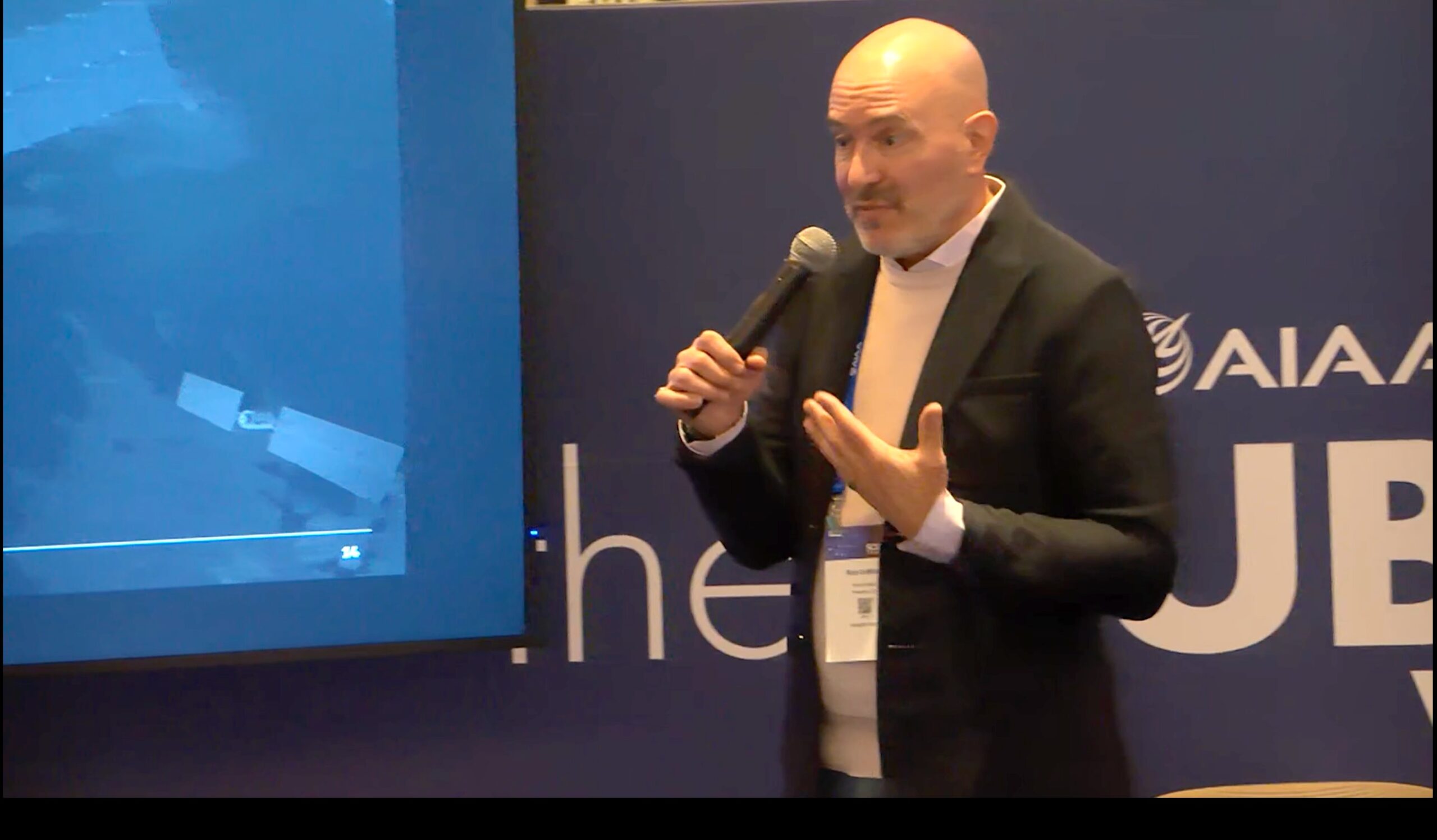
DeMillo described his company’s tile design for data servers in orbit in a HUB session at AIAA SciTech Forum 2026 in January. Sophia Space aims to build modular, passively cooled tiles that can be assembled into orbital data centers.
The core of the architecture is the Tile, a flat, modular compute slab whose design and material choices enable efficient passive heat rejection. This approach eliminates the need for active cooling, allowing heat generated by the compute elements to be managed through the Tile’s inherent thermal design and rejected directly into space, DeMillo explained.
Power comes from a solar cell mounted on the tile’s top surface. Its power output covers both the compute load and the modest heating required to keep the tile’s batteries and memory within optimal temperature range. Because the tiles are essentially flat, the entire volume is minimized, turning the heat dissipation problem into a surface area issue that can be solved with those passive radiators.
Beyond hardware, Sophia Space is developing an orbital operating system, dubbed SOOS. It handles process scheduling, heat distribution management, firmware upgrades, security patches and routing around failed tiles – all without human intervention. The operating system monitors each tile’s temperature and computational load, redistributing work if a quad or an entire tile goes offline due to debris impact or hardware failure. In large installations, the system can gracefully degrade performance until a replacement module is launched.
The company envisions three product tiers: a single tile or a small rack that a customer mounts on a host satellite or space station; a clustered array of about 40 tiles that can launch into a nearby companion orbit; and a full-scale orbital data center (ODC) of about 2,500 tiles.
Sophia Space would launch, maintain, and eventually replace the array, handling deorbiting of obsolete modules, although the company sees a 30-year lifecycle comparable to a terrestrial data center, DeMillo stated. Hardware could be refreshed roughly every six years to compensate for radiation damage and debris-induced degradation.
On Earth, roughly 92 percent of a data center’s power goes to HVAC systems and computing. In orbit, the passive design pushes that figure down to 8 percent – the remainder of the power goes directly to computation.
DeMillo said he sees a variety of Earth-based applications: military and defense; aviation, including air traffic control and dynamic routing around weather and congestion; and maritime, including enhanced automatic identification system (AIS) data, piracy avoidance, and port entry optimization. He also explained applications for emergency response, such as providing rapid analysis of wildfire smoke using combined radar and spectral imaging or directing firefighting resources. The data center could also be used for scientific research enabling higher frequency sampling without overwhelming ground stations.
The company expects to have products available next year.
Sophia Space’s vision of modular, passively cooled orbital computer tiles could portend an era of space-based data centers, side-stepping the real estate, cooling, and power drawbacks of Earth-based centers.