

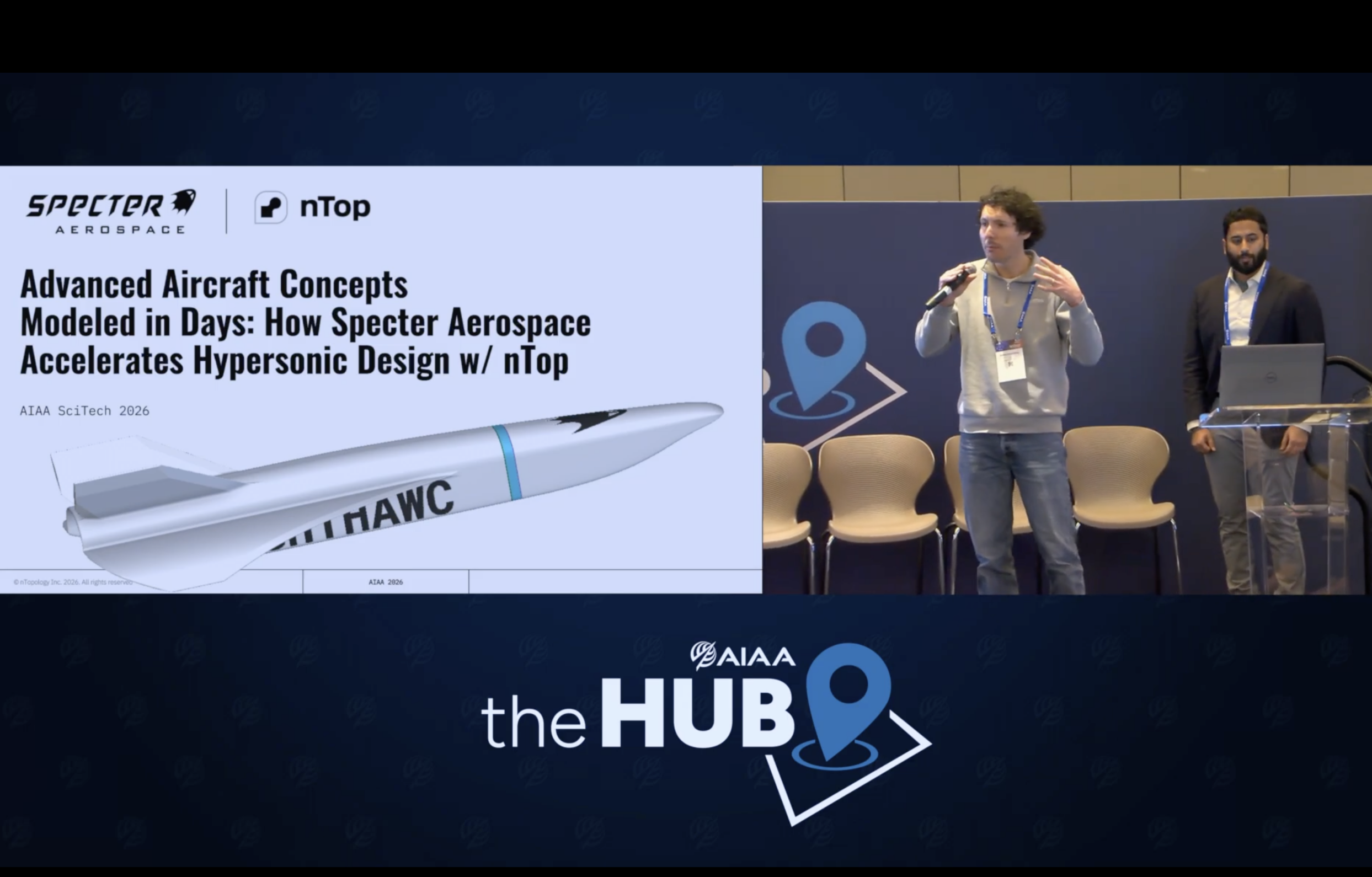
ORLANDO, Florida – Used to be, designing hypersonic aircraft, a complex and lengthy process, presented a choice: One could choose low-fidelity and have it quickly, or high-fidelity and it would take seemingly forever.
Those days may be gone if aerospace firms Specter Aerospace and nTop have their way. Now, hypersonic aircraft can be designed quickly, with high fidelity, at scale, reducing time from development requirements to validated design in days instead of weeks or months, said presenters on the HUB stage at AIAA SciTech Forum on 13 January.
“The bottleneck is geometry, not analysis or manufacturing,” said Bradley Rothenberg, CEO and founder of nTop, which provides advanced geometry modeling and simulation tools that let engineers create, modify, and analyze complex 3D shapes far faster than traditional CAD systems.
Rothenberg told the audience that a warfighter’s needs were sprinting ahead while the tools they relied on were stuck. As an example, he cited the Navy’s new “Mach XL” program – an effort to launch a hypersonic aircraft from zero to flight in less than a year. “They want a digital model in thirty days,” he said. The old ways of drawing endless spreadsheets and painstaking CAD assemblies would not do.
Enter nTop, which is allowing Specter to reduce design from months to days or weeks instead of years.
“That is only possible with nTop,” said Arun Chundru, chief technology officer of Specter Aerospace.
Chundru, whose company aims to deliver affordable, responsive hypersonic systems for defense markets, said his team had been wrestling with the same CAD monsters for months, only to find themselves stuck in a loop of redesign, remesh, and rerun.
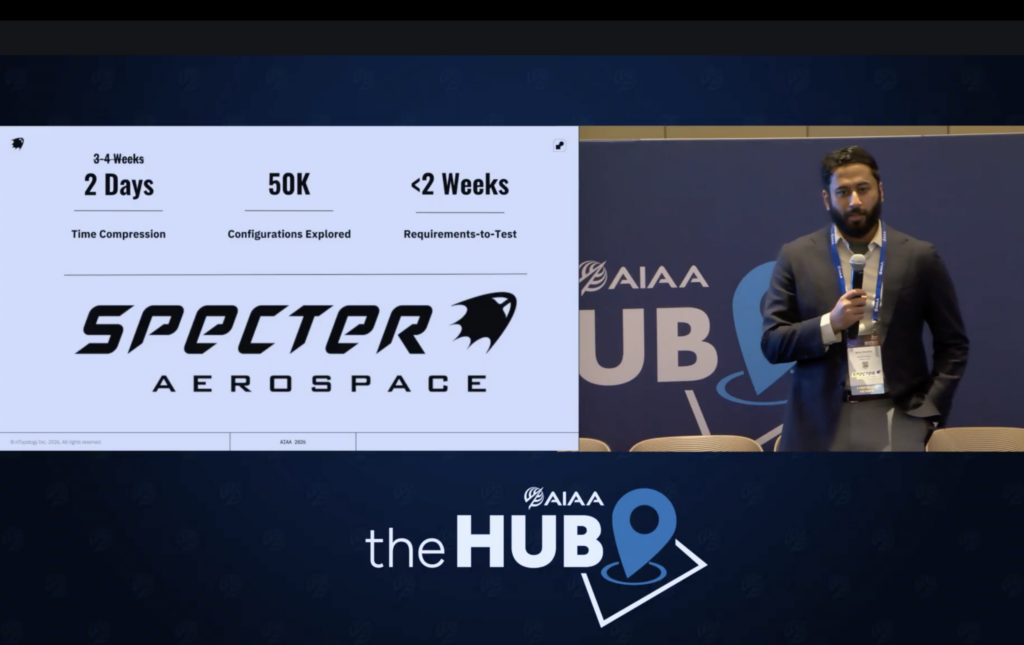
“We needed a way to close the design-build-test loop,” Chundru said. “We wanted to go from a sketch on a whiteboard to a hot-tested engine in weeks, not years.” Now the workflow allows rapid conceptual modeling, automated high-fidelity analysis, design space optimization, with additive manufacturing and hardware validation.
He used as an example a range-tuned nozzle that had been born entirely inside nTop, linked to Specter’s heat transfer analysis. With this single implicit model, the team spun out multiple variants – combustors, scramjet throats, ramjet expansions – without ever opening a new CAD file.
“nTop’s geometry tool set really allows us to create implicit models that don’t break when you run a design cycle, when you make a change, replace your fins, or change anything. That, for anyone who has ever tried to package any kind of air vehicle, knows is not the case with traditional CAD,” Chundru noted.
Coupled with advanced analysis tools, he added, the program offers the ability to turn design cycles in one or two days, not 30.
After all the design, the next step is to get to flight, which Specter expects to do within a year. On the vehicle scale, he said, the entire design, analysis, optimization, and validation cycle can be done in less than a month. “Scaling this approach with nTop’s closed loop design and model-based assistance engineering will take us to the next level of how fast we can develop systems for both defense applications, but also future commercial uses,” Chundru said.
“Our adversaries are moving fast, and if we can’t keep up, we lose the strategic edge,” added Rothenberg. Yet the same tools that accelerate hypersonic weapons could empower commercial innovators, from high-speed freight drones to next generation electric aircraft.