

It’s the first mission to bring humans to the moon in more than fifty years, and Alicia Dwyer Cianciolo is leading a team that will ensure the astronauts with the Artemis program land safely and precisely on the moon’s surface.
“This is not our grandparents’ Apollo, this is our chance to do something different,” Cianciolo said.
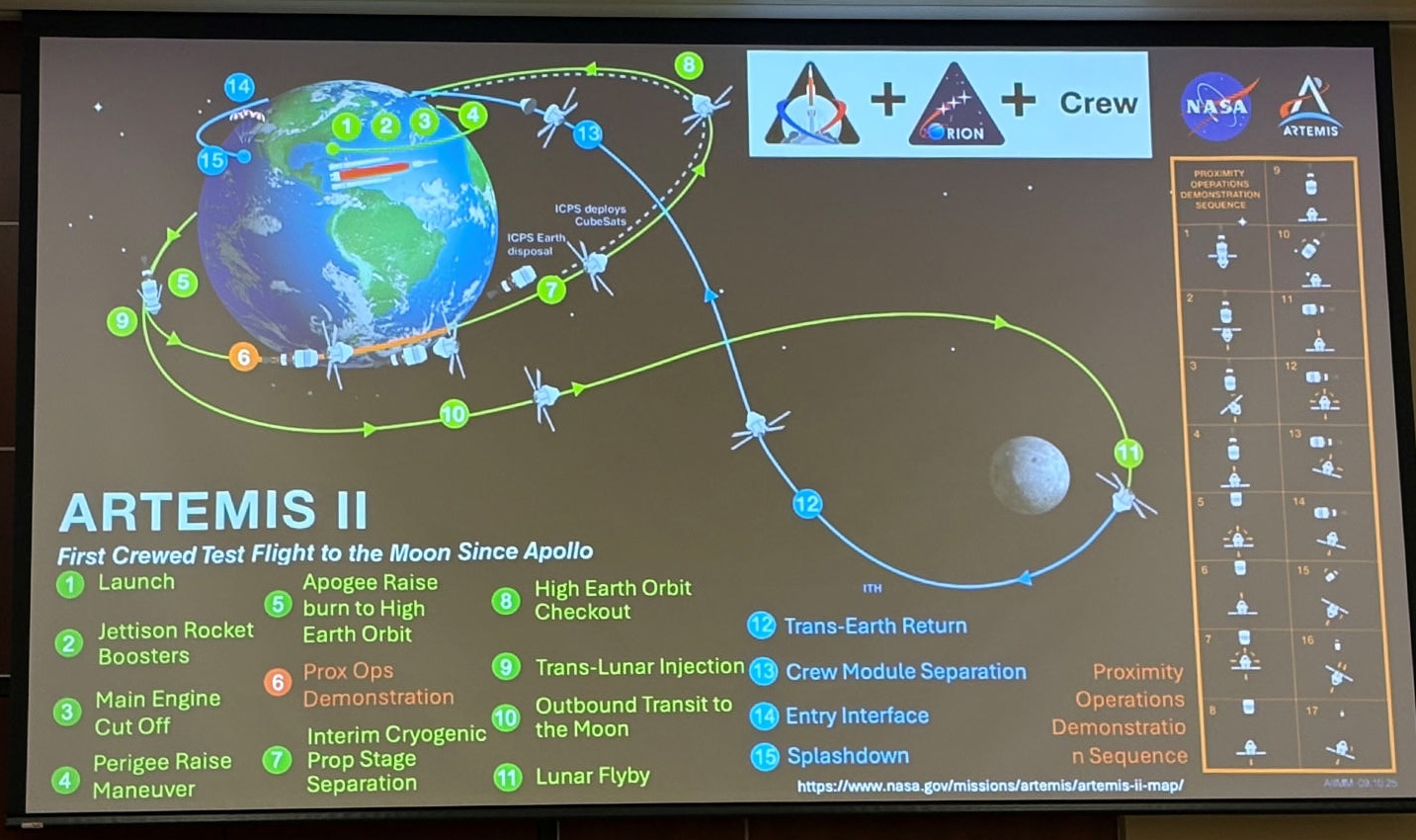
Cianciolo, an AIAA Associate Fellow, spoke with engineers representing a number of societies at the annual Wichita Council of Engineering Societies Engineers Week Banquet in February, where the AIAA Wichita Section was a silver sponsor of the event. The speech detailed the Artemis project, the various missions, and her team’s role in setting the requirements and ensuring the human landing systems meet those requirements.
The Human Landing Systems program involves the vessels that will carry humans to the surface of the moon. It’s one of several programs under development within the Artemis project, which also include the space launch system, the Orion spacecraft, the Lunar Gateway station and the Extravehicular Activity and Human Surface Mobility Program.
The human landing systems were planned to come into play during the Artemis III, IV, and V missions, but in late February, NASA announced Artemis III will no longer involve humans landing on the moon. Artemis IV is still set to move forward as planned, and if no significant delays arise, the mission should happen in 2028.
The Artemis program will deliver humans to the south pole of the moon. The location is different from all other moon missions in the past and requires a careful and exact landing location due to the considerations of light and terrain.
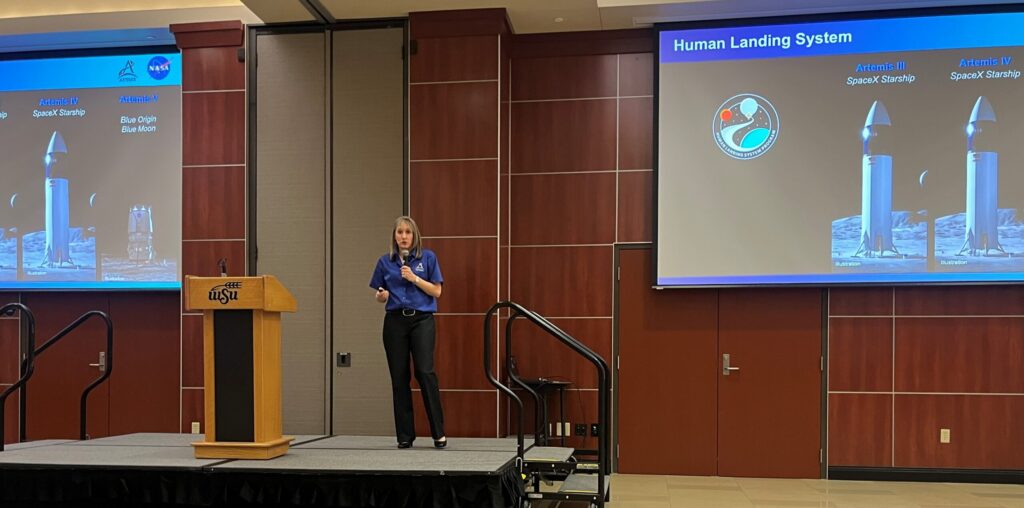
Cianciolo and her team are working to certify the human landing systems for flight. SpaceX is currently developing the human landing systems for the Artemis III and Artemis IV missions, while Blue Origin is developing the human landing system for the Artemis V mission.
During her talk, Cianciolo shared side-by-side comparisons of the Apollo human landing system and that of the Artemis missions, demonstrating the vast size difference between the two. The Artemis human landing system is more than seven times larger than that of Apollo – with the ability to deliver 15 metric tons to the moon’s surface compared to the couple hundred kilograms with Apollo. Cianciolo said the Artemis human landing system will be roughly the same height as the Leaning Tower of Pisa – roughly 170 feet – while the Apollo system was around 23 feet in height.
“We’re landing skyscrapers on the moon,” Cianciolo said.
After landing on the moon, the Artemis human landing system will carry astronauts to the moon’s surface with an elevator. Cianciolo and her team had to ensure that design teams considered backup options for every scenario – even in the case of a malfunctioning elevator.
“Because this is a risk-based program, we have to identify the risks,” Cianciolo said. “We can by no means check every single thing that they’re [SpaceX and Blue Origin] doing, we don’t have the resources.”
Cianciolo has worked for NASA more than twenty years, beginning her career as a student and transitioning to a full-time aerospace engineer at NASA in 2002. She’s worked to help calculate where robotic missions would land on other planets, human landing technologies for Mars, and now leads the Artemis human landing system team. In her current role, Cianciolo says she enjoys getting a glimpse into the entire system and how every piece comes together.
“As a systems engineer, I have 17 sub-teams watching this whole thing, and I get to see what they’re most concerned about,” Cianciolo said. “At a systems engineering level, we have to know not only the philosophy of the whole program, but how the pieces fit together.”