



Goddard and the 1920s space craze
While today’s aerospace professionals and the general public laud Robert Goddard as a technical genius and visionary, that wasn’t always the case. His early studies received negative reactions in the press that prompted Goddard to become protective — verging on secretive — when it came to his research, even as the technical community began to enthusiastically embrace his ideas. Roger D. Launius and Jonathan C. Coopersmith explore how this approach affected the pace of innovation.
William Harvey, Gregor Mendel, Galileo — history is rife with inventors and innovators who were mocked or dismissed by their contemporaries, only to have their ideas embraced and heralded by later generations. While that wasn’t quite the case for Robert Goddard, the father of liquid rocketry experienced his fair share of skepticism and ridicule from the general public, even as his research began to slowly but surely reshape the way the aerospace industry regarded orbital spaceflight.
Goddard’s first broad public attention came six years before his famous 1926 launch, when the Smithsonian published “A Method of Reaching Extreme Altitudes.” This report and accompanying press release described Goddard’s Smithsonian-funded work on liquid-fueled rockets and the ultimate potential they offered for propelling vehicles, even with humans aboard, to the moon. It was a remarkably academic study, however, containing all the staid language and cautious prose typical of such writing.
The report — but especially the press release — generated hundreds of newspaper articles that ranged from dismissing Goddard as an impractical academic dreamer to hailing him as potentially turning the 1865 Jules Vernes novel, “From the Earth to the Moon,” into reality. Most well-known is a New York Times editorial that called Goddard “a savant who isn’t writing a novel of adventure” whose ideas were certainly impractical, perhaps impossible. Titled “A Severe Strain on Credulity,” the editorial questioned Goddard’s credentials as a scientist, made fun of him operating from “his ‘chair’ in Clark College” and questioned the Smithsonian Institution’s rationale for supporting his research. The writer concluded that Goddard “seems to lack the knowledge ladled out daily in high schools.”
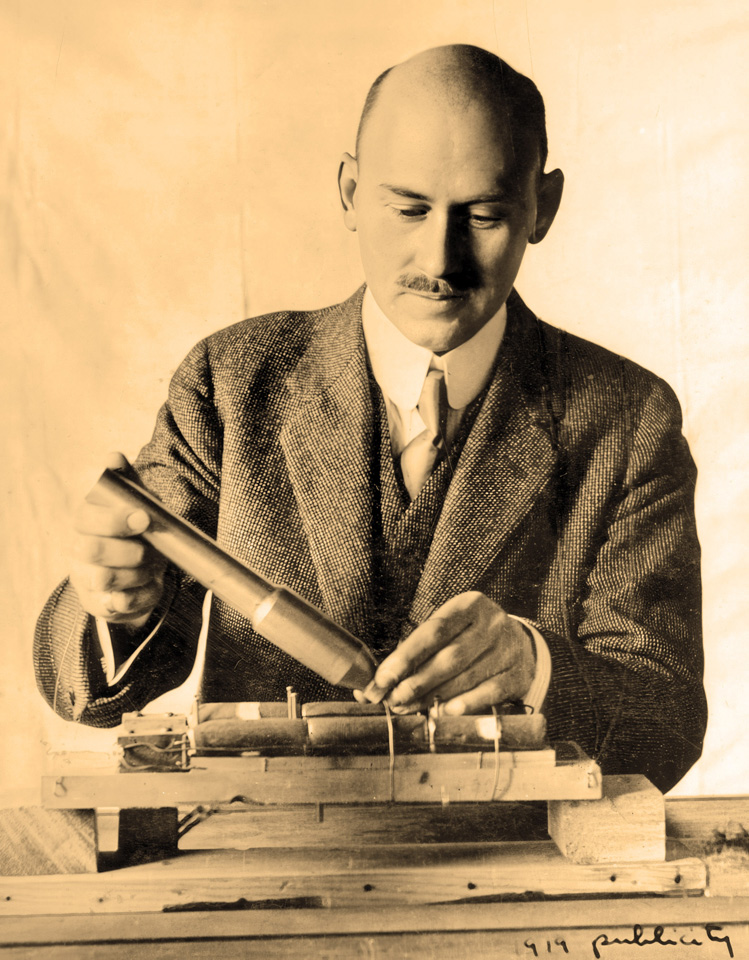
Goddard photographed in 1915 holding a rocket steel combustion chamber and nozzle. Clark University / The Goddard Rocket Researches: A Photographic Record
Not everyone agreed. Among them was Rear Adm. William Sims, the commander of U.S. naval forces for Europe in World War I, who sent a letter to the Times objecting to this assessment. Based on an experiment conducted during one of his classes at the Naval Academy, Sims wrote, he was convinced the newspaper was in error and Jules Verne was right.
Not everyone agreed. Among them was Rear Adm. William Sims, the commander of U.S. naval forces for Europe in World War I, who sent a letter to the Times objecting to this assessment. Based on an experiment conducted during one of his classes at the Naval Academy, Sims wrote, he was convinced the newspaper was in error and Jules Verne was right.
Sims’ professor suspended “from the ceiling of the lecture room a large water bottle in a horizontal position. Upon his removing the cork the bottle [recoiled] several inches,” Sims wrote. “In conclusion, he stated that a rocket would ascend in a vacuum for the same reason that a gun would ‘kick if fired in vacuum; that the propelling force of a rocket was nothing but a continuous ‘kick.’”
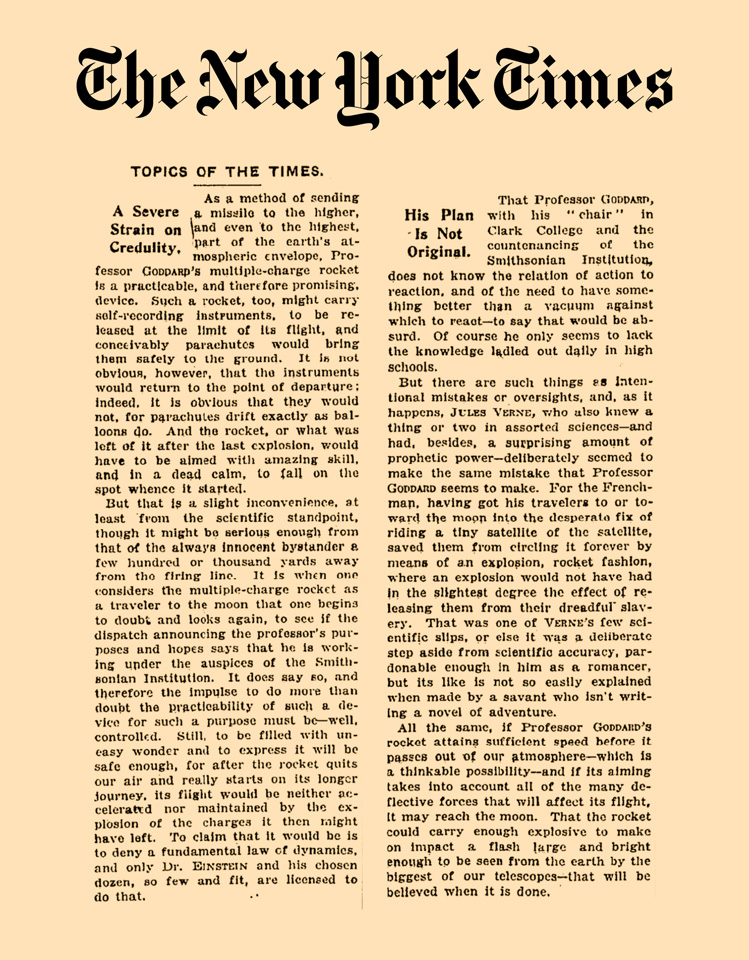
The Jan. 13, 1920, New York Times editorial, "A Severe Strain on Credibility," that criticized Goddard’s research.
Video: In 1930, Goddard’s rocket flights moved to Roswell, New Mexico, funded by a two-year grant from David Guggenheim. The Goddards returned to Roswell in 1934 for a second Guggenheim-funded project and lived there through 1942.
Over the next few years, liquid-fueled rockets emerged as the fundamental technology by which humans would reach orbit and access realms beyond Earth. Goddard’s 1920 study and subsequent experiments contributed to a flowering of broad theoretical and experimental work for this purpose, the organization of rocket societies in several countries, and the proliferation of writings on this subject. It inspired theoreticians including Germany’s Hermann Oberth and Wernher von Braun; Robert Esnault-Pelterie of France; and Frank Malina, a young engineering student at Caltech — all of whom pursued sophisticated rocket research thereafter.
In many ways, Goddard brought “the seeds of the idea of the space rocket into the public consciousness,” Frank H. Winter, a former Smithsonian curator who has long studied Goddard’s work, said in 2011.
Still, Goddard personally disliked this public attention — including that of the 21 people who volunteered by late 1921 to go into space on his theoretical rocket. At first, he tried to correct errors and misperceptions by participating in several interviews. Later in 1920, he clarified his position in an article published in Scientific American; however, that journal had neither the same audience nor the influence of The New York Times and the other large circulation publications that wrote about his 1920 study.
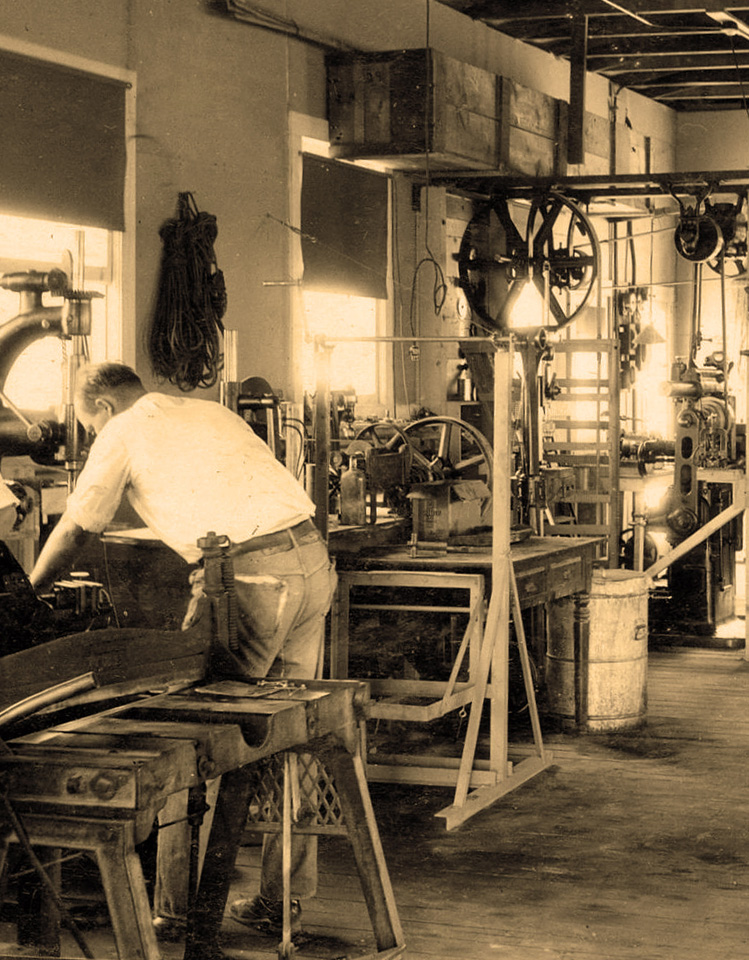
Goddard in his Roswell, New Mexico, workshop. This research, spanning 1930-1932, was funded by a Guggenheim grant. Clark University / The Goddard Rocket Researches: A Photographic Record
Unable to withstand the ridicule, by 1930 Goddard retreated into isolation in Roswell, New Mexico, becoming even more selective about who he shared information with. For instance, when Malina visited the New Mexico laboratory in 1936, Goddard was polite but showed Malina only some hardware.
“I naturally cannot turn over the results of many years of investigation, still incomplete, for use as a student’s thesis,” Goddard wrote in a letter to Caltech President Robert Millikin about the encounter.
Malina’s adviser, Theodore von Kármán, disagreed with Goddard’s insularity: “Naturally we at Caltech wanted as much information as we could get from Goddard for our mutual benefit. But Goddard believed in secrecy,” he told William Burrows for his 1999 book, “This New Ocean: The Story of the First Space Age.” “The trouble with secrecy is that one can easily go in the wrong direction and never know it.”
Goddard’s management style also wasn’t conducive to cooperative research. He always had to be in charge and only worked with assistants, not collaborators or co-principal investigators. It’s impossible to know for certain how this impacted the pace of rocketry innovation, or what might have happened differently had Goddard promoted rocketry with the enthusiasm, effectiveness, and networking of someone like von Braun. What is certain is that much of Goddard’s knowledge died with him in 1945, only partially preserved in patent applications, two Smithsonian reports and his personal papers.
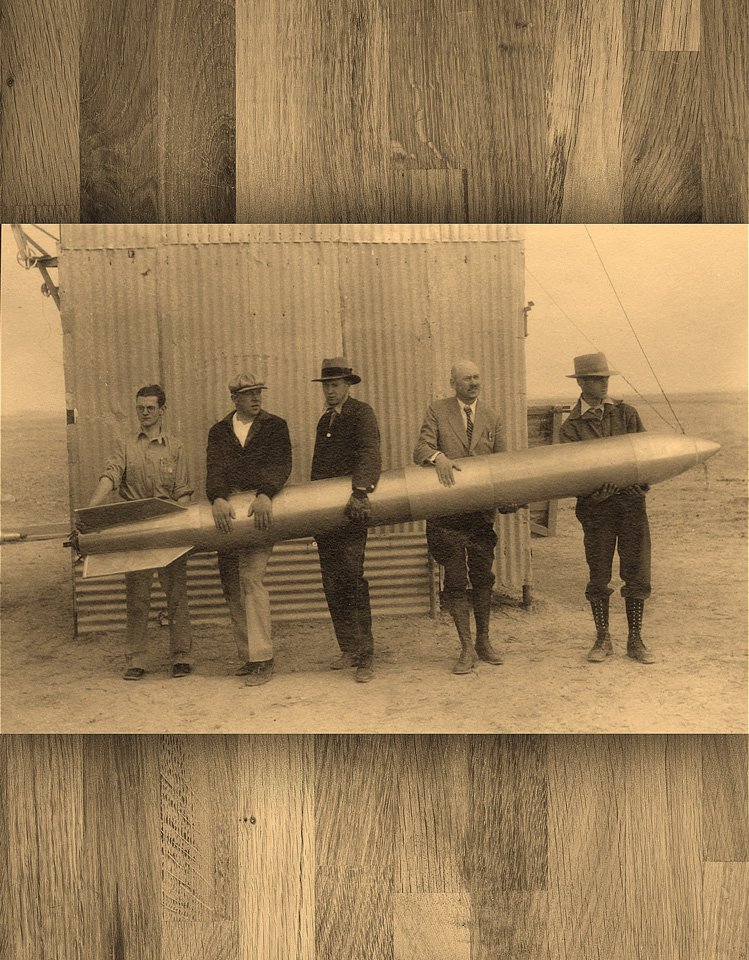
Goddard (second from right) maintained a small team for his rocketry work. This model flew in April 1932. From left: Former student Lawrence Mansur, brother-in-law Albert Kisk, welder Charles Mansur and machinist Nils Ljungquist. Clark University / The Goddard Rocket Researches: A Photographic Record
But even with these isolationist tendencies, Goddard made profound contributions to rocketry in the 1920s-1930s, aided by Charles Lindbergh. Concerned about the future of flight technology, the famous aviator in 1930 convinced the Guggenheim Foundation to support Goddard’s research. Armed with that $183,500 grant, Goddard moved his rocket research to New Mexico and helped pioneer designs including rotor motor vanes and gyro controls for guidance.
Under Lindbergh’s prodding, Goddard even donated one of his rockets to the Smithsonian in 1935, the first liquid-fueled rocket in its collection. In 1936, the Smithsonian published Goddard’s second report on his research, “Liquid Propellant Rocket Development.” Despite Goddard’s fame, that report received virtually no press coverage or public attention — a fact that was surely of huge relief to him

Roger Launius is a former chief historian of NASA and associate director for collections and curatorial affairs at the Smithsonian National Air and Space Museum in Washington, D.C.

Jonathan Coopersmith is an historian of technology and former professor at Texas A&M University in College Station who has written about 20th century space commercialization.