European Space Agency rethinks Mars plans as it kicks off a ‘mission-dense’ 2026
 By Paul Marks
 By Paul Marks
The European Space Agency is reconsidering its plans for Mars exploration in the next decade after the fiscal year 2026 budget released by the U.S. Congress offered no funding for Mars Sample Return, the joint NASA/ESA program for which ESA was developing an Earth Return Orbiter.
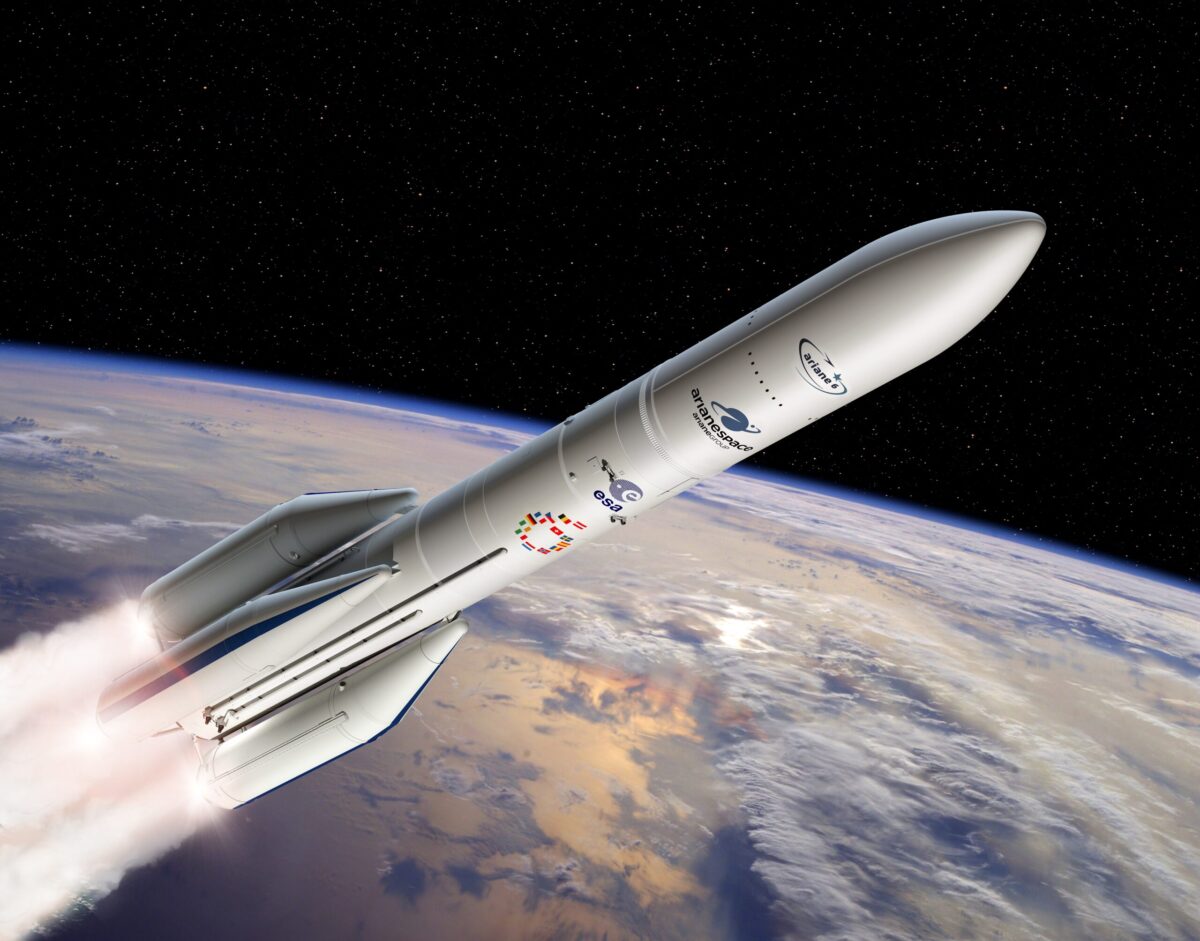
The news came from a Thursday briefing in Paris, in which ESA Director General Josef Aschbacher and colleagues outlined the agency’s broad mission plans for 2026. These include launching a record 65 missions, — a sharp increase from the 44 launched in 2025 — plus some landmark events, including the first launch of the four-booster Ariane 64 rocket, the first drop tests of the Space Rider uncrewed laboratory, and the arrival of the Hera probe at the binary asteroid system Didymos.
The joint NASA budget released Monday by the House and Senate Appropriations committees largely rejected the funding cuts proposed by the White House, but agreed with the Trump administration’s assessment not to fund the existing MSR architecture. An independent review board in 2024 estimated the mission could cost up to $11 billion and the samples wouldn’t be retrieved before 2040, a decade later than the original target.
Asked about this apparent defunding, Aschbacher said it’s a “complex” issue but that “we understand that, at least according to today’s plans, the mission will not go ahead, so we are evaluating ESA’s contribution to it.”
In charge of that assessment is Daniel Neuenschwander, ESA’s director of human and robotic exploration, who noted that “Europe cannot afford, on its own, a full Mars Sample Return mission.”
Instead, he said, ESA wants to repurpose the Earth Return Orbiter it had been developing for MSR for an as-yet-unspecified “Mars atmospheric mission.”
“This is something we’re discussing with our member states, and this will enable us to run future missions to Mars with more accurate, heavier landings.”
That said, officials emphasized that their top Martian priority remains the launch of the Rosalind Franklin Mars subterranean science rover, targeted for 2028.
The cadence of European rocket operators remains far lower than those in the U.S. — SpaceX alone conducted 165 orbital flights last year — but Aschbacher remained optimistic about the prospects of the Ariane 6. The heavy-lift design made its inaugural flight in 2024 and flew five times last year.
“Ariane 6 has been the fastest of all the major heavy lift launchers to achieve five successful flights, with just 17 months between the first and the fifth flight,” he said.
“It’s the fastest ramp-up of any launcher in 20 years,” he said, which ESA believes places Europe in a strong position. Going forward, the primary goals are to boost the Ariane 6 launch cadence and debut the Ariane 64. That four-booster variant is poised for its first qualification flight, details of which ESA said Arianespace is expected to release next week.
As for the broader market, ESA is evaluating launch designs from five new developers under its European Launcher Challenge. Additionally, Rocket Factory Augsburg of Germany is among the startups poised to begin launching this year from new European sites, including the nascent Saxavord spaceport in the United Kingdom.
Among the year’s anticipated milestones that Aschbacher highlighted is the arrival of the BepiColumbo probe at Mercury, in November, and Hera at Didymos, in December. ESA is hoping these spacecraft will provide a raft of compelling data and images. At Didymos, Hera is to observe the fate of its smashed moonlet, Dimorphos, which was impacted by NASA’s DART spacecraft in 2022. The spacecraft smashed into Dimorphos to alter its orbit, testing a possible method that could be employed against future objects set to collide with Earth.
And in October, said Aschbacher, “we plan a very large event: a full cosmology data release from Gaia.” From 2013 to its retirement in 2025, the space observatory made a series of observations that scientists have used to construct a 3D map of 1 billion celestial bodies.
Companies pondering the feasibility of placing power-hungry artificial intelligence data centers into low-Earth orbit could benefit from observations made by the SMILE spacecraft, set to launch aboard a Vega-C as soon as April.
The reason? The spacecraft is to observe 24/7, in the X-ray and UV bands, how Earth’s magnetic field responds to radiation and particle storms in the solar wind, and violent assaults from coronal mass ejections. In 1859, induced currents from a geomagnetic storm that became known as the Carrington Event wiped out many of the emerging wired telegraph systems. It’s possible that memory transistors in orbit could suffer a similar fate, which could render the concept of on-orbit AI data centers unfeasible.
“We already know from data centers on the ground that our silicon gets hit with cosmic rays that come from deep space,” said Carole Mundell, ESA science director. “The upper atmosphere and beyond into space is a very hostile environment, as we know from many of our previous solar space science missions. But with our space weather and planetary protection scientists, SMILE will be able to bring a lot of new insights.”