

1925
Nov. 7 — The Marquis de Pinedo and his mechanic arrive in Rome after a 201-day round trip to Tokyo via Australia. The 56,300-kilometer (34,000-mile) flight in their Savoia S16 flying boat is the longest airplane journey yet made. Flight, Nov. 12, 1925, p. 756.
Nov. 12 — Farman test pilot Lucien Bossoutrot sets seven world records in a F.140 Super Goliath prototype. Among them: He remains in the air for 2 hours, 19 minutes, 24 seconds; and carrying 2,000 kg, he reaches an altitude of 16,371 feet. The Aeroplane, Nov. 25, 1925, p. 756.
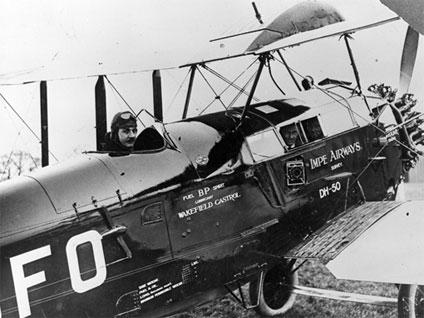
Nov. 16 — British pilot Alan Cobham begins a 20,000-mile (32,200-kilometer) round trip from London to Cape Town, South Africa, for Imperial Airways to determine the feasibility of commercial routes. His plane, a de Havilland D.H. 50 equipped with an Armstrong Siddeley engine, carries mail and greetings to officials in South Africa. The flight, which tests both the plane and its engine because of the extreme weather conditions and high altitudes at some of the landing sites, is hailed as “an epoch-making event in the history of aviation.” Flight, Nov. 19, 1925, p. 768; Flight, Nov. 26, 1925, p. 784.
Nov. 30 — The President’s Aircraft Board, better known as the Morrow Board, submits its report to U.S. President Calvin Coolidge on its recommendations on the “best means of developing and applying aircraft in national defense.” Congress accepts the recommendations and passes the Air Commerce Act of 1926, which redesignates the U.S. Army’s Air Services and the Air Corps and appropriates funds for long-range development of Army and Navy aircraft. Donald R. Whitnah, Safer Skyways, pp. 20-21.
Nov. 13 — A live music performance is broadcast from an Imperial Airways Vickers Vanguard airliner while it cruises over London. Musicians play into a microphone in the large cabin, which is relayed via a land receiving station over BBC stations. Flight, Nov. 19, 1925, p. 723.
Nov. 17 — The first public demonstration of the Holt “Autochute” takes place at Stag Lane Aerodrome in England. This design consists of a small “pilot” parachute that pulls the main parachute out of the pack. Some models of the Autochute also include a third parachute between the pilot and the main. In the Stag Lane demonstration, Capt. H. Spencer jumps from a de Havilland D.H. 9 at an altitude of 1,000 feet. Flight, Nov. 26, 1925, p. 782.
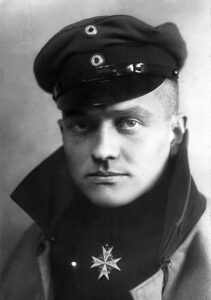
Nov. 20 — Baron Manfred von Richthofen, the famous ace of World War I who was shot down and killed in France in April 1918, is reburied with full military honors in Mercy Cemetery, Berlin. Those in attendance include Field Marshall von Hindenburg, president of the German Republic, and representatives of the German, American, British and Canadian air services. Flight, Nov. 26, 1925, p. 785.
1950
Nov. 8 — The first jet-versus-jet dogfight takes place near the Chinese-Korean border. Four U.S. Air Force F-80C Shooting Stars encounter a handful of Soviet-built MiG-15s crossing from China., and U.S. Air Force Lt. Russell Brown Jr. shoots down a Soviet-built MiG-15 fighter carrying a North Korean pilot. The entrance of MiG-15s into the Korean War prompts the U.S. Air Force to send North American F-86 Sabres to augment its fleet. In December, Lt. Col. Bruce Hinton in his F-86 shoots down a MiG-15 in the first swept wing combat of the war. C.V. Glines, The Compact History of the USAF, p. 303. Ray Wagner, The North American Sabre, pp. 36-37, 78.
Nov. 8 — The National Aeronautic Association presents the Mackay Trophy for the most meritorious flight of 1949 to U.S. Air Force Capt. James Gallagher and the crew of the Boeing B-50 Superfortress “Lucky Lady II” that in 1949 completed the first nonstop around-the-world flight. Welman Shrader, Fifty Years of Flight, p. 131.
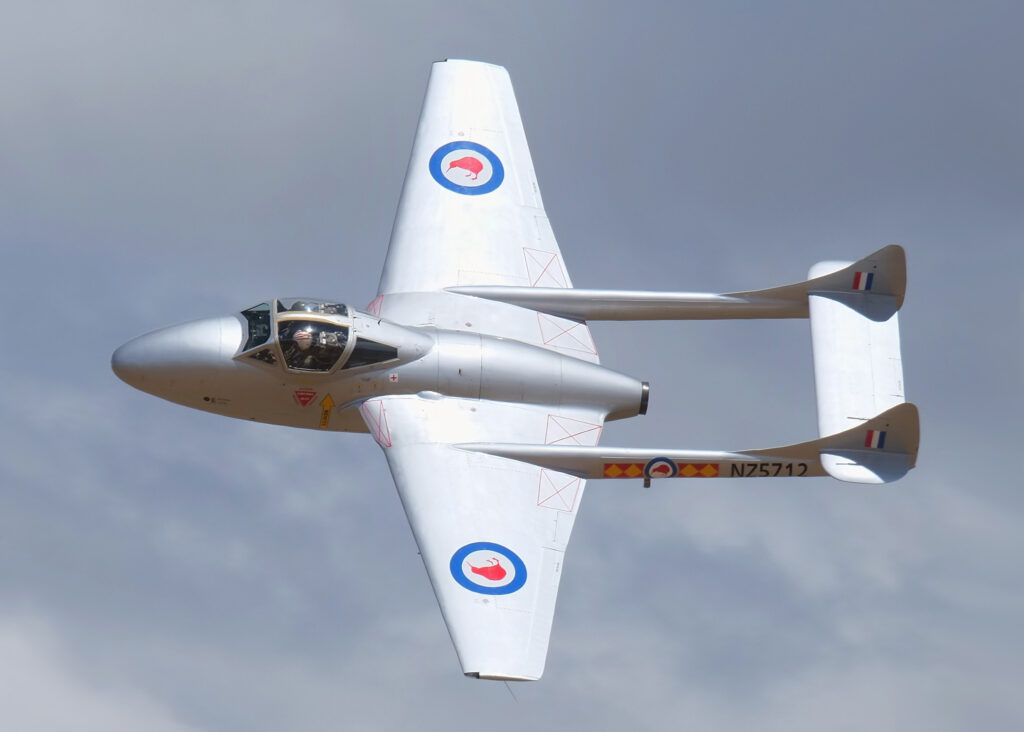
Nov. 12 — The British Air Ministry announces that the Royal Air Force will ferry de Havilland Vampire jet fighters from Britain to Singapore to reequip RAF fighter squadrons in the Far East Air Force. The 14,245-kilometer journey will be the longest jet ferry flight to date. The Vampires are to replace Hawker Tempests and Supermarine Spitfires, both piston-engine, propeller-driven designs. The Aeroplane, Nov. 24, 1950, p. 450.
Nov. 15 — Test pilot John Wilson completes the first flight of the de Havilland D.H. 115, a two-seat training version of the single-seat Vampire fighter powered by one de Havilland Goblin turbojet engine. The D.H. 115 carries four 20-mm Hispano cannons, plus rockets and bombs. The Royal Air Force later adopts the design as its standard trainer, and it is also produced in Australia and India. The D.H. 115 is eventually in service in some 20 countries, making it one of the world’s most successful jet trainers. The Aeroplane, Nov. 24, 1950, p. 444; William Green and Gordon Swanborough, The Observer’s Basic Military Aircraft Directory, p. 169.
1975
Nov. 1 — A newly discovered dwarf galaxy 55,000 light years from the sun could lead to more accurate estimates of the size of the Milky Way. In a paper in Astrophysical Journal Letters, S. Christian Simonson of the University of Maryland described the discovery via radio telescope, the first of its kind. The galaxy, which had hidden from view by dense star fields and cosmic dust clouds, is christened Snickers by Simonson’s colleagues due to its peanut-shaped structure and proximity to the Milky Way. Baltimore Sun, Nov. 2, 1975, p. A23.
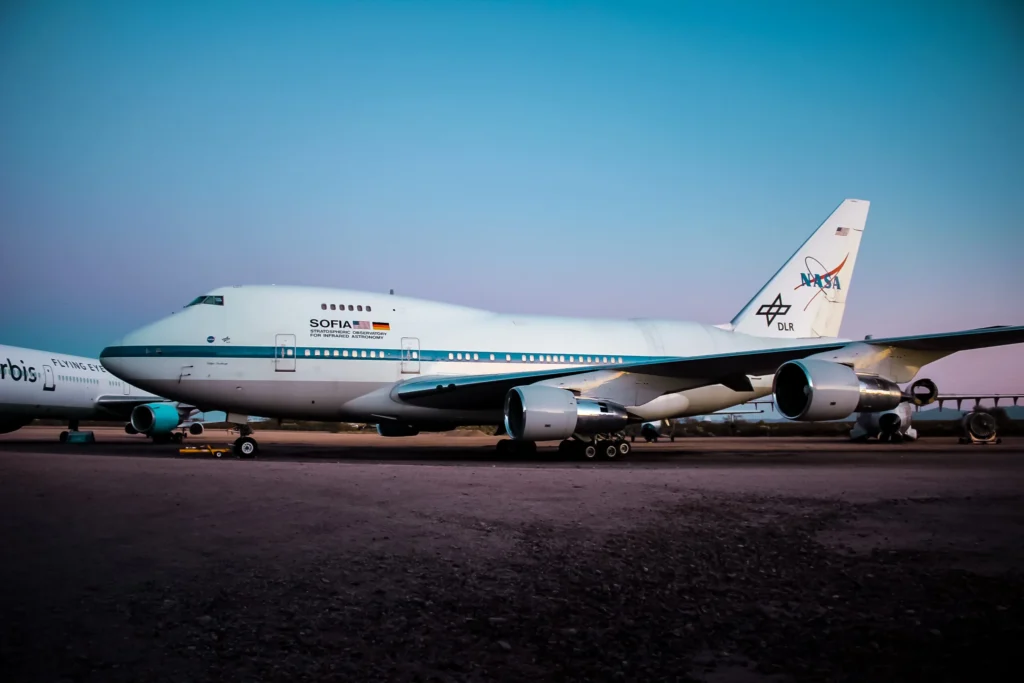
Nov. 14 — Pan American World Airways announces the industry’s first nonstop flight from New York to Tokyo, beginning early in 1976. The announcement comes a day after a new Boeing 747SP (Special Performance) jetliner made a demonstration flight from New York to Tokyo in 13 hours, 33 minutes, the fastest commercial service at this date for this route. Baltimore Sun, Nov. 15, 1975, p. A9.
Nov. 17 — Leading Soviet geochemist Alexander Vinogradov dies in Moscow at 80. He identified 40 chemical elements in Earth’s soil zones and also developed the field of cosmochemistry, the chemical analysis of lunar and planetary bodies. A mountain on the moon’s near side and a Mars crater bear his name. New York Times, Nov. 19, 1975, p. 38.
Nov. 19 — The unoccupied Soyuz 20 spacecraft docks with the Salyut 4 space station. This final flight to Salyut is dedicated to testing new onboard systems and the value of automatic docking for resupply, which the Soviet Union believes will be more economically favorable compared to crewed missions for this purpose. Washington Post, Nov. 21, 1975, p. B14.
Nov. 19 — A Delta rocket launches NASA’s Atmosphere-Explorer-E satellite to investigate the ionosphere. Redesignated Explorer 55 once on orbit, the satellite is part of a new generation of Explorer spacecraft equipped with onboard propulsion for advanced maneuvering. The satellites are able to raise and lower their orbits by hundreds of kilometers or go from highly elliptical to circular orbits. NASA Release 266-75.
Nov. 25 — The Soviet Union launches the Cosmos 782 biological satellite, carrying experiments from Czechoslovakia, France, Hungary, Poland, Romania, Russia and the U.S. This is the first satellite equipped to simulate gravity in space — via a specially constructed centrifuge — to compare effects of biological processes with those of weightlessness. The animals onboard include rats, tortoises, fruit flies, fish embryos and carrot tissues. NASA Release 75-292.
2000
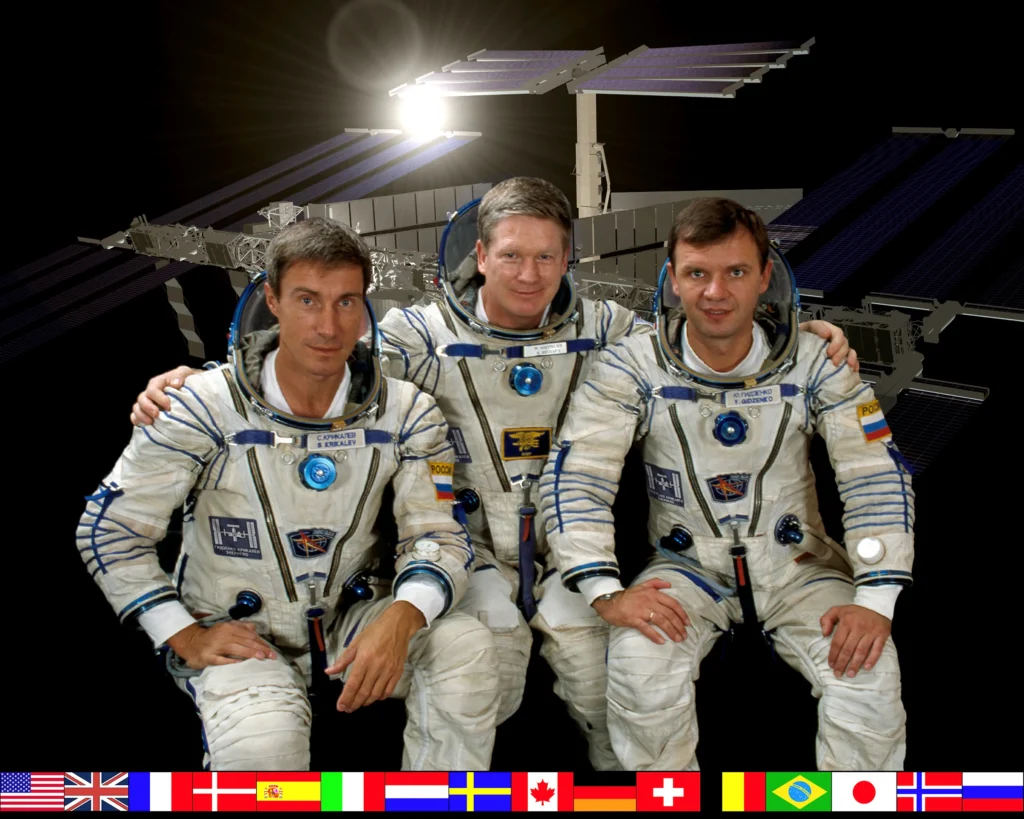
Nov. 2 — The Soyuz TM-31 capsule docks with the International Space Station, carrying the first long-duration crew. NASA astronaut Bill Shepherd, cosmonaut Yuri Gidzenko and cosmonaut Sergei Krikalev stay aboard for 115 days, installing equipment, conducting biomedical experiments and welcoming multiple cargo and crew vehicles, among other tasks. Flight International, Nov. 7-13, 2000, p. 32.
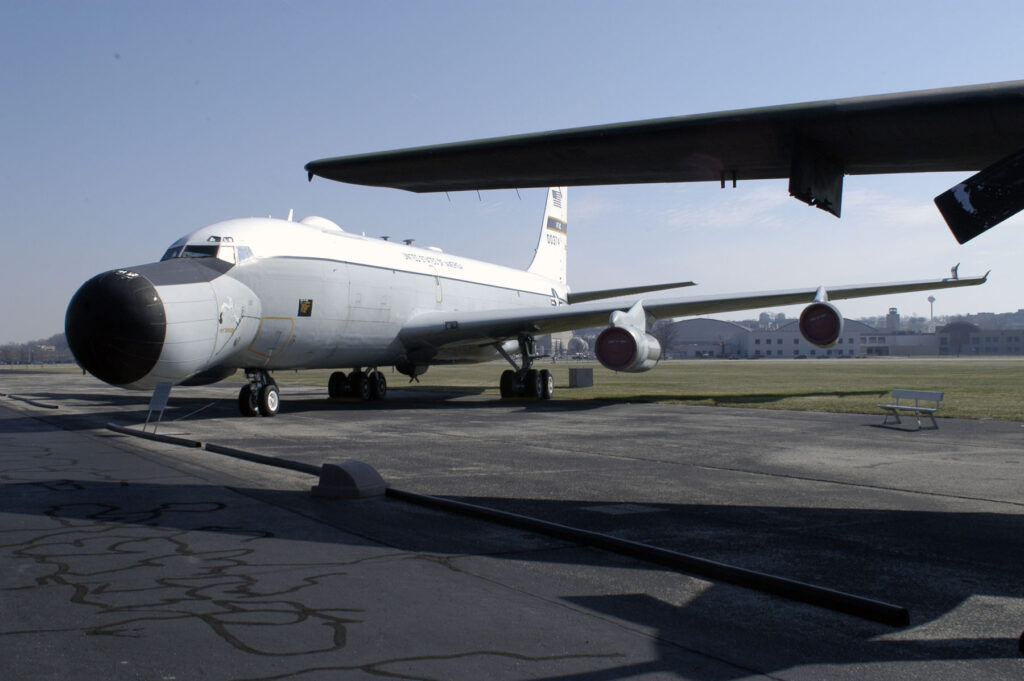
Nov. 3 — The last Boeing EC-135E completes its final flight. Nicknamed “Bird of Prey,” this aircraft was one of eight C-135 Stratolifters modified to provide mobile tracking and telemetry for NASA’s Apollo lunar program and other space flights. U.S. Air Force crew flies the plane from Edwards Air Force Base in California to the museum at Wright-Patterson base in Ohio for display. National Museum of the U.S. Air Force fact sheet.
Nov. 15 — Lockheed Martin test pilot Bret Luedke conducts the first flight of the Raptor 4004, the first F-22 equipped with a full avionics suite. Lockheed Martin press release, Nov. 15, 2000.
Nov. 21 — A Delta II rocket launches the first of NASA’s three New Millennium EO-1 (Earth Observation-1) satellites. Also aboard is Sweden’s Munin nano satellite that is to study auroral activity and Argentina’s SAC-C, the country’s first Earth-observing satellite. SAC-C is to study the Earth’s surface, atmosphere, and magnetic field, and Flight International, Dec. 4, 2000, p. 31.
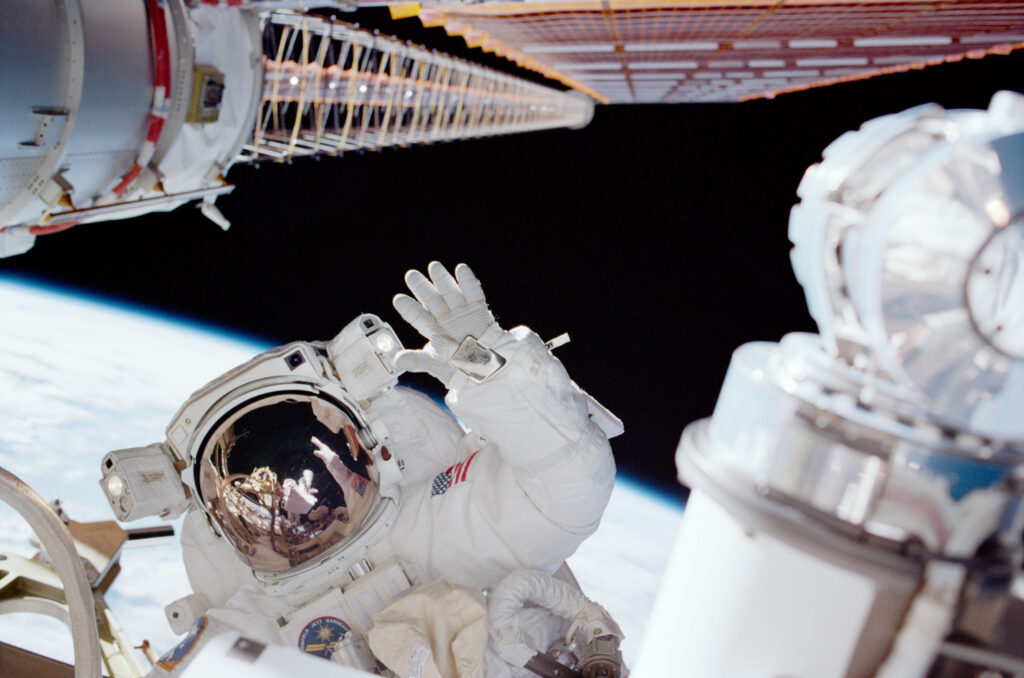
Nov. 30 — NASA’s Space Shuttle Endeavour is launched and on Dec. 2 docks with the International Space Station. The STS-97 crew will install four giant panels of solar cells, two on each side of the station. The tasks require three spacewalks. Flight International, Dec. 5-11, 2000, p. 7; Dec. 12-18, 2000, p. 8; and Dec.19, 2000 – Jan.1, 2001, p. 29.