

1926
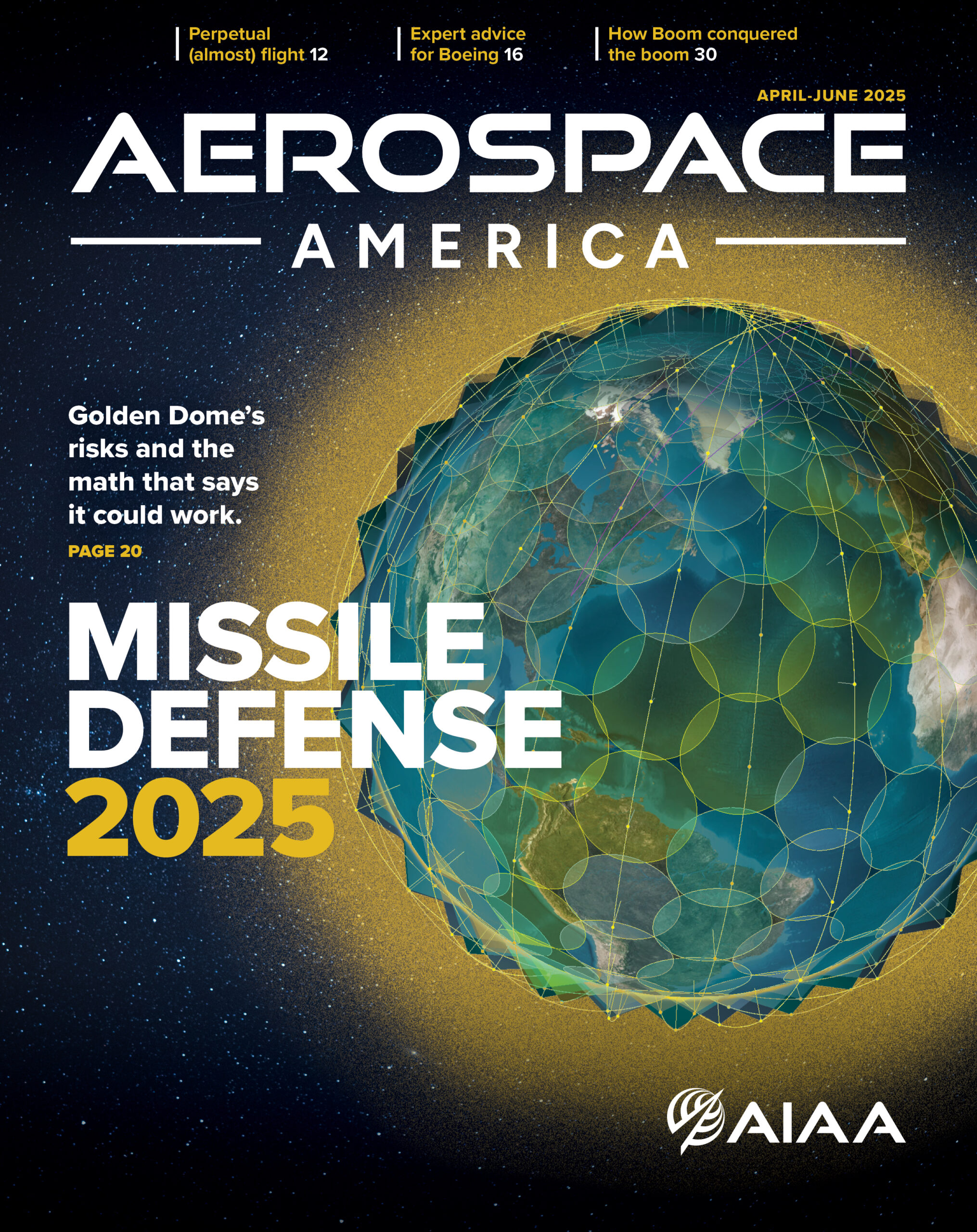
Feb. 10 — Spanish Commander Ramon Franco and his crew conclude the first trans-Atlantic flight from Spain to Argentina, a 10,270-kilometer journey. They depart Palos, Spain on Jan. 22 in their Dornier Wal flying boat, the “Plus Ultra,” making multiple stops on the way to Buenos Aires, their destination. Their cumulative flight time was 59 hours, 39 minutes. Aircraft Yearbook, 1927, p. 175.
Feb. 15 — The first contract air mail service in the U.S. begins with a flight by Ford Air Transport. A party of observers that includes Henry Ford watches the Ford Stout all-metal monoplane take to the air in Dearborn, Michigan. The new service will connect Detroit with Chicago and Cleveland. Aviation, March 1, 1926, p. 292.
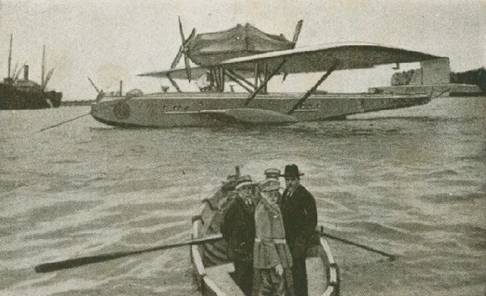
Feb. 17 — British pilot Alan Cobham completes his nearly 13,000-kilometer survey flight from London to Cape Town, South Africa. Thousands of spectators greet him and his two traveling companions, cinematographer B. W. G. Emmott and engineer J. B. Elliott. They departed in mid-November in a de Havilland D.H. 50.J, with the goal of determining the feasibility of establishing commercial flight routes between the two cities. Flight, Feb. 25, 1926, pp. 108-109.
1951
Feb. 8 — The U.S. Navy completes the first trans-Atlantic flight with carrier aircraft. Six North American AJ-1 Savage bombers accompanied by three Lockheed P2V-3C Neptune aircraft depart Norfolk, Virginia. All but one of the bombers completes the three-day journey to Port Lyautey, French Morocco, via Bermuda and the Azores. Andrian O. Van Wyen and Lee M. Pearson, U.S. Naval Aviation, 1910-1970, p. 185.
Feb. 10 — The Douglas DC-6B, a lengthened passenger version of the DC-6A and DC-6C cargo aircraft, makes its first flight. This 32-meter-long variant, which proves to be one of the most successful piston-engine transports ever built, can seat up to 102 passengers and has a range of 2,610 nautical miles (4,830 kilometers). Douglas produces nearly 300 before ending DC-6 production in 1958. Kenneth Munson, Airliners Since 1946, pp. 123-124.
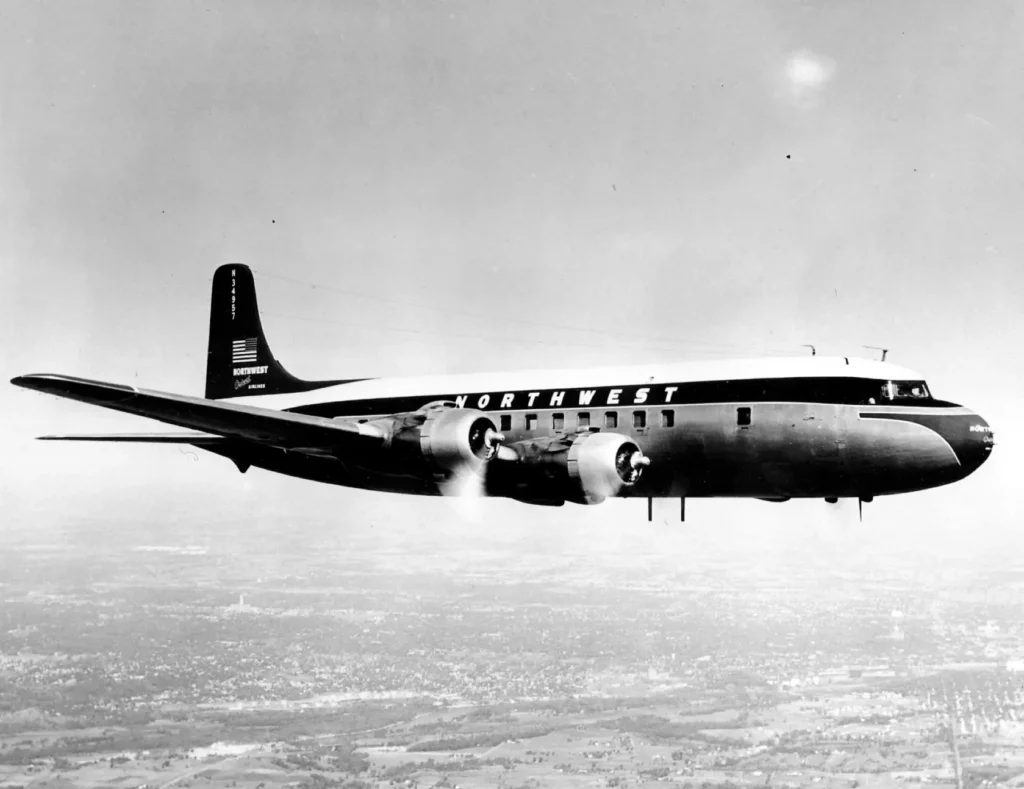
Feb. 12 — During a routine flight, a U.S. Air Force Military Air Transport Service Boeing C-97A sets a Japan-Hawaii record of 10 hours, 23 minutes. This aircraft is the military equivalent of the Boeing 377 Stratocruiser. Welman Shrader, Fifty Years of Flight, p. 141.
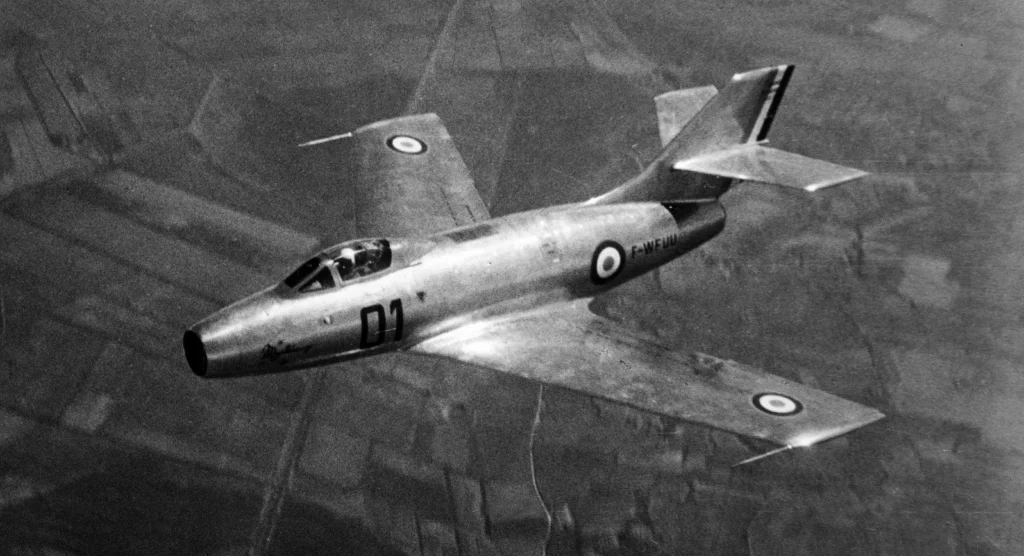
Feb. 23 — Dassault conducts the inaugural flight of the prototype Mystère II fighter, powered by a Rolls-Royce Nene turbojet. The design is essentially a sweptwing version of the earlier Dassault Ouragon. The Mystere later enters production as the much-modified Mystere IIC and IVA, and is purchased by nations including France, India and Israel. William Green, and Roy Cross, The Jet Aircraft of the World, p. 120.
1976
Feb. 4 — NASA has conducted the first main stage test of the space shuttle main engine, Marshall Space Flight Center announces. The engine was fired at the National Space Technology Laboratories in Mississippi for 3.38 seconds, reaching 50% of its rated power level of 1,668,075 newtons at sea level, or 2,090,654 newtons at altitude. Marshall Space Flight Center Release 76-29.
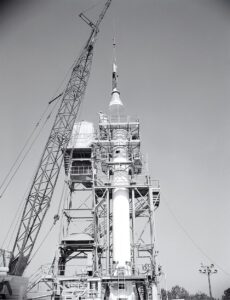
Feb. 5 — NASA’s historic Redstone test site, largely unused since the last Redstone missile firing in 1961, is to be restored to its original appearance as an exhibit for visitors during the U.S. bicentennial celebrations throughout 1976. In January 1958, a modified Redstone launched Explorer 1, the first U.S. satellite. Another modified Redstone powered Alan Shepard’s May 1961 trip to orbit, the first U.S. crewed spaceflight. Marshall Space Flight Center Release 76-32.
Feb. 10 — NASA’s Pioneer 10 spacecraft crosses Saturn’s orbit on its way out of the solar system. The probe is now 1.4 billion kilometers from Earth. NASA estimates it will be able to keep in contact with it via the Deep Space Network until 1979 when it is slated to reach Uranus. NASA Release 76-21.
Feb. 11 — The U.S. Navy conducts the first test of the TERCOM (terrain contour matching) missile guidance radar aboard a modified Firebee drone. The technology is later adapted and installed in the Tomahawk and other cruise missiles. Roy A. Grossnick, United States Naval Aviation 1910-1995, p. 314.
Feb. 13 — Alexander Lippisch, designer of the first operational rocket-powered fighter aircraft, dies at 81. As chief of design at Germany’s Messerschmitt aircraft company, his research on high-speed flight led to the delta-wing Me 163B rocket fighter, which became operational in 1944. At the time, it was the world’s fastest plane, reaching 105 kph, but the short duration of the engine burn drastically limited its usefulness in combat. After the war, Lippisch was sent to the U.S. under Project Paperclip and stationed at Wright-Patterson Field in Ohio, where he worked on other advanced aircraft. New York Times, Feb. 13, 1976, p. 34.
Feb. 19 — A Delta rocket launches Marisat 1, the first private satellite to provide rapid high-quality communications between ships at sea and off-shore stations. Comsat General Corp. plans to launch two additional Marisat craft within the year, setting up a three-satellite network for utilization by commercial shipping lines as well as the U.S. Navy. Washington Star, Feb. 20, 1976, p. A-6.
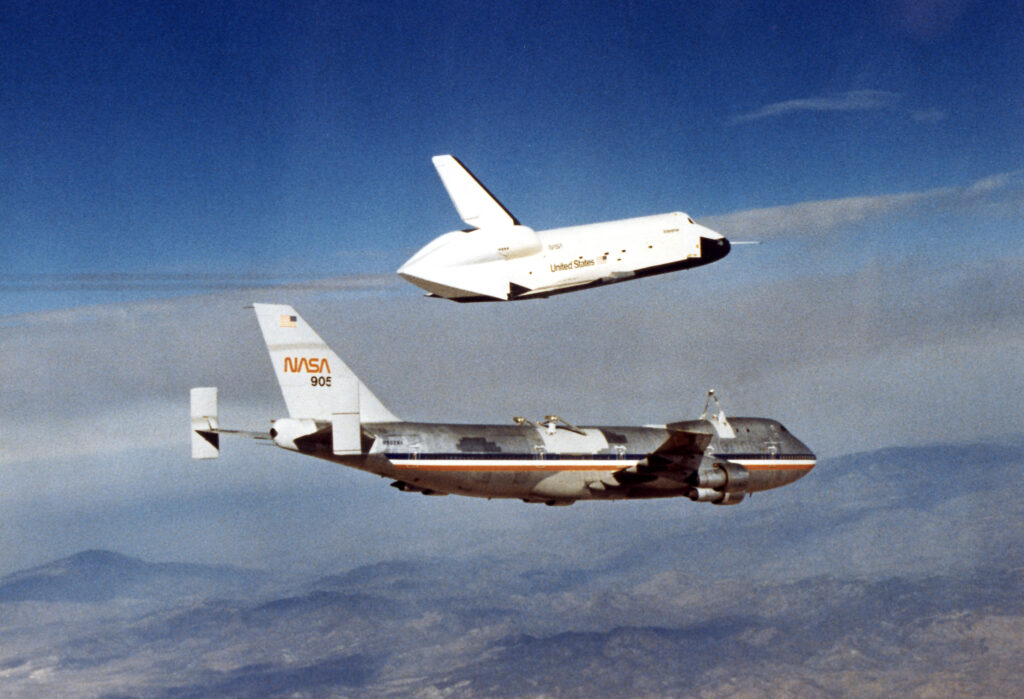
Feb. 25 — NASA selects Fred Haise Jr., the lunar module pilot for Apollo 13, to command initial flight tests of a space shuttle orbiter. For some of the flights, the space shuttle Enterprise remained mated to its carrier aircraft. For others, the orbiter separated and glided to a runway landing at Edwards Air Force Base in California. Sixteen total of these Approach and Landing Tests are conducted in 1997 to verify the orbiter’s flight and handling characteristics. NASA Release 76-17.
Feb. 29 — Aviation pioneer Grover Loening, the first person to earn an aeronautical degree from a U.S. university, dies at 87. A member of Orville Wright’s early design team, Loening in 1913 became the manager of the Wright factory in Dayton, Ohio, before his appointment in 1914 as chief aeronautical engineer of the U.S. Army Signal Corps. His later achievements include pioneering the first steel-frame aircraft in the U.S. and helping establish Pan Am Airways and Grumman Aircraft Engineering Corp. Washington Star, March 2, 1976, p. B-5.
2001
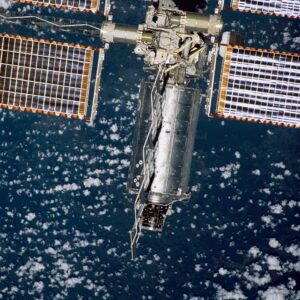
Feb. 7 — NASA’s space shuttle Atlantis is launched from Cape Canaveral carrying the Destiny module, the primary U.S. research laboratory on the International Space Station. The main objective for the STS-98 crew is to attach Destiny to the station. NASA, Astronautics and Aeronautics: A Chronology, 2001-2005, p. 5.
Feb. 7 — An Ariane rocket launches the United Kingdom’s Skynet 4F and Italy’s Sicral, the country’s first military satellite. Flight International, Feb.13-19, 2001, p. 30.
Feb. 7 — The first Iranian-built Antonov An-140, designated IrAn-140, makes its inaugural flight from the Iranian Aviation factory near Isfahan. The aircraft, assembled from a kit produced in Kharkov, Ukraine, is also claimed to be the first commercial airliner produced in Iran. Flight International, Feb. 20-26, 2001, p. 13.
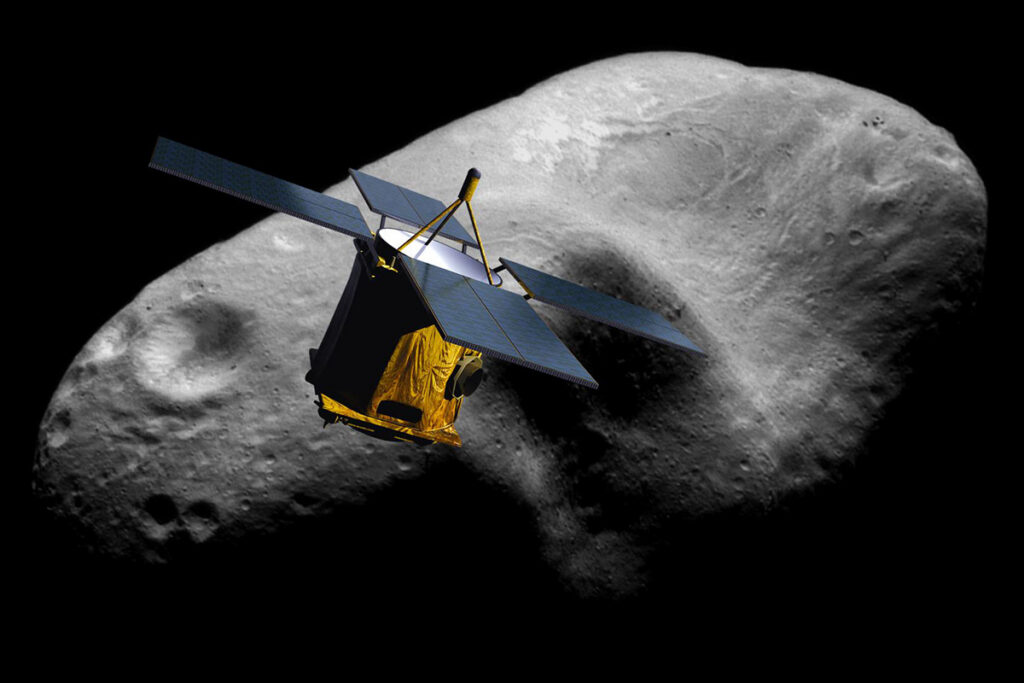
Feb. 12 — NASA’s NEAR (Near Earth Asteroid Rendezvous) Shoemaker probe becomes the first human-made object to land on an asteroid. The soft landing upon the asteroid Eros, some 355 million kilometers from Earth, was not part of the original mission, which simply called for Shoemaker to orbit the asteroid. Flight International, Feb. 20-26, 2001, p. 33.
Feb. 20 — A Russian four-stage Start 1 launch vehicle, based on the former SS-25 missile, orbits Sweden’s Odin satellite. Built with the assistance of Canada, Finland, and France, Odin is designed to study the causes of ozone depletion of the atmosphere. Flight International, Feb. 27-March 5, 2001, p. 30.
Also during February — South Korea announces it has selected Oenarodo Island, off Kohung, Cholla Province, as the site for its satellite launch base. The site, later renamed the Naro Space Center, is scheduled to open by 2005. Flight International, Feb. 13-19, 2001, p. 30.