

1926
During April and June — U.S. airmail service by commercial airlines begins in earnest. In April, Florida Airways opens the Miami-Jacksonville air mail route, and Western Air Express opens a route between Los Angeles and Salt Lake City. In June, Northwest Airways opens service between Chicago and the Twin Cities of Minneapolis and St. Paul, by way of Milwaukee. Aviation, May 3, 1926, p. 665; May 10, 1926, pp. 704-705; July 26, 1926, p. 125.
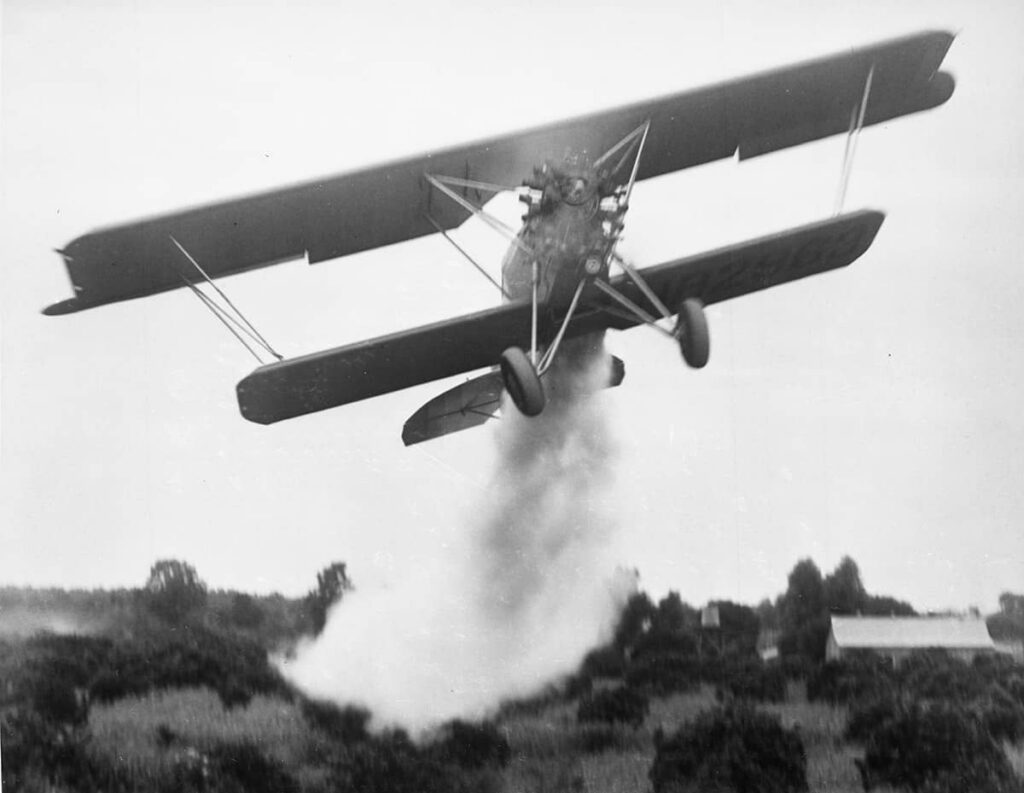
April 16 — The U.S. Department of Agriculture purchases its first crop-dusting airplane to distribute pesticide to save cotton crops from highly destructive boll weevil insects. In later tests, the department uses the aircraft to distribute insecticide to effectively control malaria-carrying mosquitoes. Aviation, May 24, 1926, p. 798; Eugene M. Emme, Aeronautics and Aeronautics, 1915-1960, p. 21.
April 29 — The National Elimination Balloon Race commences in Little Rock, Arkansas. Veteran pilot Ward Van Orman takes the trophy for the third year in a row, traveling 848 miles (1,365 kilometers) in three days with aide Walter Morton in their Goodyear IV balloon. They land near Petersburg, Virginia. Aviation, May 10, 1926, p. 708.
1951
April 2 — The U.S. Air Force establishes Air Research and Development Command. Commanded by Maj. Gen. David Schlatter, ARDC is composed of the Air Development Force at Wright Field, Ohio; the Air Force Flight Test Center at Edwards Air Force Base in California; and the research organization at Holloman Air Force Base in New Mexico. ARDC later expands to include Arnold Engineering Development Center in Tennessee; the Air Force Armament Center in Florida; and the Air Force Special Weapons Center at Kirtland Air Force Base in New Mexico. Eugene M. Emme, Aeronautics and Astronautics, 1915-1960, pp. 66-67.
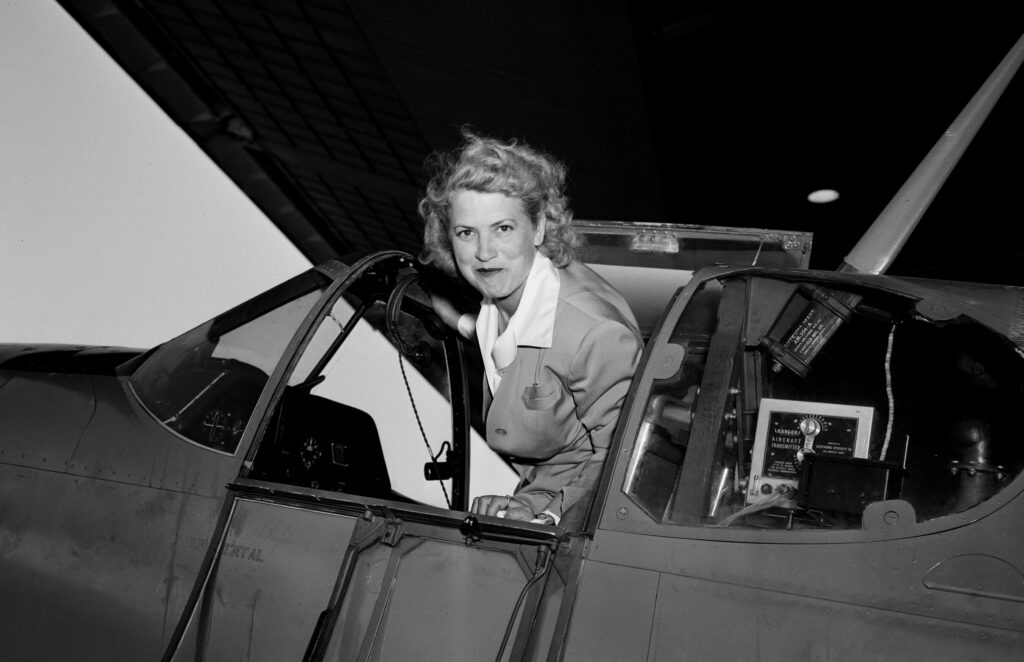
April 9 — Famed pilot Jacqueline Cochran sets a world speed record of 464 mph over a 16-km straight course at Indio, California, in a North American F-51 Mustang. By the time of her death in 1980, she holds more speed, altitude and distance records than any other pilot. Aviation Week, April 16, 1951, p. 7.
April 18 — The first Aerobee research rocket carrying a monkey launches from Holloman Air Force Base, New Mexico. The creature, a rhesus monkey dubbed Albert V, wears instrumentation to measure its heart rate and other vitals. Like previous biomedical flights with V-2 rockets, the Aerobee capsule had a parachute malfunction and crashed after separating from the rocket. Albert V was killed on impact. Eugene M. Emme, Aeronautics and Astronautics, 1915-1960, p. 67.
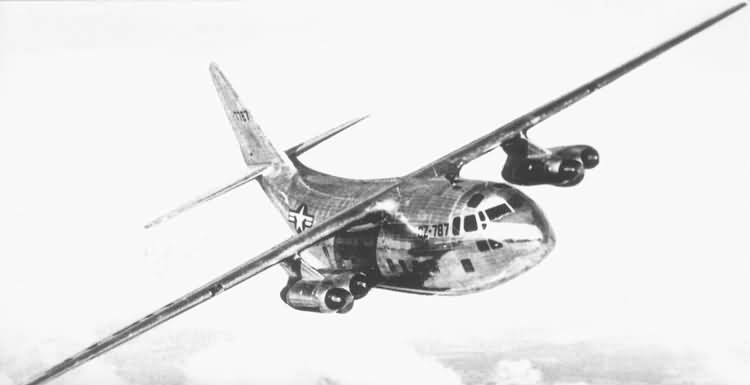
April 21 — The first U.S. jet transport, the Chase XC-123A, makes its inaugural flight in Trenton, New Jersey. Four pod-mounted General Electric J-47 turbojets power this modification of the YC-123 piston-powered airplane. Aviation Week, April 30, 1951, p. 16.
1976
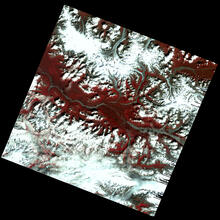
April 1 — Under the Alaska Native Claims Settlement Act of 1971, the U.S. government transferred tens of millions of acres to some 200 native village corporations and a dozen native regional corporations, settling land claims related to the United States’ 1867 purchase of Alaska from Russia. The recipients represented about 100,000 Inuit, Aleutian Islander and other Native peoples. Although known to be rich in minerals and commercially profitable forest, large swathes of the 99 million acres (40 million hectares) available to choose from had no detailed maps and few settlements, roads or airfields. Scientists at the University of Alaska’s Geophysical Institute used Landsat images along with limited ground and aerial data to create updated maps, which NASA says at least doubled the value of the 44 million acres (17.8 million hectares) that were selected. NASA Release 76-63.
April 1 — Egypt reaches an agreement with the Federal Republic of Germany to obtain a ground station for receiving transmissions from the Symphonie 1 and Symphonie 2 communications satellites jointly operated by Germany and France. Under the arrangement, a team of Egyptians will visit Germany for training to operate the future station. NASA, Astronautics and Aeronautics, 1976, pp. 69-70.
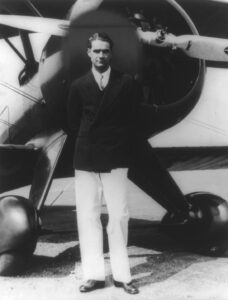
April 5 — Aviation pioneer and mogul Howard Hughes dies due to medical problems aboard a private plane en route to Houston, Texas. He learned to fly while directing and producing the 1930 film “Hell’s Angels” and set a world speed record in 1935 and transcontinental speed record in 1937. Hughes goes on to design the Spruce Goose flying boat and other aircraft at his company, Hughes Aircraft, and also contribute to the designs of the Lockheed P-38 fighter and Constellation transport. New York Times, April 6, 1976, p. 1.
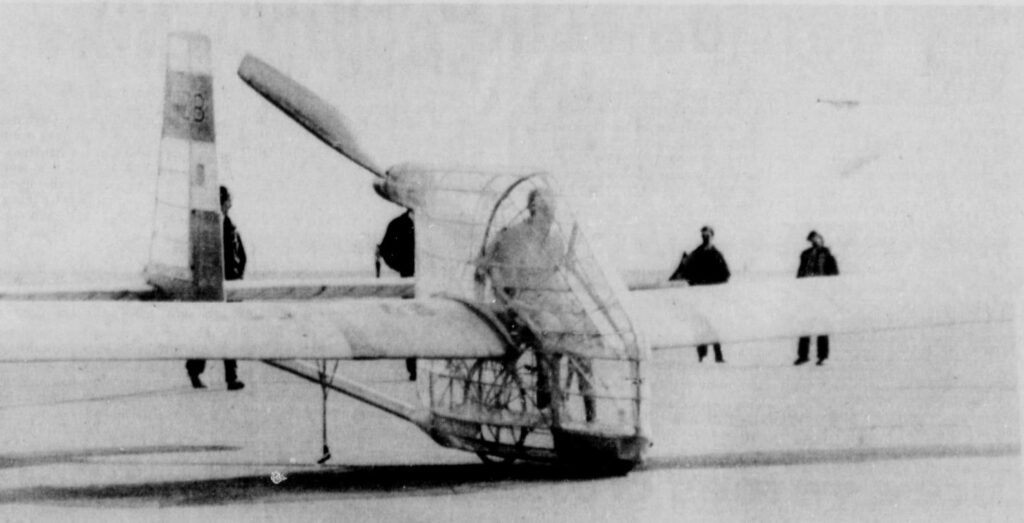
April 21 — Retired U.S. Air Force pilot Joseph Zinno flies a human-powered aircraft of his own design, the Olympian ZB-1. By pedaling a modified bicycle wheel, he remains airborne for five seconds and flies at least 24 meters over Quonset Point, Rhode Island. Zinno was attempting to win the $92,500 prize offered by British industrialist Henry Kremer to the first human-powered aircraft able to fly 10 feet off the ground and complete a figure-eight course around two pylons set at 0.8 km apart. Zinno doesn’t secure the prize, but some credit him with achieving the first human-powered aircraft flight in the U.S. NAA Newsletter, June 1976, p. 3; Ed Mack Miller Ed., Aviation Yearbook 1977, pp. 416-419.
April 22 — NATO IIIA, the first of three NATO-USAF military communications satellites, is launched by a Delta rocket into synchronous transfer orbit. The satellite will transmit voice, data, facsimile and telex messages between military ground stations from its operational altitude of 35,000 kilometers above the equator near West Africa. NASA Release 76-46.
Also during April — Scheduled airline service in the U.S. celebrates its 50th anniversary. The first regular commercial flights began on April 13, 1925, when Henry Ford started an air freight service between Detroit and Chicago. Soon after, President Calvin Coolidge signed the Air Commerce Act of 1926, paving the way for such flights to be regulated and a rapid expansion of commercial aviation. The U.S. fleet now consists of 2,200 jets making 13,000 daily flights nationwide. NAA News, April 1976, p.3.
2001
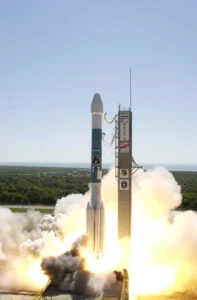
April 7 — A Delta II rocket launches NASA’s Mars Odyssey probe, named after Arthur C. Clarke’s 1968 novel “2001: A Space Odyssey.” It enters orbit around Mars in October, commencing a detailed geological mapping and chemical survey. The probe’s significant finds include the abundance of subsurface water ice, which indicates that life may have once existed on the red planet. Flight International, Nov. 6-12, 2001, p. 30.
April 18 — India’s inaugural Geosynchronous Satellite Launch Vehicle (GSLV) lifts off from Sriharikota, putting the GSAT-1 communications satellite into a geostationary transfer orbit. A previous launch attempt in March was aborted when one of the four liquid-fuel Vikas strap-on engines lost thrust shortly after ignition, prompting the main engines to shut down before the rocket lifted off. Flight International, April 3-9, 2001, p. 30, April 10-16, 2001, p. 30, and April 24-30, 2001, p. 6.
April 23 — The A340-600, the largest Airbus plane so far, makes its first flight from the company’s airport in Toulouse, France, kicking off a 14-month flight test program. This four-engine widebody airliner is designed to carry up to 380 passengers with a maximum range of over 8,000 miles. Flight International, May 1-7, 2001, p. 15.
April 28 — American millionaire Dennis Tito flies aboard a Soyuz TM-32 spacecraft with two veteran cosmonauts, becoming the first paying “space tourist.” He pays $20 million to spend nearly eight days aboard the International Space Station, during which he primarily takes photographs and videos. Tito holds a degree in aeronautical engineering and spent five years at JPL helping craft Mars mission trajectories. New York Times, April 29, 2001, p. 6.