Space operations in 2025: intelligence, resilience and sustainability
 By Cat Hofacker
 By Cat Hofacker
Space operations in 2025 were defined by autonomy, interconnectivity and sustainability. The industry has evolved from “launch and monitor” to “launch and collaborate” as spacecraft become more intelligent and self-reliant. Modern operations integrate the Concept of Operations; Fault Detection, Isolation, and Recovery (FDIR); mission planning; and ground automation, enabling complex missions across diverse orbital regimes with minimal human intervention.
Autonomy is the cornerstone of next-generation missions. The European Space Agency’s Proba-3, launched in December 2024, achieved millimeter-level precision through vision-based navigation and in June captured the first images of the sun’s inner corona during an artificial solar eclipse created by the precise alignment of its two spacecraft.
NASA’s Starling mission, launched in 2023, continued in 2025 to validate autonomous formation-flying and cooperative navigation among its four CubeSats, a milestone toward fully self-managing constellations.
SpaceX made significant strides, achieving the 500th launch of a Falcon rocket in June. This was followed by the 500th Falcon 9 flight in July, the Starlink 10-25 mission. In October, a Falcon 9 booster completed its 31st flight, a design record that underscored the maturity of reusable launch operations. The Starship program also advanced rapidly, bringing the company closer to fully operational reusability.

In orbit, self-healing communication networks enhanced resilience. The U.S. Space Development Agency in September launched the first of its Tranche-1 Transport Layer satellites. The layer will employ optical inter-satellite links to route data dynamically among 126 satellites, maintaining connectivity even when nodes fail and forming the digital backbone of autonomous operations.
As autonomy expands, cybersecurity has become critical. Operators adopted Zero-Trust architectures, rotating encryption keys, and onboard anomaly detection to counter spoofing and command injection. A key milestone was the signing of a partnership between the European Space Agency and Honeywell International in September to advance the QKDSat project, launching the delivery phase of a satellite-based quantum key distribution system aimed at protecting critical infrastructure like power plants, hospitals and banks. Together, these technologies ensure resilient and trustworthy operations.
Sustainability became central to mission design. Autonomous servicing, refueling, and debris-removal missions advanced a circular orbital economy.
In April, Northrop Grumman secured a contract from Space Systems Command to develop the Elixir payload, an on-orbit refueling system designed for rendezvous, docking, refueling and undocking of client satellites. In July, Astroscale U.S. signed a Space Act Agreement with NASA to demonstrate rendezvous and proximity operations in preparation for a geostationary servicing mission supporting national security assets.
Later in the year, Astroscale also finalized launch agreements for debris inspection and removal missions, reinforcing the transition from “launch-and-abandon” to “launch-and-extend.” These milestones demonstrated that satellites could be maintained, life-extended and even reused rather than discarded.
Beyond Earth orbit, NASA’s Commercial Lunar Payload Services (CLPS) program achieved multiple deliveries in March, when Firefly Aerospace and Intuitive Machines landers reached the lunar surface.
During the same period, LunaNet advanced from concept to implementation with the release of its Interoperability Specification V5 and Signal-in-Space standards, successful lunar demonstrations of the LuGRE GNSS and Nokia 4G/LTE network, and design and analysis work presented at SpaceOps 2025 — establishing the foundation for an interoperable cislunar communications and navigation network.
Model-Based Systems Engineering (MBSE) and digital engineering reshaped mission design in 2025. The Object Management Group in July officially adopted the SysML v2 standard, enabling greater precision and interoperability across tools such as Cameo Systems Modeler and Simcenter Studio. Tool vendors released aligned updates, and new applications were showcased through NASA’s digital transformation efforts and at the SEI MBSE in Practice conference held in August, advancing a unified digital thread from design through operation.
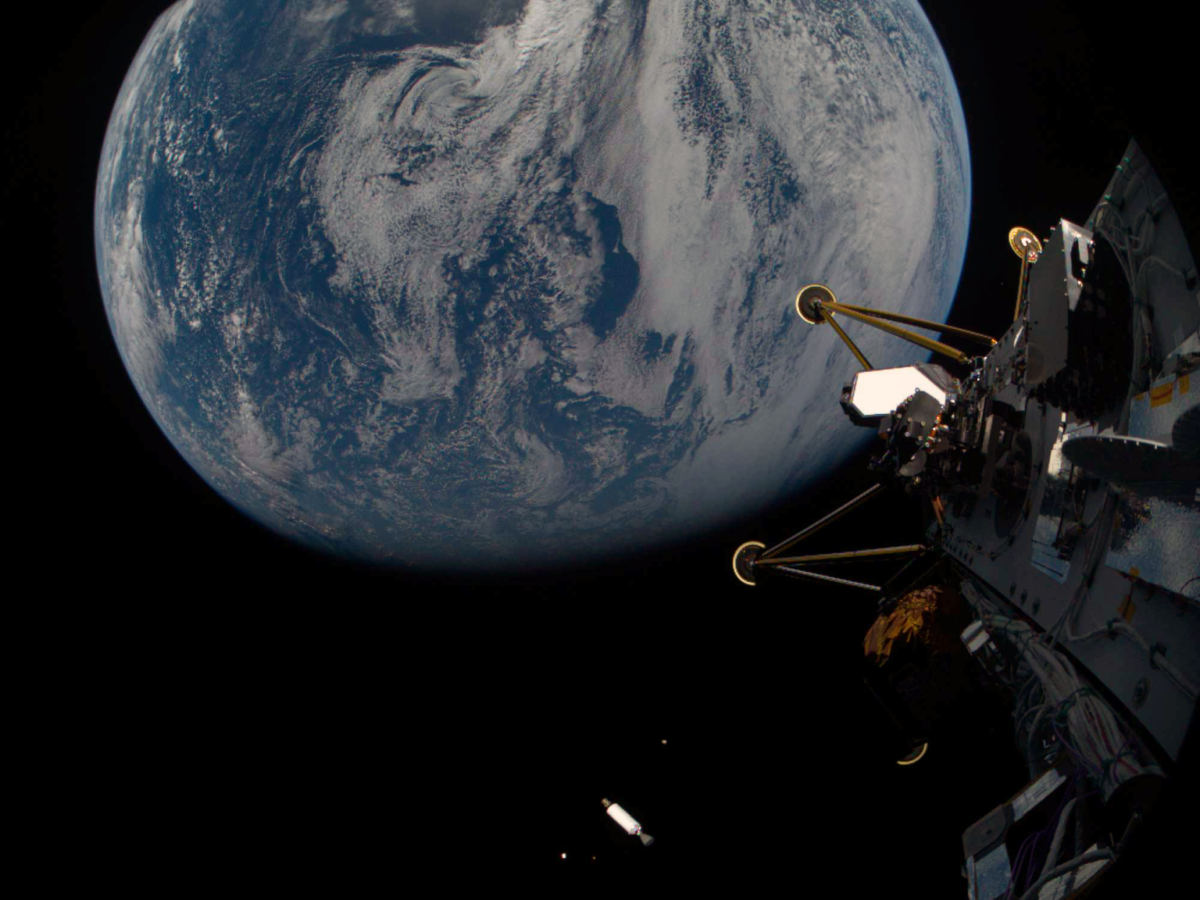
Opener image: An Intuitive Machines Nova-C lunar lander Athena took this selfie shortly its launch in February 2025. The spacecraft touched down on the moon about a week later. Credit: Intuitive Machines