Hypersonics in 2025: progress amid evolving priorities
 By Cat Hofacker
 By Cat Hofacker
Hypersonic momentum continued throughout the year, with steady technical progress across government, industry, academia and international programs. 2025 was marked by new contracts, technology demonstrations and the inauguration of several major research facilities, underscoring the global momentum behind hypersonics.
In January, a team led by Kratos secured a $1.45 billion, five-year contract for the second phase of the Pentagon’s Multi-Service Advanced Capability Hypersonic Test Bed (MACH-TB) program. The initiative aims to significantly increase the nation’s hypersonic testing cadence. Alongside Kratos, the team brought together Rocket Lab, JRC Integrated Systems, KODA Technologies, CFD Research and the Purdue Applied Research Institute, among others. June brought additional government investment: Lockheed Martin received a $1 billion contract to continue development of the U.S. Navy’s Conventional Prompt Strike hypersonic weapon program, while the U.S. Air Force announced plans to acquire the AGM-183A Air-Launched Rapid Response Weapon.

Another major announcement was the unveiling of the Golden Dome initiative in January. However, its impact on hypersonic development remains uncertain, leaving questions about future funding priorities. As part of the program, in June the U.S. Space Force awarded BAE Systems a $1.2 billion contract to provide missile-tracking satellites, which will contribute to detecting hypersonic threats. In October, the Atlantic Council’s Hypersonic Task Force released a report urging the U.S. to significantly scale up hypersonic programs.
Industry played a particularly dynamic role, with a flurry of activity demonstrating the sector’s expanding capabilities. In May, Stratolaunch achieved the first reusable launch of its Talon-A hypersonic testbed; Varda’s W-3 capsule reentered from space, providing valuable data to support Air Force Research Laboratory research; Hermeus completed the initial tests of its Quarterhorse Mk 1 high-speed aircraft, and Venus Aerospace announced the first flight test of its rotating detonation rocket engine.

Momentum continued in June, when GE announced significant investments to expand its hypersonic testing infrastructure across three separate sites.
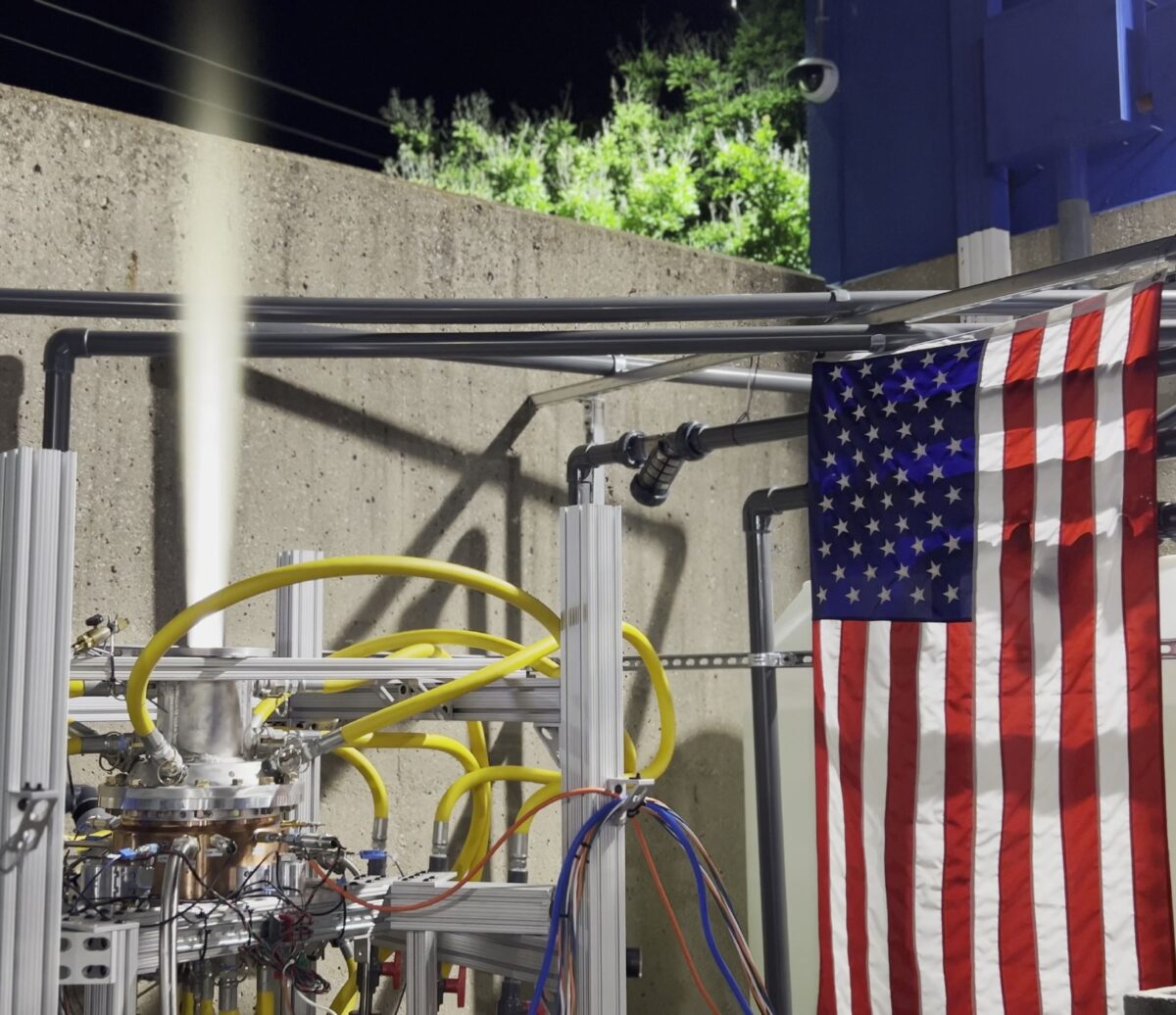
By August, Texas startup HY-SET brought commercially online its Hypersonic Integration Facility (HIF), a novel test environment that utilizes supersonic combustion of acetylene to provide high-throughput, high-fidelity materials screening, a unique resource for both industry and government programs.
Research institutions also contributed strongly, highlighting academia’s essential role in advancing hypersonic science and technology. In April, Texas A&M opened the Ballistic Aero-Optics and Materials Range, a half-kilometer facility designed to bridge the gap between wind tunnels and flight testing. Later in September, the University of Michigan led a team awarded $19.2 million from the Department of Energy to establish a new center focused on artificial intelligence to solve the complex physics of hypersonic flight.
Materials development remained a high priority. In February, Embry-Riddle Aeronautical University, in collaboration with Argonne National Laboratory, received $1.4 million from the Joint Hypersonics Transition Office to develop a dedicated hypersonic materials testbed, while the University of Arizona secured successive U.S. Army awards — $3.1 million in March and $5 million in August — to investigate novel metallic alloys and additive manufacturing processes tailored to hypersonic applications.
Internationally, 2025 saw continued advancement across several programs. In June, China’s Northwestern Polytechnical University reported a flight test in which a hypersonic vehicle reached Mach 12 using a rocket-ramjet propulsion combination. In September, South Korea disclosed a previously classified test of its HyCore technology demonstrator, which achieved Mach 6.
That same month, Dassault Aviation and the French procurement agency formalized an agreement to begin development of the VORTEX spaceplane, signaling Europe’s continued investment in hypersonics. Meanwhile, Brazil pressed forward with ground testing of its hydrogen-fueled 14-X scramjet engine and neared completion of its Combustion Driven Hypersonic Shock Tunnel T5. Russia also maintained focus on operational capabilities, conducting a September test of its Zircon hypersonic weapon system.
Opener image: n June 2025, Texas startup HY-SET opened its Hypersonic Integration Facility (HIF) for commercial operations. Credit: HY-SET