Global progress in applied aerodynamics
 By Cat Hofacker
 By Cat Hofacker
In January, researchers from the Center for Wind Energy Research (RÜZGEM) at the Middle East Technical University (METU) in Türkiye reported results of their experimental campaign regarding aerodynamic polars and transition characteristics of the NLF (1)-0416 natural laminar flow airfoil up to a Reynolds number of 4 million. The experiments were performed at METU-RÜZGEM’s large-scale subsonic wind tunnel that opened in December 2020. Experimental work included nonintrusive infrared thermography for transition detection, as well as wake-rake and surface pressure measurements for determining aerodynamic polars.
This airfoil was previously tested in the NASA Low Turbulence Pressure Tunnel in the early 1980s using different techniques and was one of the test cases presented in the AIAA 2021 Transition Prediction Workshop. Current measurement results are compared to the previous NASA data as well as to new computational fluid dynamics predictions. Although they were obtained 45 years apart in significantly different facilities and with completely different measurement techniques, the NASA and METU wind tunnel data are quite consistent, potentially providing a well-proven benchmark dataset for transition research.
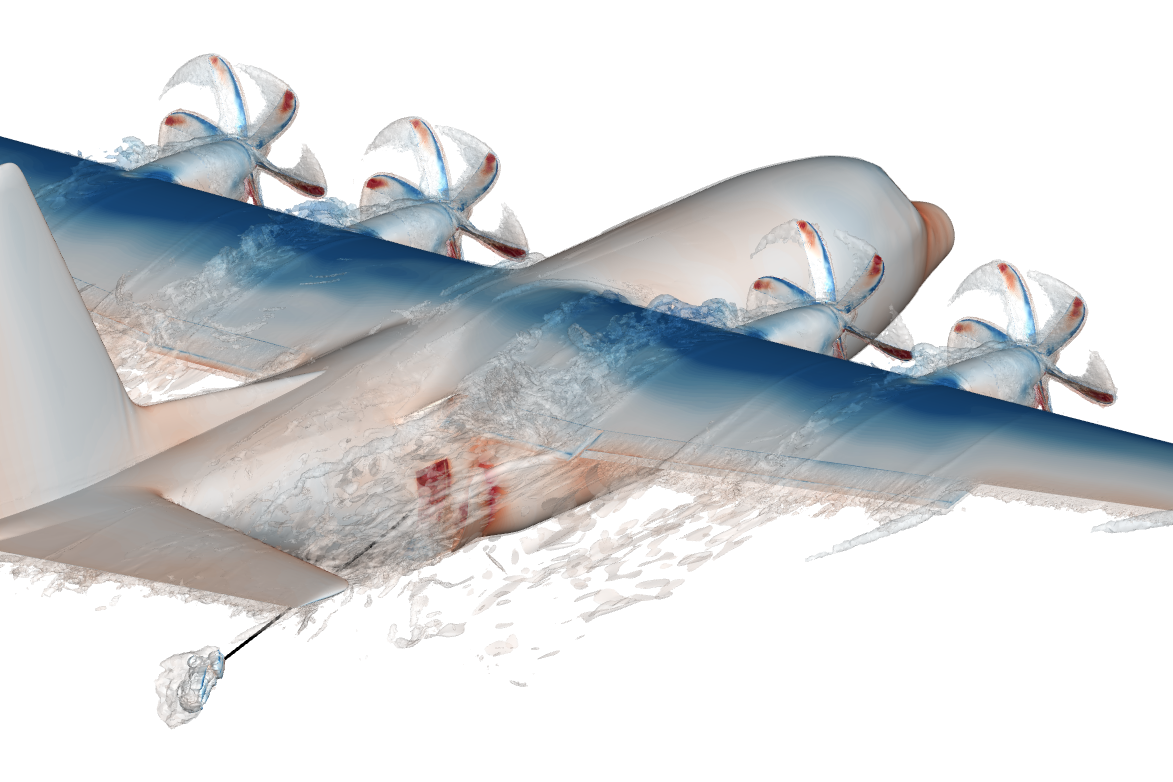
In July, the U.S. Army Combat Capabilities Development Command Soldier Center (DEVCOM SC) Modeling and Simulation (M&S) Capabilities Group and the U.S. Air Force Academy High Performance Computing Research Center completed proof-of-concept (PoC) simulations, modeling a towed paratrooper from a C-130 J. This PoC demonstration enables M&S studies for the DEVCOM SC Aerial Delivery Division regarding static line performance and supports upcoming interoperability efforts with allied military aircraft. Paratrooper body scans were also generated with the support of the DEVCOM SC Applied Ergonomics Branch and will be used to model the effects of paratrooper body positions during exits.
To meet the increasing analysis demand, DEVCOM SC is leveraging the Defense Department’s High Performance Computing Modernization Program (HPCMP) computing resources to generate high-fidelity computational fluid dynamics analysis using Kestrel, a software application maintained through the Computational Research and Engineering Acquisition Tools and Environments (CREATE) element of the HPCMP.
In July, Airbus, the German Aerospace Center (DLR) and the European Transonic Wind Tunnel (ETW) concluded tests under cryogenic conditions for the DLR-F25 research aircraft configuration. This short/medium-range civil transport aircraft configuration features a slender, high-aspect ratio wing and is currently the subject of scientific research in many projects. The tests were carried out using a full-span model designed for cryogenic conditions, manufactured by Deharde from maraging steel.
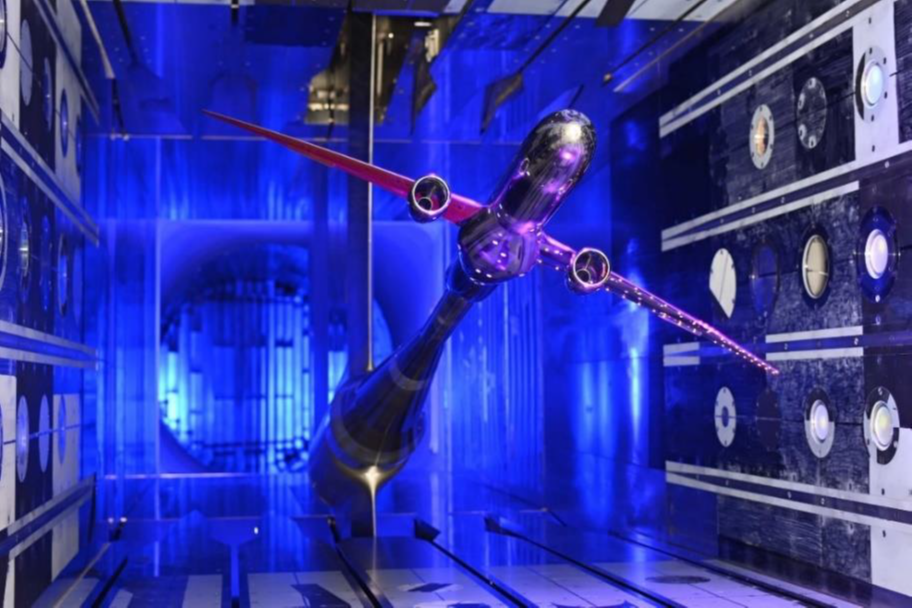
Together with its project partners, the DLR Institute of Aerodynamics and Flow Technology and the DLR Institute of Aeroelasticity examined the aerodynamic and aeroelastic behavior of the DLR-F25 under realistic cruise flight conditions, for the clean configuration and for several control surface deflections. The key focus in this campaign was to experimentally explore the potential of the high-aspect ratio cantilevered wing to improve the efficiency of future short/medium-range aircraft. These ETW tests were conducted as part of the German national research project VIRENFREI, funded by the German Federal Ministry for Economic Affairs and Energy, which addresses the pressing challenges of aviation, particularly improving efficiency and reducing emissions.

In August, the University of Dayton, with support from the U.S. Air Force Office of Scientific Research, reported the development of event-based imaging algorithms for two-dimensional, two-component (2D2C) velocimetry to measure ablation plumes. Unlike conventional frame-based sensors, event cameras offer microsecond temporal resolution, high dynamic range and low latency, enabling the precise capture of fast, transient features in low-light or high-contrast conditions at a fraction of the cost. These capabilities are critical for resolving the fine-scale spatiotemporal dynamics of ablation plumes. Using microsecond-resolution event streams, plume behavior was characterized over a wide parameter space, enabling the generation of “risk maps” that highlighted zones susceptible to particle redeposition.
Contributors: Oguz Uzol, Usbaldo Fraire, Jr., Sven Geisbauer, Sidaard Gunasekaran
Opener image: A July 2025 towed paratrooper simulation using HPCMP CREATE-AV Kestrel, executed by the U.S. Army Combat Capabilities Development Command Soldier Center. Credit: U.S. Army DEVCOM-Soldier Center