From promise to practice: space logistics in 2025
 By Cat Hofacker
 By Cat Hofacker
The year marked a tangible shift for space logistics: moving from ambitious demonstrations to the start of an operational service economy. Governments acted as anchor customers for new capabilities, fostering a wave of commercial progress in servicing, manufacturing and deep-space supply chains. This was the year the theoretical promise of an in-space economy began to look more like an operational reality.
Government agencies led this charge. In April, the China National Space Administration invited international payload cooperation for its Chang’e-8 mission, a key step toward establishing a planned lunar research station. In August, through the Flight Ticket Initiative, the European Space Agency contracted Spanish company PERSEI Space to demonstrate a novel tether-based deorbiting system and French company Infinite Orbits to launch two satellites to demonstrate a space debris cleanup mission.
The most significant move came from NASA, which in September awarded a landmark $30 million contract to Katalyst Space Technologies to robotically raise the orbit of the Swift Observatory, a satellite not designed for servicing. The U.K. Space Agency also expanded its reach in September and funded 23 new international projects in areas like autonomous 3D printing and deep space radar.
The commercial sector responded with major milestones in in-space servicing, assembly and manufacturing. In April, Astroscale U.S. won a contract to conduct the first-ever refueling of a U.S. Space Force satellite in geostationary orbit. Varda Space Industries demonstrated end-to-end logistics by recovering its third in-space manufacturing capsule in May and launching its fourth in June. The company then secured a $187-million Series C funding round in July to scale its orbital drug manufacturing. In September, U.K.-based Space Forge partnered with United Semiconductors to develop a supply chain for semiconductor materials produced in microgravity.
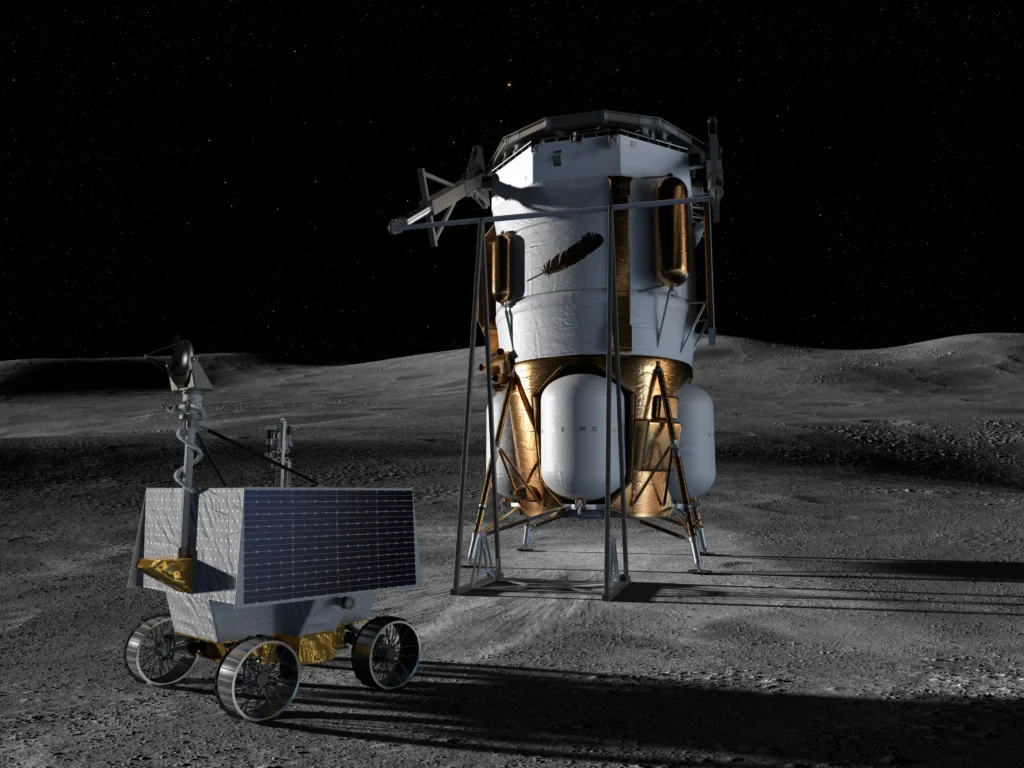
Efforts to build a cislunar supply chain also took concrete steps. In May, NASA awarded Sierra Space a contract to study surface logistics concepts, including expandable habitats for storage and trash management. Then in September, NASA solidified a key piece of its Artemis architecture by awarding Blue Origin a $190 million task order that includes an option to deliver the Volatiles Investigating Polar Exploration Rover (VIPER) to the moon’s south pole to prospect for water ice.
In the defense realm, logistics became a clear strategic priority. The U.S. Air Force broadened its launch provider base in March and awarded contracts with a $5.6 billion ceiling to California-based Rocket Lab and Stoke Space of Washington for national security missions. That same month, the U.S. Space Force launched its Orbital Watch initiative to share threat data with commercial operators. In July, DARPA concluded its BRIDGES program, a successful pilot to integrate more nontraditional companies into the defense industrial base. Finally, in a demonstration of allied capability, U.S. and U.K. Space Commands conducted their first coordinated on-orbit maneuver in September, using one satellite to inspect another.
This progress was underpinned by foundational academic work. In January, NASA’s Kennedy Space Center partnered with three Florida universities to form the Florida University Space Research Consortium, directly linking academic research to moon to Mars mission needs. In September, City St George’s, University of London, opened a new robotics facility to support in-space servicing, assembly, and manufacturing research, with both the U.K. Space Agency and ESA in attendance.
Opener image: Varda’s W-3 capsule landed in May 2025, providing new data to support the U.S. Air Force Research Laboratory’s hypersonic research efforts. Credit: Varda Space Industries