
From LEO to lunar: 2025’s expanding space architecture
 By Cat Hofacker
 By Cat Hofacker
Small satellite constellation proliferation, deep space exploration and crewed missions were advanced in the United States and internationally in 2025. However, NASA faced significant restructuring, workforce reductions and mission realignments that are expected to impact the agency’s current operations and long-term strategic capabilities.
In low-Earth orbit, deployment of satellite constellations continued at an increased pace compared to 2024, with at least 3,000 satellites planned to be launched. The Space Development Agency launched the first 21 satellites (out of 154 planned) of its Tranche 1 constellation in September, with a goal of having the full Proliferated Warfighter Space Architecture fully populated by 2027. Also in September, SDA demonstrated a Space-to-Air laser communication link between a Tranche 0 satellite and a General Atomics Electromagnetic Systems Group laser communications terminal mounted on an aircraft.

In January, U.S. President Donald Trump directed the Pentagon to create Golden Dome, a multilayered missile defense shield. Multiple architectures were studied and suggested, several of which include a proliferated constellation of space-based interceptors.
The China Aerospace Science and Industry Corporation continued to advance its LEO constellation, launching the eighth batch of satellites for the Guowang network in August.
The commercial sector also continued to grow. Amazon in April launched the first 27 satellites for its Amazon LEO constellation, and SpaceX launched 2,143 Starlink satellites as of mid-November.
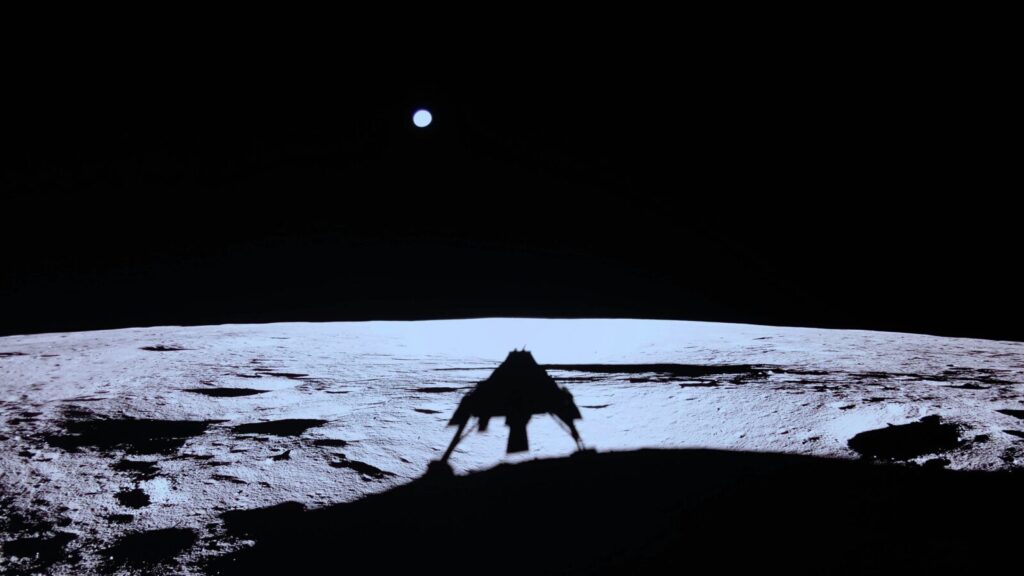
A handful of commercial landers funded by NASA’s Commercial Lunar Payloads Services (CLPS) initiative reached the moon. Firefly Aerospace’s Blue Ghost launched in January onboard a SpaceX Falcon 9 and touched down in the moon’s Mare Crisium region in March. The lander delivered 10 payloads and operated for 14 days, a record for commercial lunar operations. Also in March, Intuitive Machines landed a spacecraft under the IM-2 mission. During descent, the lander’s altimeter failed, and it touched down in a suboptimal orientation; however, the lander operated under battery power for approximately 13 hours and returned data and images.
Interest in asteroid missions for science and commerce continued. The China National Space Administration launched the Tianwen-2 spacecraft in May. It is to rendezvous with the asteroid Kamoʻoalewa in 2026, collect 100 grams of material and return the samples in a capsule to Earth in 2027. AstroForge’s Odin mission, designed as an on-orbit demonstrator to capture images of the metal rich asteroid 2022-OB5, launched in February, but contact with the spacecraft was lost shortly after separation.
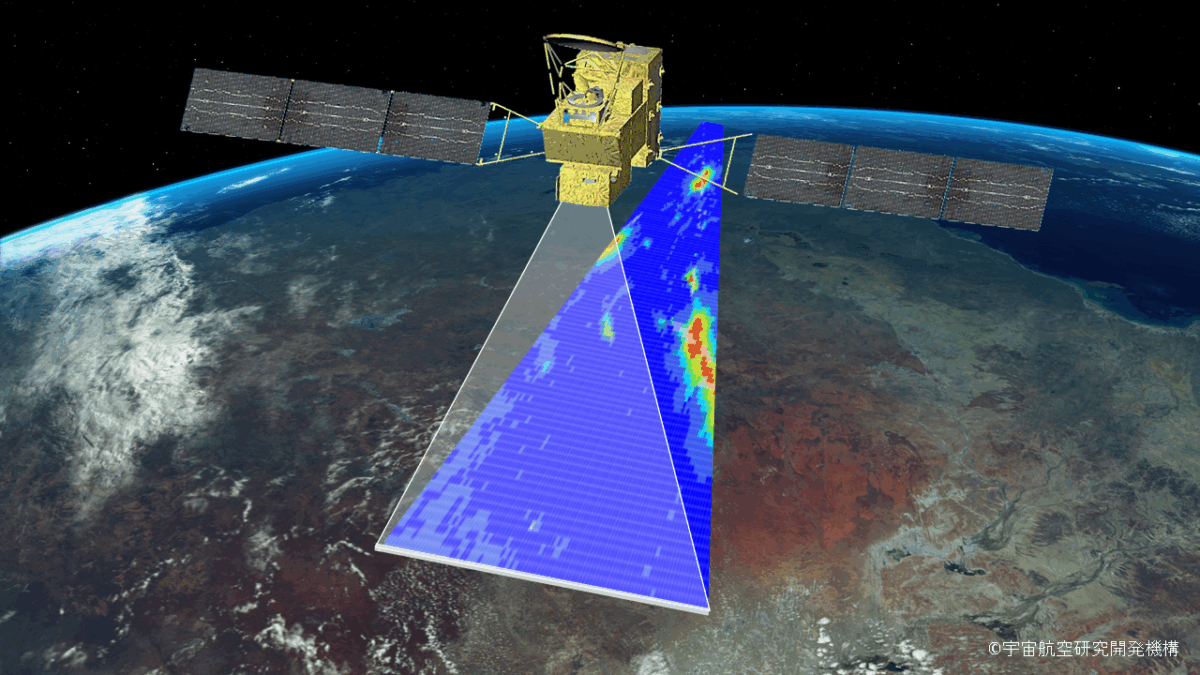
In April, the Japan Aerospace Exploration Agency launched the Global Observing SATellite for Greenhouse gases and Water cycle (GOSAT-GW), also known as “IBUKI-GW.” This spacecraft is equipped with the new TANSO-3 imaging spectrometer for high-resolution greenhouse gas monitoring and the Advanced Microwave Scanning Radiometer 3 (AMSR3) for observing water cycle dynamics.
NASA astronauts Suni Willaims and Butch Wilmore returned to Earth in March from the International Space Station aboard a SpaceX Dragon capsule, as NASA decided in 2024. They spent 10 months in orbit, significantly longer than their planned eight-day mission, because their Boeing Starliner capsule experienced thrusters issues while en route to ISS. NASA decided to return the empty capsule, and it landed in September 2024 without incident. This saga highlighted several challenges future commercial space missions may face, including a lack of common interfaces for spacesuits and capsules made by different companies.
Commercial crewed launches continued, with Blue Origin launching an all-female crew in April on the NS-31 suborbital mission. China continued to expand its human presence in LEO, launching three taikonauts to the country’s Tiangong space station in April. A replacement crew of three launched in October. A suspected debris strike on the Shenzhou-20 vehicle delayed the return of the first crew by several days, and they returned safely in mid-November.
Contributors: Smrithi Keerthivarman
Opener image: An illustration of the GOSAT-GW that was launched in June 2025, measuring carbon dioxide emissions. Credit: JAXA