Electric propulsion continues to proliferate
 By Cat Hofacker
 By Cat Hofacker
2025 saw electric propulsion systems proliferate across many metrics.
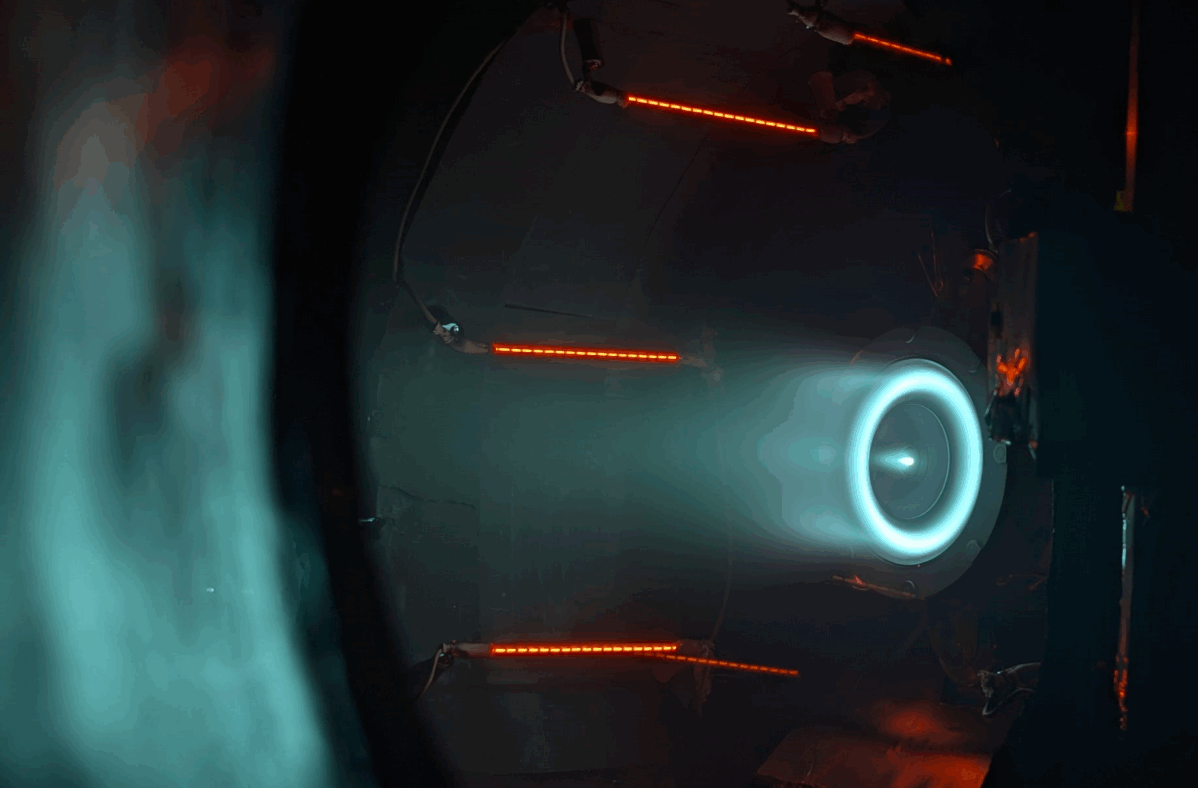
In high-powered systems, all the flight thrusters for the Power and Propulsion Element (PPE) of NASA’s lunar Gateway space station were scheduled to be delivered by December. The three 12-kilowatt AEPS units from Aerojet Rocketdyne and four 6-kW BHT-6000 units from Busek of Massachusetts will be integrated onto the PPE by Lanteris, formerly Maxar Space Systems. Environmental qualifications were scheduled to be nearly completed by December, while lifetime testing continues.
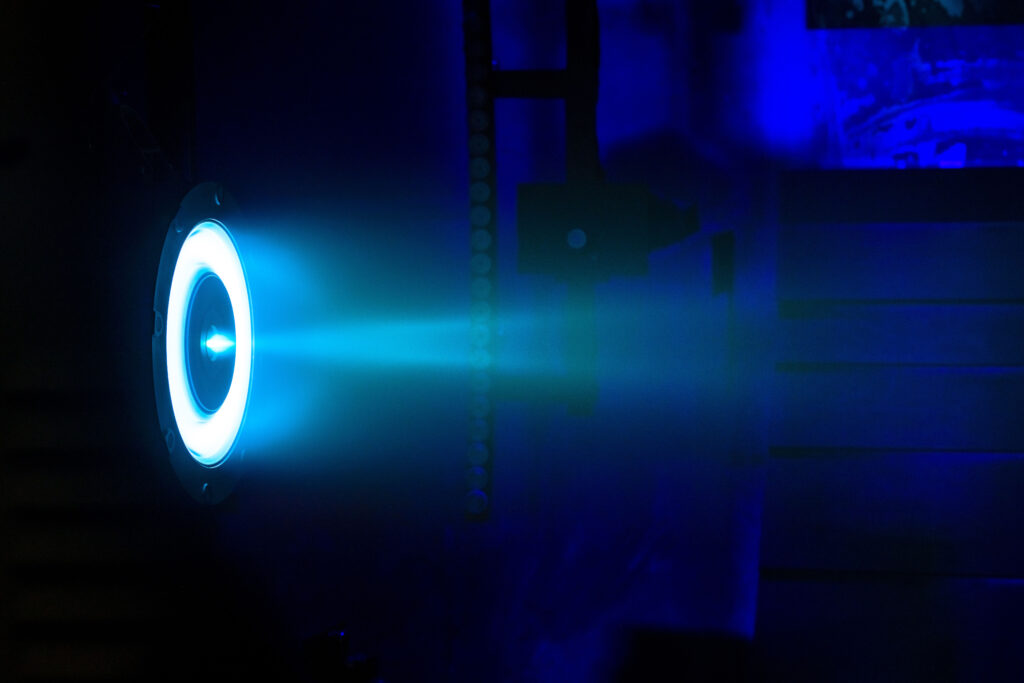
NASA’s Jet Propulsion Laboratory has been testing a LaB6 hollow cathode at 250A to benchmark models for 200-kW-class Hall thrusters; the test exceeded 2500 hours of operation in November, and is due to complete the 4000-hour test duration in mid-January 2026. NASA’s Psyche mission to the asteroid of the same name completed the first phase of cruise thrusting in September; the next phase is set for September 2026. As of October, Psyche’s thrusters used 325 kilograms of xenon across 8,000 hours of operation.
Regarding systems at moderate power levels, Busek delivered its 350th BHT-350 thruster in September, with 150 units operating on-orbit; the 50th BHT-600 is due for delivery by December. Also in September, the Japanese Aerospace Exploration Agency’s asteroid explorer Hayabusa2 completed ion engine operations, ahead of a planned flyby of the asteroid Torifune in July 2026. SpaceX’s Starlink constellation continued deployment, with over 8,500 satellites operating in orbit as of October, each of which has a Hall thruster aboard.
At low powers, a Busek BIT-3 iodine-fueled ion thruster, with an iodine radiofrequency (RF) cathode, was operated in July after three years’ dormancy on-orbit. Also using iodine propellant, ThrustMe of France expected its 200th NPT30-I2 thruster to launch by the end of the year, making this design the most populous gridded ion thruster design on orbit.
In September, CU Aerospace of Illinois launched the Dual Propulsion Experiment (DUPLEX) 6-unit cubesat with two of its innovative electric propulsion technologies: the Fiber-fed Pulsed Plasma Thruster (FPPT) using Teflon propellant, and the Monofilament Vaporization Propulsion (MVP) micro-resistojet system using Delrin-filament propellant. DUPLEX was to deploy from the International Space Station in early December. The two-year mission in low-Earth orbit will establish flight heritage for these two new electric propulsion technologies.
In March, Pale Blue Inc. of Japan reverified its water resistojet thruster after two years in orbit. In May, it demonstrated the ultra-compact resistojet system, the PBR-10. In September, Pale Blue also achieved a world first with the successful in-orbit operation of the PBI, a water ion thruster optimally designed for small satellites.
On the research front, researchers at TU Dresden in Germany developed a novel emitter for field-emission electric propulsion systems in February, using ferromagnetic particles suspended in room-temperature liquid metals. The emitter needles are created by magnetic fields, removing both the need for costly processes to make the needles, and the need for a vacuum process to wet the needles with propellant.
At George Washington University in Washington, D.C., an axisymmetric micro cathode arc thruster achieved over 13 million pulses. Students presented their paper on the effort in September at the International Electric Propulsion Conference at Imperial College London.
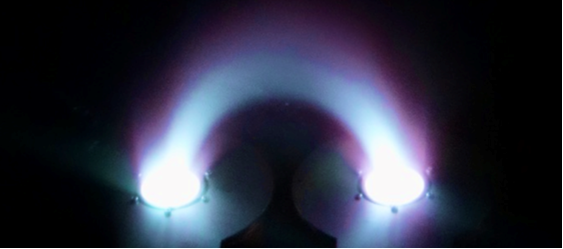
In July, some 40 experts attended the first International EPT Workshop on electrodeless plasma thrusters (EPTs), hosted by Universidad Carlos III de Madrid. Among the work presented was an experiment to join two EPTs to form a magnetic arch. This was done to explore magnetic topologies that cancel the magnetic dipole moment created by each thruster while proving that a plasma jet is still formed, producing thrust. This work was done at Equipo de Propulsión Espacial y Plasmas at UC3M within the framework of the ERC-ZARATHUSTRA Starting Grant project.
Contributors: Richard Hofer, James Szabo, Mario Merino, Daniel Herman, David Carroll, Martin Tajmar, Guru Duppada, Akira Kakami, Elena Zorzoli Rossi
Opener image: Qualification Model 1 of the AEPS thruster undergoing thermal vacuum qualification tests at NASA’s Jet Propulsion Laboratory in July 2025, to demonstrate that the design meets the requirements imposed by the space environment. Credit: NASA-JPL/Caltech