Combustion stabilization approaches enabling high-speed flight
 By Cat Hofacker
 By Cat Hofacker
Reliable, compact, fuel-efficient and fuel-flexible propulsion systems are critical to advancing high-speed aircraft for military and civil aerospace systems. Stable combustion is of utmost importance in such systems, and there were several key advances in this area within the last year.
Researchers from Purdue University investigated fuel temperature effects on thermoacoustic instabilities in gas turbine engines. Work conducted in February focused on studying combustion instabilities in a piloted swirl flame for conventional and synthetic jet fuels. Measurements revealed a self-excited longitudinal instability driven by unburnt fuel accumulation in low-velocity regions of the flame and subsequent high heat release rates during acoustic compression. Increasing fuel temperature attenuated the instability through faster evaporation and improved fuel–air mixing.
In June, researchers from the University of Cincinnati and the U.S. Army Research Laboratory investigated unsteady flow, mixing, and combustion in the NASA Energy Efficient Engine combustor using a large-eddy simulation (LES) framework. Calculations across all 30 sectors provided a quantitative explanation for “hot streaks” observed in the combustor at sea level takeoff conditions. Inefficient mixing of dilution air in the pilot dome directed hot gases toward the combustor edges, driving hot streaks, which detrimentally affect high-pressure turbine stages.
Innovative solutions to stabilizing combustion at supersonic flow conditions were pursued by several research groups. In August, researchers at Georgia Tech successfully stabilized flames in supersonic flow without flame holders using a free-standing recirculation bubble created by shock-induced vortex breakdown. The bubble, sitting between the shock wave and recirculation zone, formed a stationary “shock-flame complex” and facilitated stable flames over a wide range of operating conditions.
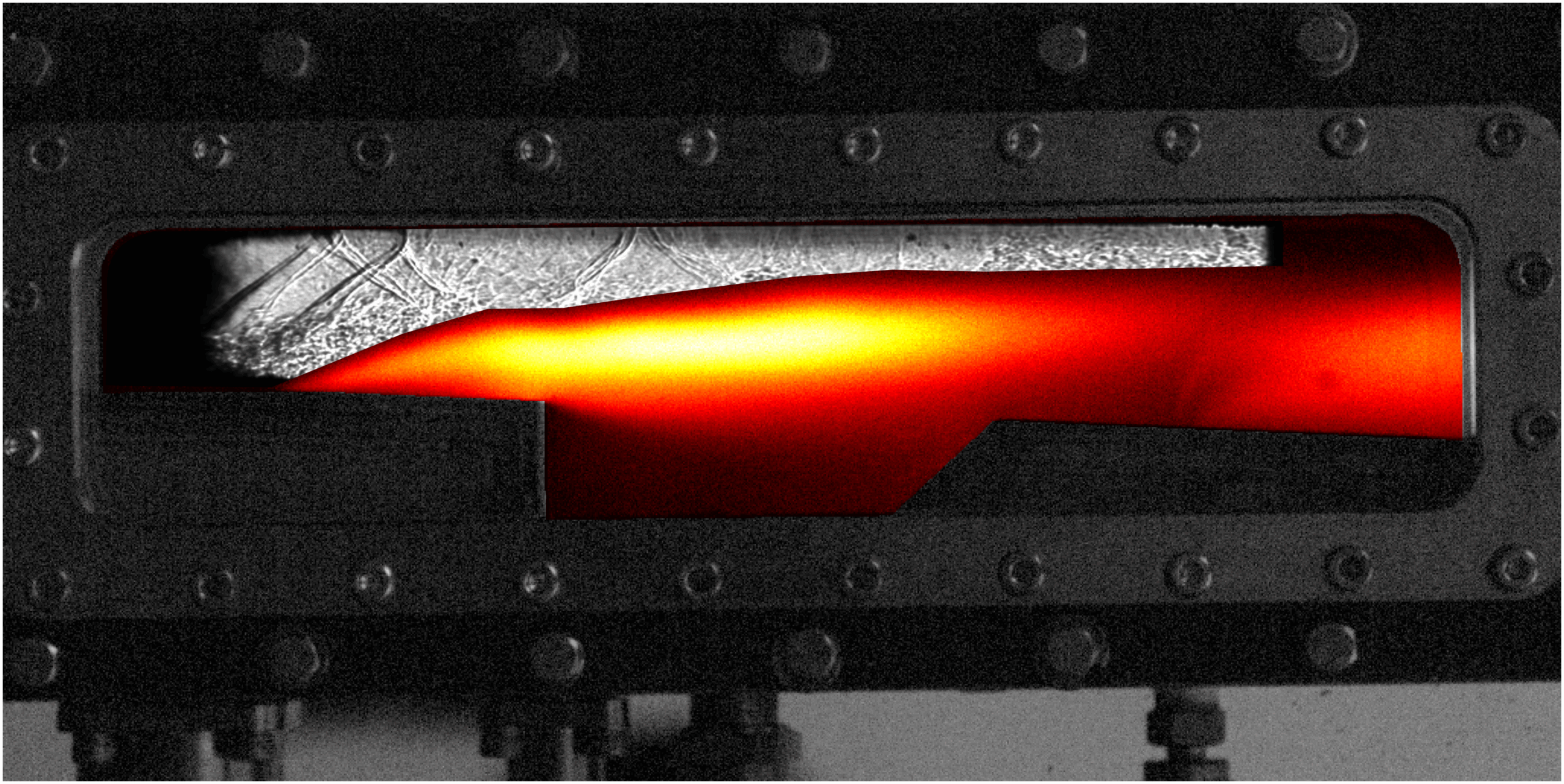
Researchers from Technion – Israel Institute of Technology studied the impact of distributing the injected fuel upstream and downstream of the cavity flame holder on flame stabilization for a dual-mode scramjet engine. Measurements taken in May provided insight into the relationship between wall pressure and flame and flow dynamics. These results could lead to practical control approaches with the potential to enhance engine performance and stability.
Tests conducted at the U.S. Air Force Research Laboratory in Ohio from January to March pushed operational limits for scramjet data. Researchers obtained measurements at a simulated flight of Mach 3 at extremely high altitudes with cavity flameholder static pressures of <10 kilopascal. Unique interchangeable flameholder geometries and fuel injection locations were explored in an ethylene-fueled modular axisymmetric scramjet research rig. Stable ignition and combustor operation measurements at a broad range of global equivalence ratios will facilitate advancement and validation of computational models.
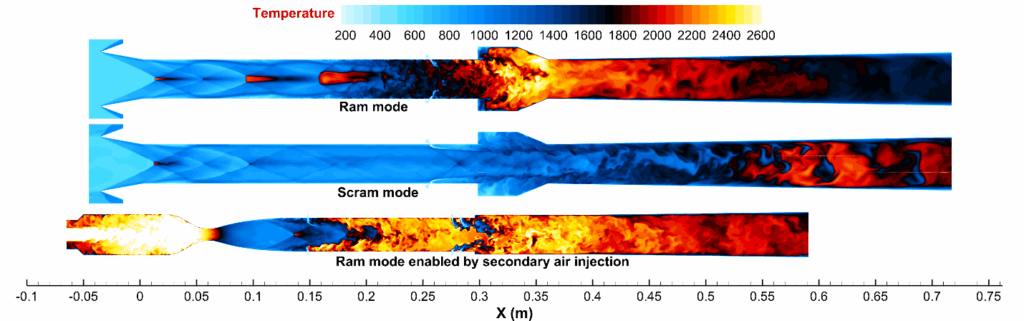
In April, researchers at North Carolina State University and the University of Illinois Urbana-Champaign studied high-altitude scramjet operation. With LES, they investigated scram-mode operation of an ethylene-fueled isolator/combustor configuration. The role of secondary oxidizer addition in enabling stable ram-mode combustion without a cavity flameholder was identified through simulations that captured transient wall heating and the presence of radical species in the inflow.
In the hypersonic realm, work conducted in January by researchers at the University of Central Florida presented the flow conditions and configuration that generate a standing normal detonation wave. A normal detonation, the most powerful form of combustion, is stabilized through balancing the high-Mach propellant mixture of the inlet flow relative to the consumption speed of the detonation. This game-changing approach allows for a possible pathway for standing detonation jet engines (STANDJET) for hypersonic propulsion.
Contributors: Carson Slabaugh, Prashant Khare, Adam Steinberg, Shavit Attar, Dan Michaels, Timothy Ombrello, Jack Edwards, Kareem Ahmed
Opener image: An average CH* chemiluminescence image showing the main and secondary combustion zones, overlayed with a shadowgraph image showing the oblique shock train and mixing zone. Credit: Technion – Israel Institute of Technology