Celebrating 50 years of international space cooperation
 By Cat Hofacker
 By Cat Hofacker
July marked the 50th anniversary of the Apollo-Soyuz Test Project, which took place during the height of the Cold War. An Apollo capsule, commanded by NASA astronaut Thomas Stafford, docked in space with a Soyuz spacecraft launched from the Soviet Union, beginning five decades of international space cooperation. November marked 25 years of continuous human presence in low-Earth orbit, which began in 2000 with the arrival of a joint American and Russian crew to the International Space Station.
Other significant milestones included the 100th anniversary of the founding of aircraft engine manufacturer Pratt & Whitney, the 50th anniversary of Airbus commercial aircraft service in the U.S. with Eastern Airlines, the 50th anniversary of the launches of the Viking probes to Mars, and the 25th anniversary of the first flight of Lockheed Martin’s X-35, the prototype for the F-35 Lightning.
The Smithsonian’s National Air and Space Museum opened five new galleries, the Lockheed Martin IMAX Theater, and its redesigned entrance along the National Mall in Washington, D.C. The galleries were the Boeing Milestones of Flight Hall; Futures in Space; Barron Hilton Pioneers of Flight; World War I: The Birth of Military Aviation; and the Allan and Shelley Holt Innovations Gallery. The museum’s major renovation, which began in 2018, is to conclude with the reopening of several more galleries in time for its 50th anniversary in July 2026.
In February, the Space Center Houston in Texas premiered “The Moonwalkers: A Journey,” a 360-degree immersive experience narrated by Tom Hanks. Using remastered images from the Apollo era, this unique film is both a retrospective history of the Apollo lunar missions and a look forward to the Artemis II mission, a crewed lunar flyby mission targeted for 2026. Many of these images were published in “Apollo Remastered” by British space photography enthusiast Andy Saunders, who published a companion book, “Gemini and Mercury Remastered,” in September.
From February to September, the NASA History Office presented a seminar series on Aerospace Latin America, exploring the origins, evolution, and historical context of aerospace in the region. This collaborative effort is to be published as an anthology of essays. As NASA’s Chief Historian Brian Odom noted in the Summer 2025 issue of NASA News & Notes, “History serves as a vital guide for decision-makers by assembling the evidentiary record, collecting institutional memory, and contextualizing and analyzing past decisions.”
At AIAA’s SciTech Forum in January, the History Committee recognized Michael W. Hankins from Smithsonian’s National Air and Space Museum for the 2025 AIAA Gardner-Lasser Aerospace History Literature Award. His book, “Flying Camelot: The F-15, the F-16, and the Weaponization of Fighter Pilot Nostalgia,” explores the influence and interconnectedness of fighter pilot culture and mythology on the design, development, and procurement of military aircraft, specifically through case studies of the F-15 Eagle and F-16 Fighting Falcon.
The History Committee relaunched its Historic Aerospace Sites program under the leadership of Walter Gordon and recognized two new historical sites. Aeronautical engineer Otto Lilienthal’s pioneering glider flights were honored in a May ceremony, in which AIAA designated Gollenberg Hill, Germany, as the “oldest airfield in the world.” In June, aviation pioneer Glenn Curtiss’ original facility in Hammondsport, New York, was recognized as an AIAA Historical. Curtiss’ achievements include the development of the JN-4 Jenny that was used to train over 10,000 American pilots during World War I. Nominations are now open for future AIAA Historic Aerospace Sites.
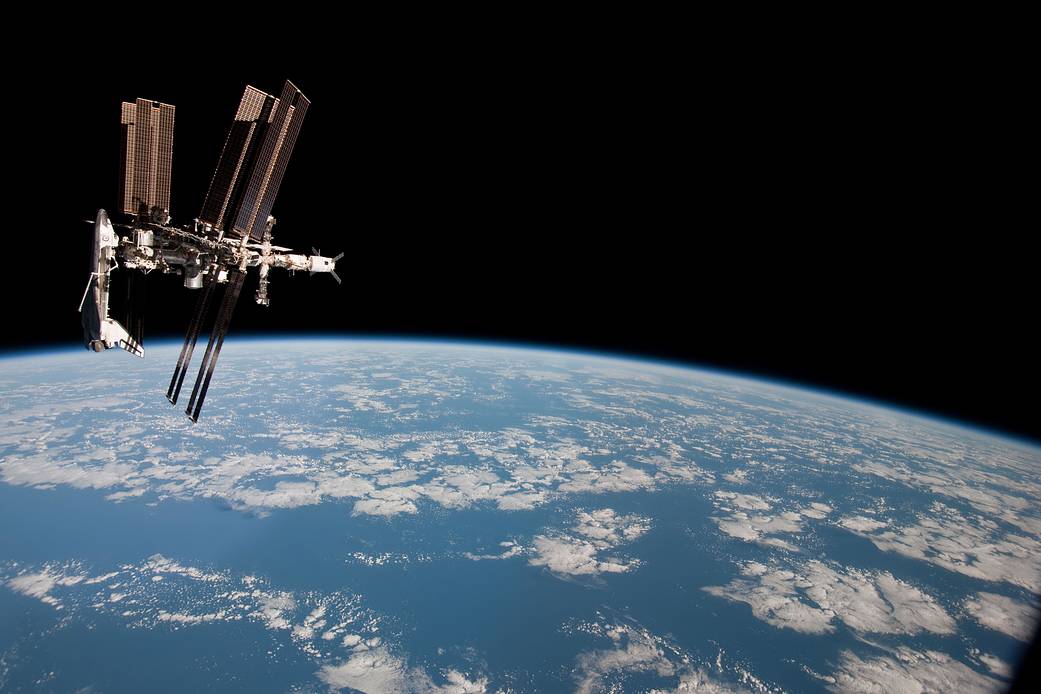
Opener image: ESA astronaut Paolo Nespoli took this photo of the space shuttle Endeavour docked to the International Space Station in 2011, shortly after he and his crewmates departed in their Soyuz TMA-20 capsule. Credit: NASA/ESA