

The Aerodynamic Decelerator Systems Technical Committee focuses on development and application of aerodynamic decelerator systems and lifting parachutes, paramotors, and inflatables for deceleration, sustentation, and landing of crewed and uncrewed vehicles.
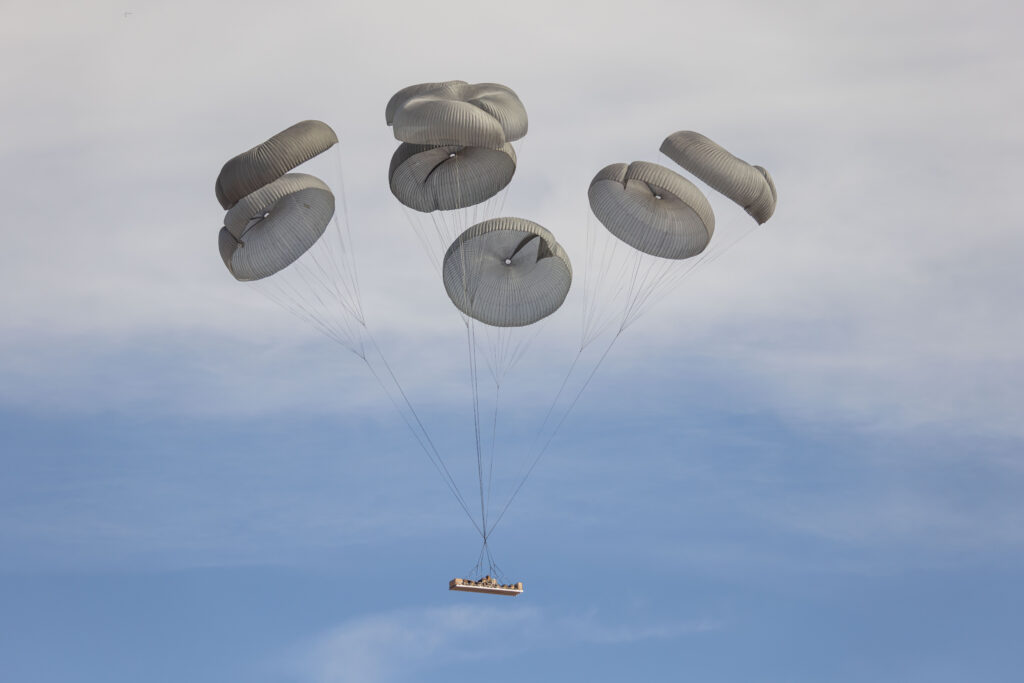
In April, the U.S. Army Combat Capabilities Development Command Soldier Center (DEVCOM SC) Airdrop Research Capabilities and Systems (ARCS) Branch airdropped the Extended Length Low Velocity Airdrop System (ELLVAS) with 12 500-gallon blivets. This test expanded the Type V platform envelope from 9 to 12 meters, allowing more fuel to be released by a single aircraft in one pass. This would extend operational reach, prolong endurance and ensure mission freedom of action. ELLVAS increases the fuel that can be delivered in a single airdrop by over 860 gallons, a 28% increase. The 12-meter platform is the largest ever airdropped from a C-130 aircraft.
In May, the DEVCOM SC Modeling and Simulation Capabilities Group completed a proof-of-concept simulation of the Shoring System (SHORSY) to support Standard Airdrop Impact Test efforts being performed by DEVCOM ARCS Branch. The simulation featured a High Mobility Multipurpose Wheeled Vehicle (HMMWV) rigged on a Rapid Rigging and De-Rigging Airdrop System (RRDAS) platform using 20 airbags and two SHORSY elements under the chassis. This model required developing a foam and air spring model to simulate energy dissipation performance. The simulated SHORSY engages when the HMMWV’s load spreader contacts the upper plate, compressing the air spring and foam element during landing. This capability will help the ARCS Branch evaluate impact shocks and optimize SHORSY positioning.
In June, the DEVCOM SC ARCS Branch demonstrated the Aerial Delivery & Autonomous Deployment of Unmanned Vehicles (ADADUV) capability. Funded by U.S. Transportation Command, ADADUV enables the airdrop of uncrewed ground and sea vehicles (UxVs) with fully autonomous derigging after landing, eliminating the need for soldiers on the ground. This allows for faster and closer emplacement of UxVs independent of ground forces. The ADADUV capability is made possible by the RRDAS platform reducing the amount of energy dissipating material, allowing UxVs to be autonomously driven off within seconds of delivery.
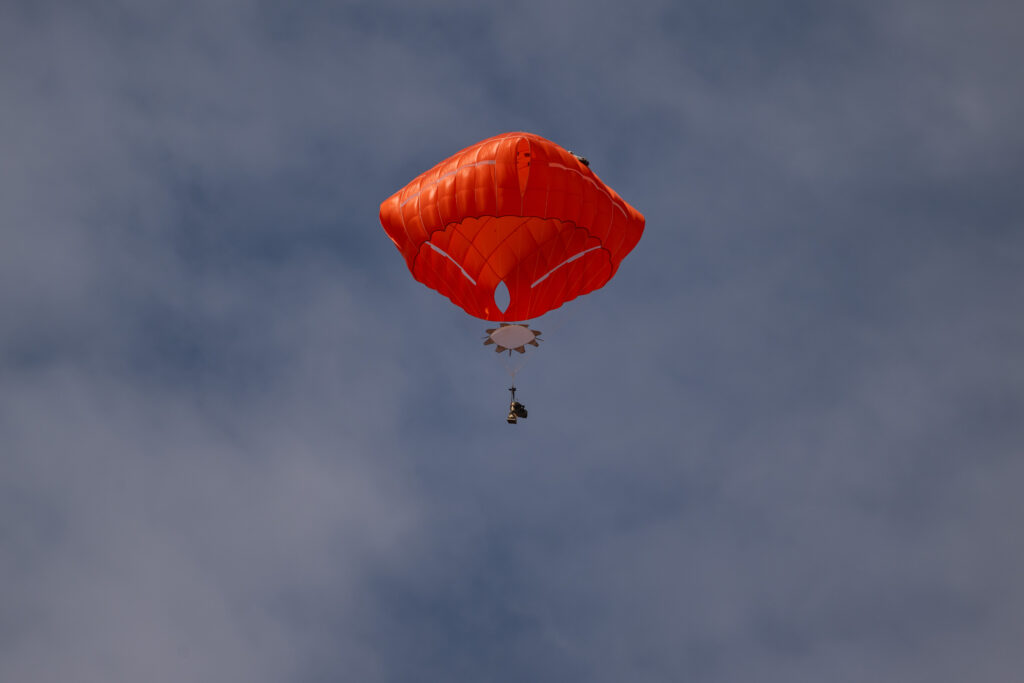
In July, the DEVCOM SC Airdrop Technology Branch tested T-11 static line personnel parachute prototypes constructed from alternative canopy cloth materials. The two lighter materials reduced pack volume compared to PIA-C-44378 Type IV canopy cloth used in standard U.S. Army static line parachutes. Testing included material lab testing and 28 live airdrop tests with mannequins weighing 160-400 pounds (72-18 kgs). Data was collected on opening altitude loss, oscillation performance and stabilized rate of descent, which will be compared to standard T-11 parachute performance.
The European Space Agency in July completed the final end-to-end test of the parachute system for the ExoMars Rosalind Franklin rover. The system consists of two main and two pilot parachutes. The first main parachute, a 15-meter Disk-Gap-Band, is deployed at close to Mach 2 during Mars entry. It stabilizes and decelerates the Entry and Descent Module to about Mach 0.6, where the second 35-meter Ringslot main parachute is deployed. A powered descent system takes over for terminal descent. Both main parachutes are deployed by mortar-deployed pilot parachutes. The system was designed by Vorticity Ltd under a Thales-Alenia Space contract. The pilot parachutes and second main were manufactured by Arescosmo of Italy. The first main was manufactured by U.S.-based Airborne Systems.
The high-altitude test, managed by Vorticity, released an 800-kilogram test article containing the complete parachute system from a stratospheric helium balloon at an altitude of 28 kilometers. The test took place at the Swedish Space Corporation’s ESRANGE test facility, the largest commercially available drop zone in Europe. The entire parachute sequence was tested, with the first parachute being deployed just below Mach 1. All the parachutes were recovered after the test, and the analysis of the data is ongoing. The ExoMars mission is on track for launch in 2028.
Contributors: John Underwood, Usbaldo Fraire, Jr., Liz Barret, Andrew Connors, Brian Huffman
Opener image: The ExoMars second stage parachute deployment during high-altitude testing in July 2025, with the first main parachute and two pilot parachutes shown in the background. Credit: ESA