Advances that benefit and protect society
 By Cat Hofacker
 By Cat Hofacker
Looking back on 2025, aerospace technologies continued to captivate and benefit society. In the areas of civil and commercial space, autonomous air vehicles, aviation, and national security, U.S. presidential executive orders issued will shape how aerospace technologies can benefit, involve, protect, and transform society.
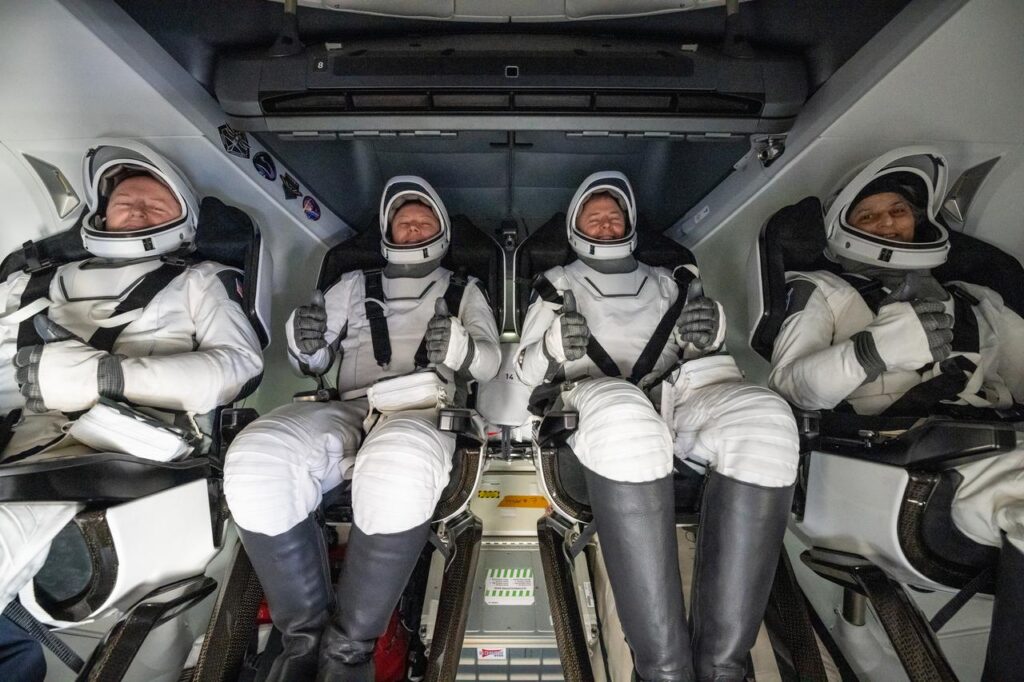
NASA astronauts Butch Wilmore and Suni Williams returned to Earth on a SpaceX Crew Dragon capsule in March, capturing public interest, after thruster and helium malfunctions on their Boeing Starliner extended their stay aboard the International Space Station to nine months.
The advertised wholesale cost of space launch reportedly continued to decrease. However, according to a study published in July by NASA analyst Moon J. Kim, limited competition has enabled final contract price increases to NASA’s public-funded commercial launch services. This means public tax dollars were not realizing anticipated savings. President Donald Trump in August signed Executive Order 14335, “Enabling Competition in the Commercial Space Industry,” with a goal to increase U.S. competition and reform regulations for commercial launch and reentry, spaceport infrastructure, and novel space activity authorization.
In March, a prototype FireSat launched from Vandenberg Space Force Base in California aboard the SpaceX Transporter 13 rideshare mission. FireSat combines multispectral imagery with AI to improve fighting wildfires. Launched and tested by Earth Fire Alliance in partnership with the Gordon & Betty Moore Foundation, Muon Space, and Google Research, the protoflight demonstrated that high-resolution early fire warning is possible.
Autonomous technologies continued to be developed for the benefit of the public. In June, Trump signed Executive Order 14307, “Unleashing American Drone Dominance,” to accelerate the safe commercialization of drone technologies and integration into the national airspace. FAA proposed a rule in August to normalize beyond-visual-line-of-sight operations, which the agency says would enable operations for package delivery, aerial surveying, public safety, recreation, and more.
In October, NASA conducted the inaugural flight of the X-59 demonstrator, bringing the return of supersonic passenger flights over American soil closer to reality. Built by Lockheed Martin Skunk Works, the aircraft is designed to reduce sonic booms to sonic thumps, lessening the noise impact on the public. Using the same principles, Boom Supersonic’s XB-1 demonstrator conducted its first supersonic flight in January.
In June, Trump signed Executive Order 14304, “Leading the World in Supersonic Flight,” directing FAA to repeal the ban on overland civil supersonic flight. Other directives are to advance supersonic research and development, and to promote international engagement on civil supersonic flight regulations.
In January, Trump directed the Pentagon to construct the Golden Dome missile defense shield to better counter rising threats such as hypersonic missiles, and existing decoy warheads, and sheer launch volume, by signing Executive Order 14186, “The Iron Dome for America.” A variety of aerospace technologies and systems, which include space-based sensors and missile interceptors, would be combined to defend the U.S. against these advanced threats.

In March, U.S. Space Force Gen. Chance Saltzman discussed the need to prioritize American “space superiority,” including diverse space-based weaponry to counter similar pursuits by near peer nations Russia and China. “It includes things like orbital warfare and electromagnetic warfare,” Saltzman said, with non-kinetic “counterspace” the priority over kinetic countermeasures. Such capabilities protect U.S. space assets, including GPS and communication satellites, that are critical to our daily lives.
The interaction between society and aerospace technology will be shaped in 2026 as the federal government implements executive orders and the community continues to develop aerospace technology.
Opener image: Boom Supersonic’s XB-1 demonstrator exceeded Mach 1.1 during its second supersonic flight in February 2025. Credit: Boom Supersonic