Advances in AI-integrated CFD and multiphase flow modeling
 By Cat Hofacker
 By Cat Hofacker
Throughout 2025, researchers at Rensselaer Polytechnic Institute advanced the integration of agentic artificial intelligence into computational fluid dynamics, transforming how engineers approach design, simulation and optimization. The team’s work bridged traditional CFD with AI tools capable of learning physics, automating simulations and reasoning about engineering problems. Their efforts progressed on three fronts: building large, high-fidelity datasets for data-driven modeling, developing autonomous AI agents to set up and run CFD workflows independently, and creating benchmarks to evaluate AI systems’ understanding of physical laws.
In May, Pan and collaborators released UniFoil, the world’s largest RANS-based airfoil simulation dataset, with over 500,000 samples spanning diverse Reynolds numbers, Mach numbers and angles of attack. The dataset captures laminar-turbulent transition and compressible flow effects, including shocks, providing a comprehensive benchmark for training and evaluating data-driven aerodynamic models.
The team also developed Foam-Agent, a multi-agent framework that automates OpenFOAM-based CFD workflows from natural language or high-level instructions. Using hierarchical retrieval, dependency-aware configuration and iterative error correction, the system executes CFD simulations without human intervention, achieving up to 88% success across more than 100 benchmark cases.
Additionally, in September, the researchers introduced CFDLLMBench, the first benchmark suite for evaluating large language models on computational fluid dynamics tasks, testing numerical reasoning, physical consistency and the ability to generate complete simulation workflows.
Significant progress in hypersonic rain droplet impacts emerged from multiple research groups. In July, Dorrin Jarrahbashi of Texas A&M University developed a DNS model for single-droplet aerobreakup with phase change for Mach > 5 and advanced efficient numerical methods for simulating droplet clusters interacting with hypersonic vehicles.
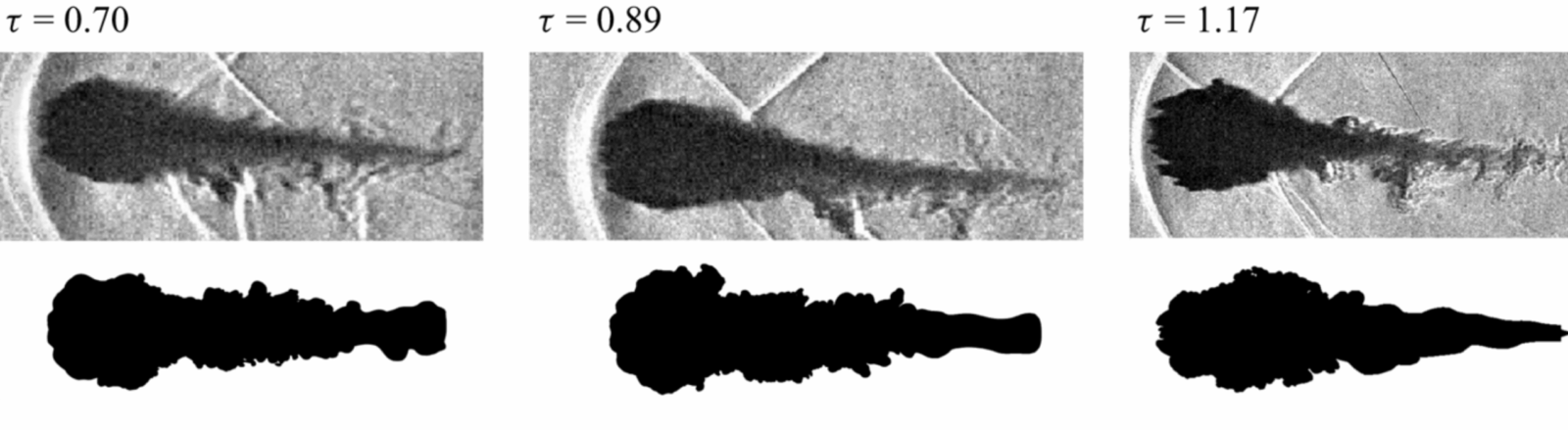
This work enabled the first Euler–Lagrange simulations of multiple droplet impacts on realistic hypersonic geometries, considering evaporation effects. In a related work, Nick Parziale of the Stevens Institute of Technology and Christoph Brehm of the University of Maryland in May presented combined simulation and experimental research examining droplet breakup in hypersonic impacts using the rail-gun facility at the U.S. Navy’s Dahlgren division in Virginia.
Their work captured experimental images of droplets breaking up at very high Weber numbers alongside corresponding high-resolution simulations that revealed the mechanisms of breakup. The experiments required imaging at frequencies exceeding 100 kiloHertz, while the simulations incorporated novel physical models to accurately represent the extreme conditions.
Researchers at the Technion – Israel Institute of Technology developed new methodologies for Eulerian simulation of polydisperse turbulent particle-laden flows. This approach combines a modified quadrature moment method with low-dissipation numerical schemes for compressible flows.
With this methodology, the team in April demonstrated for the first time the capability of a fully Eulerian approach to resolve turbulence modulation by particles, a highly sensitive phenomenon requiring the resolution of reflection and particle crossing in a compressible framework. The research group’s ongoing studies include erosion and ablation of aerodynamic materials and application of enhanced heat transfer by submicron particles.
These investigations have potential applications in aerospace propulsion, aerodynamics, environmental sciences and atmospheric studies.
Contributors: Yuval Dagan, Shaowu Pan and Jacob McFarland
Opener image: Comparison of experimental shadowgraphs versus numerical shadowgraphs for a drop at three different times. Credit: Dworzanczyk AR, Viqueira-Moreira M, Langhorn JD, Libeau MA, Brehm C, Parziale NJ. On aerobreakup in the stagnation region of high-Mach-number flow over a bluff body.