Toyota details progress, use for ‘Mothership’ high-altitude kites


This article has been updated to correct the maximum elevation reached with prototypes.
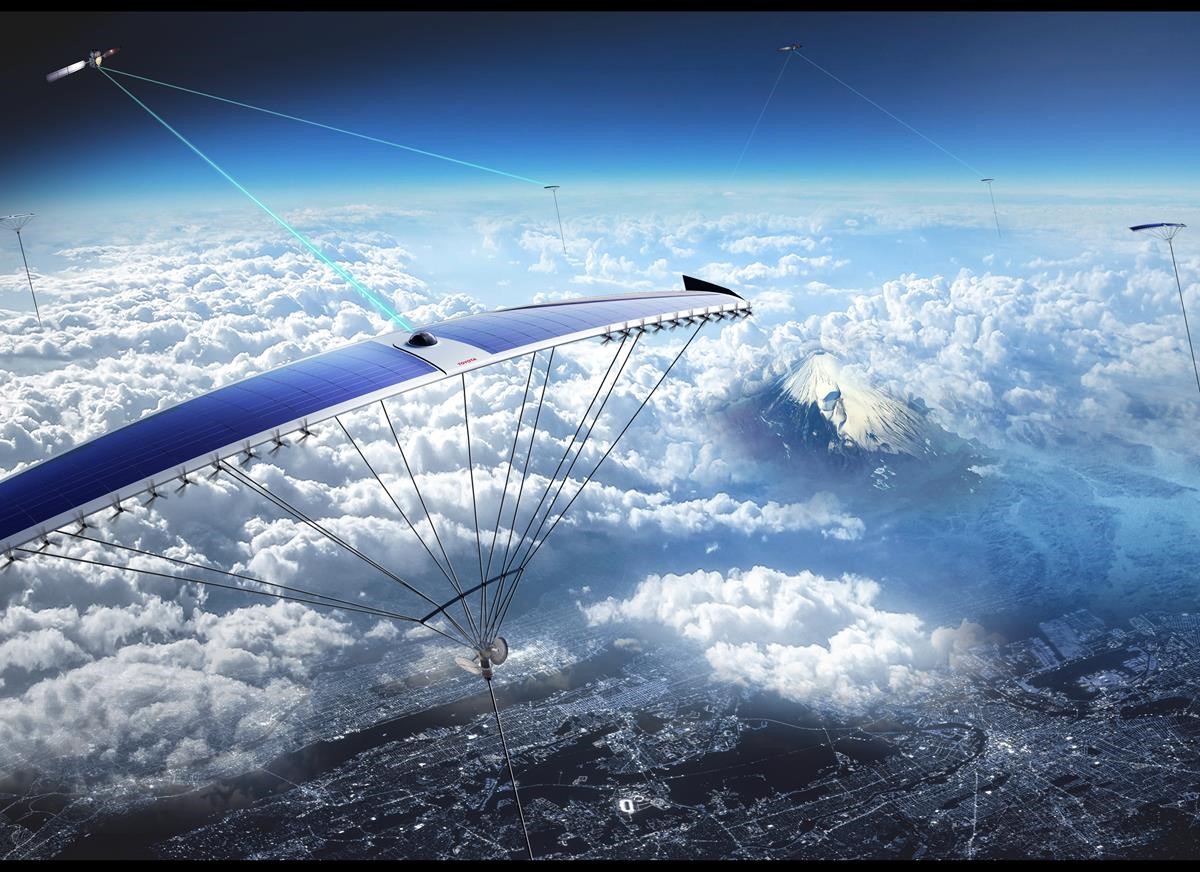
AIAA SCITECH FORUM, ORLANDO, Fla. — Scientists working on Toyota’s high-altitude kite project believe their latest research has demonstrated these wing-shaped inflatables can be controlled safely and efficiently to gather weather data, relay communications and eventually even generate power.
Since announcing the Mothership Project in 2018, Toyota has been performing wind tunnel tests and high-altitude flight tests of prototype kites made from lightweight fabric and equipped with a winch mechanism and pitch or altitude controls. They described some of the testing results and other progress here Wednesday.
Just as a recreational kite is attached to a string, a Mothership would be tethered by a cable and elevated into atmospheric winds — including the lower reaches of the narrow, fast-flowing jet stream — where the tension of the tether and various control surfaces would keep the kite flying in continuous figure-eight patterns.
That nearly constant tension and motion could be converted into electric power on the surface, said Taewoo Nam, a principal research scientist who leads the project work in the U.S. Other possible applications include weather observation and communications, and Toyota has also researched how cargo or payloads could be transported.
“We think it’s still early for commercialization efforts, and we want to make more technology development,” Nam told me after one of the presentations. Toyota views the kites as a long-term research project and hasn’t announced a time goal for deploying them.
Five U.S. universities are research collaborators for the project: Princeton University, University of Michigan, Purdue University, Baylor University and Arizona State University. Aimy Wissa, associate professor of aerospace and mechanical engineering at Princeton, presented on how she developed new control surfaces for kites by examining the biology and physics of bird feathers, specifically covert feathers that can adjust and smooth airflow over the wing. The standard airfoil shape of a typical aircraft wing wouldn’t suffice, she said, because the kites could careen wildly out of control or crash.
This research led Toyota to add flaps on the trailing lower and upper edges of the unique airfoil kite shape that would adjust midflight to maintain control, she said, playing a video of a flight test to illustrate.
“The flaps are deployed, and what you see is the stabilization of the pitch rate. This was really exciting,” Wissa said. “So we understood the biological solution, the physics, and that allowed us to develop these unique control vectors that satisfy the metrics: sufficient control authority and suppressing pitch oscillations.”
During flight tests in Japan, Mothership prototypes have soared as high as 3,950 meters and up to about 12 hours, Nam said.
He said he expects the kites will prove to be a more efficient method to generate power than today’s stationary wind turbines, but noted that Toyota has committed to doing more research on that application and many others.
Japan is in a unique position to benefit from such high-altitude wind power generation, he said, because of a strong jet stream that converges after splitting over the Himalayan Plateau of Central Asia, sometimes called the Japan Jet.