Q&A: Electra on design, business strategy for its hybrid-electric aircraft
 By Cat Hofacker
 By Cat Hofacker
With the planned EL9 aircraft, an Electra executive says the company has a design suited both for aviation’s present and future.
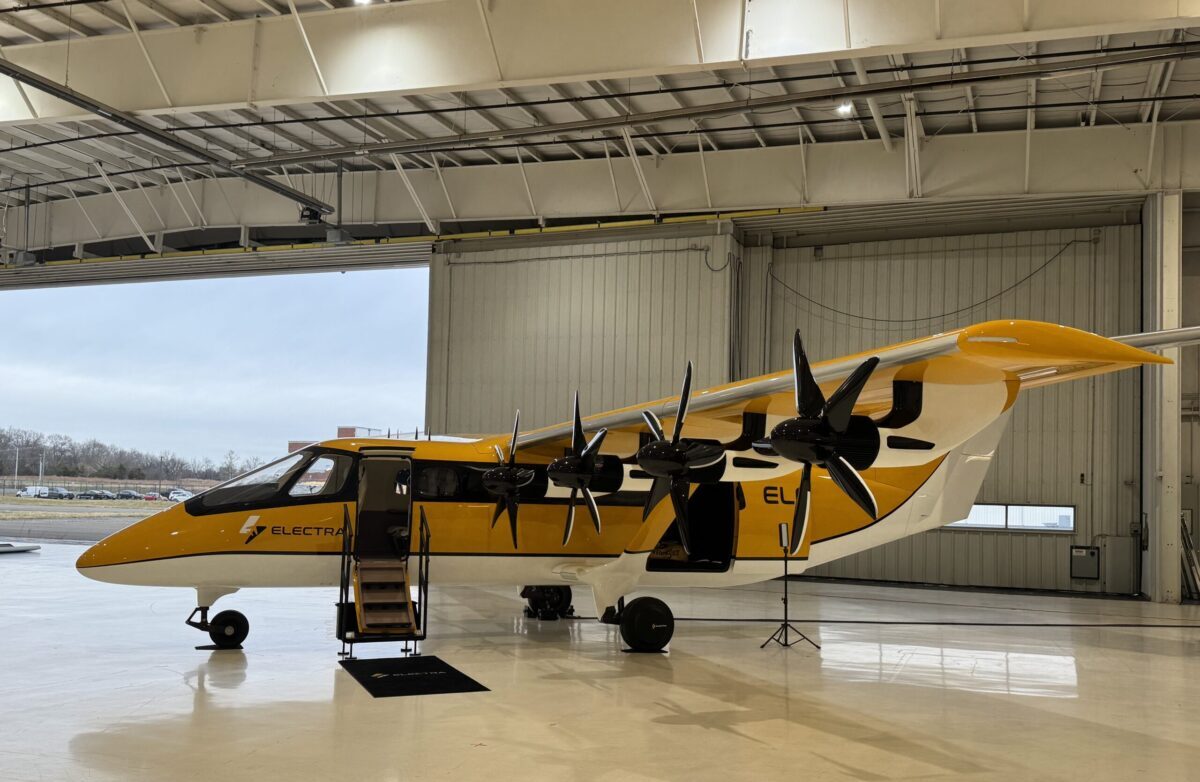
The Virginia company is seeking to certify its nine-seat aircraft, which is to be propelled by a hybrid powertrain in which a gas turbine turbogenerator drives electric motors, under FAA’s existing Part 23 regulatory pathway. But the EL9 is also being designed to take off and land in areas as small as 150 feet (45 meters), which Electra hopes will usher in a new era of “direct aviation.” In this concept of operations, passengers fly directly to destinations that are inaccessible with today’s airports.
“EL9 works in the system that exists today and delivers value in the way people operate airplanes today, and it has this capability to change the way people operate airplanes tomorrow and evolve from the one to the other,” Chris Courtin, Electra’s head of technology development, told Staff Reporter Paul Brinkmann during an on-stage interview in the exhibition hall here.
Below are selected excerpts of their conversation, condensed and lightly edited for clarity.
A: The basic idea is you can use blown lift to make a fixed-wing aircraft take off and land in and out of [an area the size of] a soccer field — a 150-foot ground roll. So you can keep the fixed-wing simplicity, safety, cost structure, regulatory pathways, but give this novel access capability.
A number of other side benefits — noise cost, emissions reductions — all come together in this package, and that all is enabled by the blown lift, which is using the distributed propulsion from electric propulsion. And electric propulsion is great for this, because you can really easily put a lot of electric motors on an airplane, and that allows you to blow the air over the wing.
The simplest way to think about this is the airspeed that the wing sees is a lot higher than the actual airspeed of the aircraft, and so it can generate a ton of lift at really low speeds. That gives you the short takeoff and short landings.
A: It’s interesting because it’s both a very new and very old idea, this idea of doing powered-lift augmentation and making the wing work harder at low speeds by integrating it with the propulsion system.
People have been doing that even way back to the 1930s, but really the ’60s, ’70s, ’80s, there was a lot of really incredible NASA airplanes doing that. Where the novelty comes in with electrification is you’re always challenged with how much you want to distribute the propulsion, versus the practical limits that you have to work around in terms of being able to do flight control and not having 20 turbine engines on an aircraft, because that’s not really practical.
Electrification allows you to do that. It gives you a huge amount of freedom, but then you have to figure out how to use that freedom and evaluate all the design options in that space. That’s kind of the real novelty: how many motors, where do they go relative to the wing, et cetera, and all that works together to make the concept [work].
A: When you think about the takeoff and landing performance, normally you figure out what the stall speed of your aircraft is and back out your takeoff and landing performance from there. But the blowing effect is really strong, and it does a really good job of essentially preventing that wing from stalling, or delaying the stall to extremely high angles. And so that normal way of thinking doesn’t really apply.
A lot of the early [research] effort was looking at this in terms of all the real physical constraints — tail strike, rotation power, pitching moments. All those things kind of come together. And then being able to figure out how to turn the knob for each element of the aircraft design — where the props go, what the tail looks like — to get the result that you want.
A: There is. The “above and below” thing is a question we get a lot. That’s an interesting aspect of this, and that really comes back to the propeller placement and how that interacts with the different flavor of things you care about. There’s a little bit of blowing over the top of the wing that really helps increase the stall angle, but the more blowing you do higher up, the higher pitching moments you get. So doing a lot of under-wing blowing helps with both making the flaps work and keeping the pitching moments down. That all trades off with the tail size you need, and then drag and cruise and on and on — so there’s a lot of complicated interactions.
A: One of the big things that we’re focusing on right now is making this a dual-use military and civilian technology. In the civilian world, we’re passenger first. We have a lot of interest from small airlines, regional carriers, people who are working around capacity constraints at major airports, trying to get people in and out of those really congested airspaces. But we also have cargo operators, so there’s a whole spectrum of people that are interested in this.
A: Electra is a good example of a really good development of a novel technology through military-commercial partnership. The EL-2 started as this academic research concept that then rolled into a startup company that had a lot of commercial venture funding associated with it, but a lot of the early development — the testing of the wings, the development of the hybrid system, the development of some of the early flight control laws — was all done through the SBIR [Small Business Innovation Research] and STTR [Small Business Technology Transfer] programs.
That then allowed Electra to move into the next phase of commercial fundraising and start to deliver a real product, which will have benefits both in the civilian end and in the military market.
A: It is. The strongest selling point of the airplane depends on who you’re selling it to, but in general, the desire to use less fuel and fly more cheaply is never going to go away. There’s also a lot of flexibility in how you use the aircraft.
People on short-range missions who really want to optimize emissions reduction can discharge the batteries to use less fuel and get some further savings. People who want to really maximize battery life and are interested in the low noise or the access features of the aircraft can optimize the battery life and have lower costs that way. So there’s all sorts of tradeoffs that you can do to make this affordable.