
NASA’s Artemis II lifts off, beginning first crewed moon mission since 1972


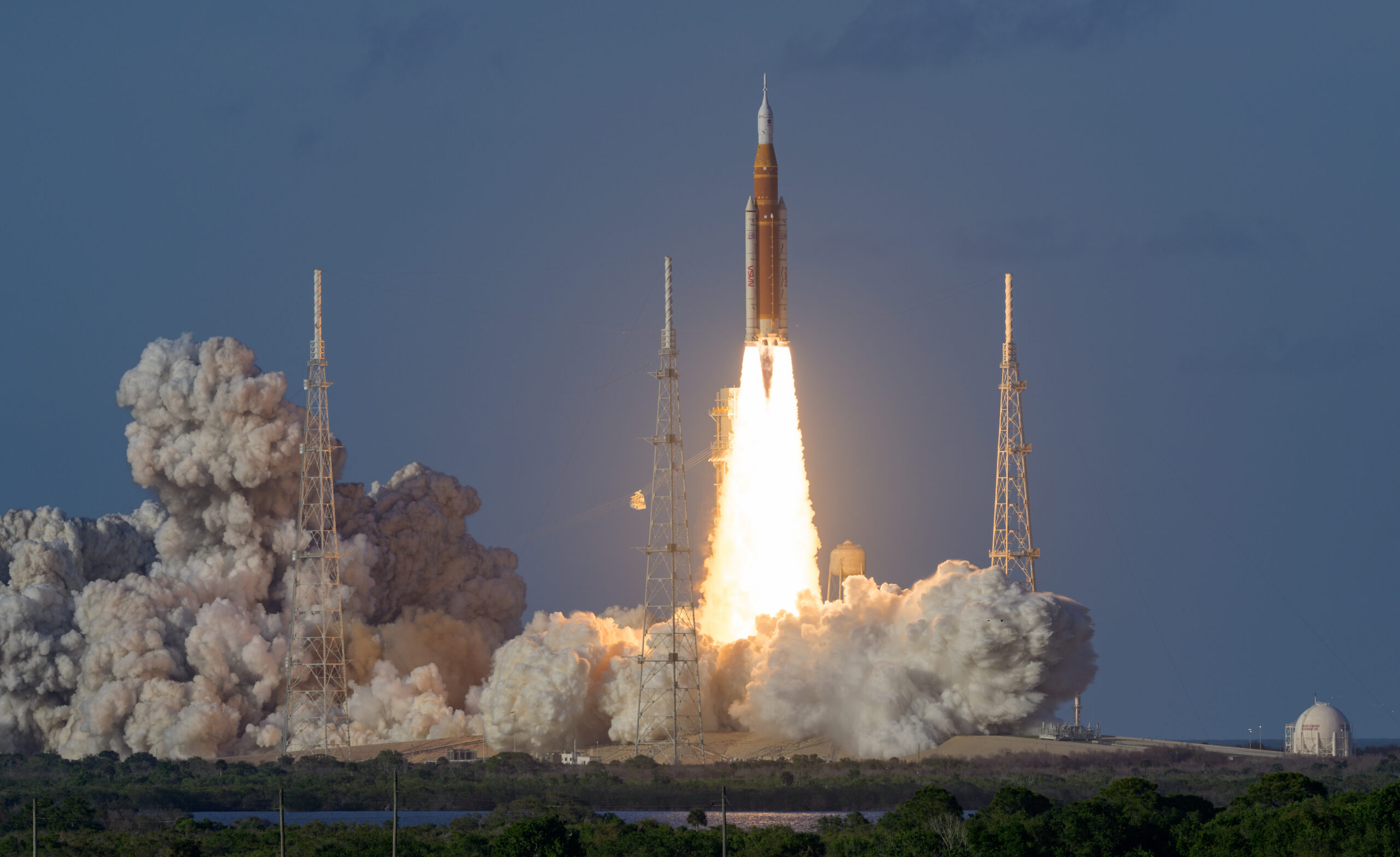
KENNEDY SPACE CENTER, CAPE CANAVERAL, Fla. — NASA’s first crewed lunar mission in over 50 years began today when the towering SLS rocket lifted off at 6:35 p.m. Eastern, leaving behind a thick, white plume as it ascended into the blue sky over Cape Canaveral and disappeared over the Atlantic.
Inside the Orion crew capsule atop the rocket are NASA’s Reid Wiseman, Victor Glover and Christina Koch, and Canadian astronaut Jeremy Hansen. Over the next 10 days, they are to loop around the moon and return to Earth for a splashdown in the Pacific Ocean, marking a critical step toward NASA’s goal of returning humans to the lunar surface in 2028.
Glover is the first Black astronaut to fly on a lunar mission, Koch is the first woman, and Hansen the first Canadian.
“On this historic mission, you take with you the heart of this Artemis team, the daring spirit of the American people and our partners across the globe, and the hopes and dreams of a new generation,” Launch Director Charlie Blackwell-Thompson told the astronauts shortly before liftoff, after the final launch poll of engineers and technicians. “Good luck. Godspeed.”
Nine minutes after liftoff, Orion and the crew reached Earth orbit, where they are to remain for roughly 24 hours as the astronauts confirm the capsule’s systems are working as planned. The next big milestone is slated for Thursday evening, when Orion will fire its main engine in a translunar injection burn to send it toward the moon.
The overarching purpose of this Artemis II mission is comparable to that of Apollo 8, in that the 1968 flyby demonstrated many of the technologies required for the Apollo 11 lunar landing. Similarly, Artemis II is to demonstrate various technologies and techniques, including Orion’s life support systems and navigation and control performance.
NASA’s original plan called for the next flight, Artemis III, to be the program’s inaugural landing, touching two astronauts down near the lunar south pole. However, the agency in late February adjusted its plans to more closely resemble the Apollo cadence, converting Artemis III into a rendezvous and docking demonstration in Earth orbit — akin to Apollo 9 — in which Orion will dock with one or both of the commercial lunar landers in development. That test is targeted for 2027, potentially setting up landings in 2028 with the Artemis IV and V missions.
The feasibility of that schedule now partly hinges on the outcome of Artemis II, which will send the crew farther from Earth than humans have traveled since the ill-fated Apollo 13 in 1970.
NASA had originally hoped to launch as early as February, but instead had to spend weeks addressing SLS anomalies that popped up during pre-launch tests and required rolling the rocket back to the Vehicle Assembly Building before returning it to the launchpad. Ground teams had to replace seals to remedy leaks in the hydrogen lines of the rocket’s core stage and an irregular flow of helium to its upper stage, challenges that were also encountered in the leadup to the Artemis I uncrewed demonstration in 2022.