
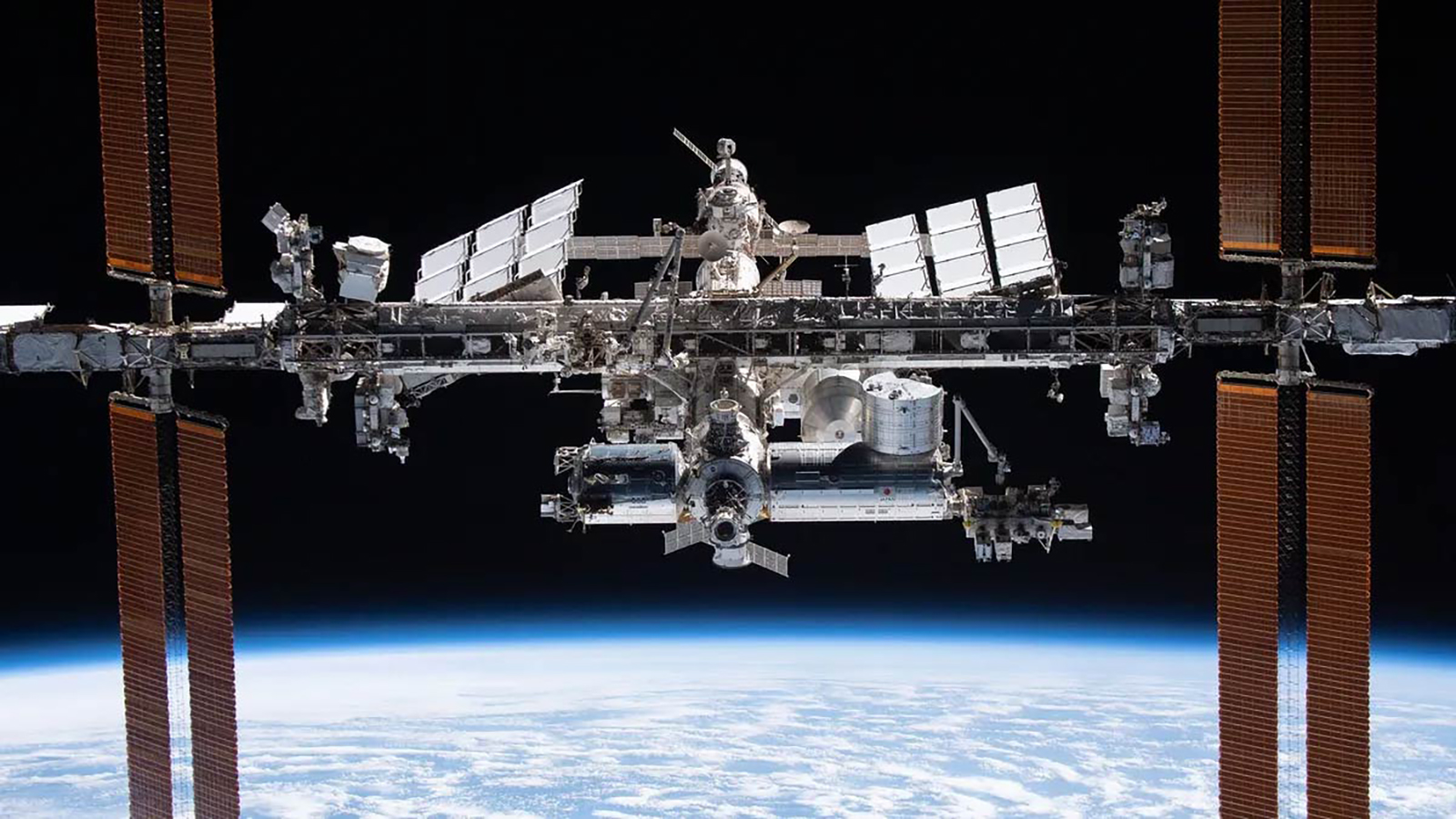
The International Space Station in 2021. Credit: NASA
WASHINGTON, D.C. — If the continuous presence of U.S. astronauts on the International Space Station the last 25 years represents the country’s past efforts to maintain influence in low-Earth orbit, the future is partnerships with industry, according to NASA Chief of Staff Brian Hughes.
Speaking at the U.S. Chamber of Commerce’s Global Aerospace Summit here on Tuesday, Hughes said the next phase of the agency’s Commercial Low Earth Orbit Development Program will be structured “so that the best and brightest in the commercial space can come and see what the next steps are.”
NASA intends to select multiple companies developing space stations for additional funding under Space Act Agreements, instead of selecting just one provider to receive a firm-fixed price contract as was the previous plan. The final solicitation for proposals is to be released by Oct. 4.
ISS, which is scheduled to be retired in 2030 and deorbited by early 2031 from its orbit 400 kilometers above sea level, has shown “the dominance of American innovation,” Hughes said, but a transition to privately owned and operated stations would allow NASA to access LEO for research and other purposes at a reduced cost to the American taxpayer.
“We have partners that have been working on commercial LEO platforms in a variety of ways, but we really want to put that into hyper speed and get to a place where we’re making the next big steps, and it is driven by the gap,” he said.
He indicated that this would require additional industry research. “NASA has driven this program for 25 years, so it’s time for us to help develop a full market, figure out all the ways that we can commercialize, and look at some of the innovation in microgravity and all the different potential commercial interests,” he said.
This doesn’t entail fully “surrendering” NASA’s role in LEO, he said, but acknowledged the government is seeking to reduce costs. The White House’s budget proposal for fiscal 2026 cuts nearly 25% of NASA’s current budget, which has prompted concern and alarm from academics and other space-watchers.
Hughes pushed back on the notion that relying more heavily on commercial operators would increase risks, saying safety would remain paramount and that NASA looks forward to working with “very successful companies in the space for generations,” as well as newcomers.
“Commercialization isn’t about surrendering — only the private sector driving these things — but the transition right now for NASA is that the old model doesn’t work,” he said. “Low-Earth space dominance is important. We’ve got to find a way to do it in a leaner financial environment.”
In LEO, as well as NASA’s quest to return humans to the moon through the multi-phase Artemis program, Hughes emphasized competition with China as a driving force. He echoed Duffy’s previous comments that the U.S. is now in a “second space race” with China as its chief competitor.
The Artemis II crewed flight test around the moon remains on track to take place early next year, he said, with the Artemis III landing targeted to take place before the conclusion of President Donald Trump’s second term in 2029.
He also referred to NASA’s Fission Surface Power Project, which advanced in late August with a draft industry feedback solicitation for nuclear reactor designs that could generate 100 kilowatts or more of power.
“We’re committed to seeing a fission power source developed fully and implemented, hopefully by about 2030,” Hughes said.