
Magdrive’s plasma thruster proves its mettle in first orbital test
 By Paul Marks
 By Paul Marks
A high-power electric satellite thruster design thats use a sliver of metal as its fuel has completed its first round of firing tests in low-Earth orbit — holding out the prospect that thrusters could one day be refueled using metal scavenged by servicer satellites from space junk or mined on asteroids.
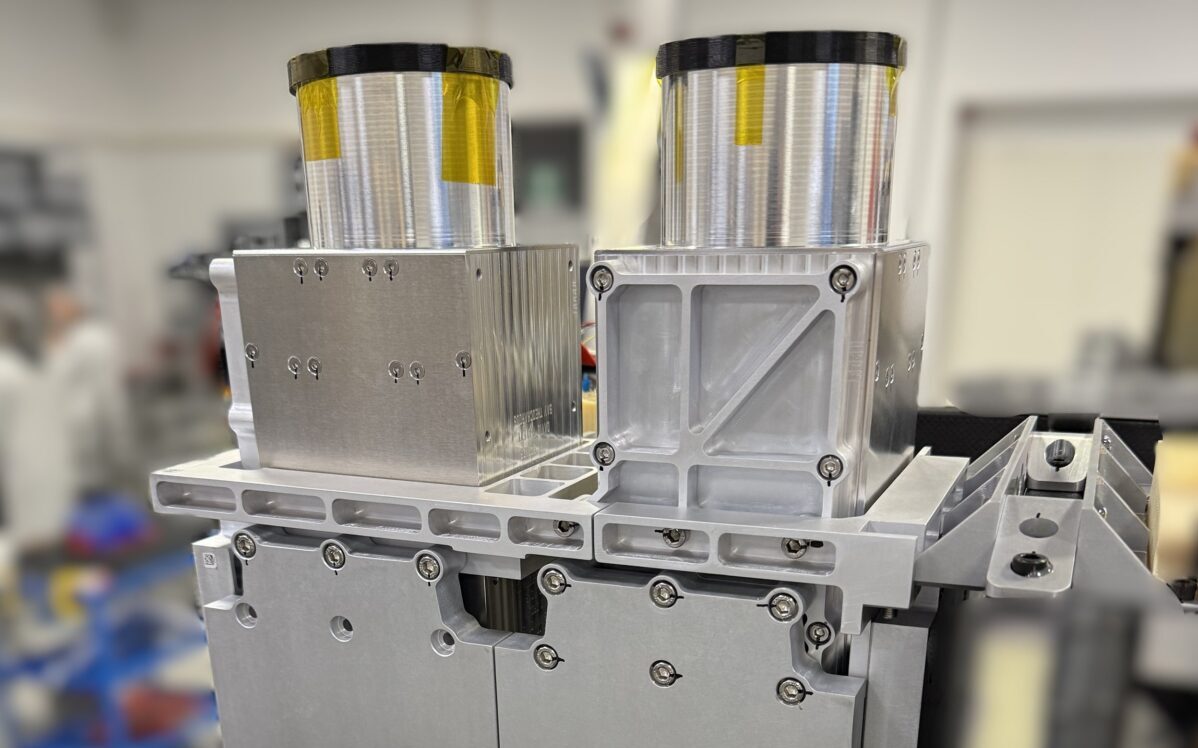
This Rogue thruster, designed and built by startup Magdrive of Harwell, U.K., relies on a bank of commercial off-the-shelf supercapacitors to punch electrical energy into a copper or aluminum target, producing bursts of a thrust-producing plasma, CEO Mark Stokes told me Tuesday.
The majority of satellites are equipped with thrusters that run on a pressurized, ionized gas like argon or xenon, which provide thrust in the region of tenths of milli-Newtons and eventually run out of propellant. By contrast, Stokes said the Rogue is designed to provide tens of milli-Newtons, use less fuel per manuever and eventually be refuelable.
“We want to take advantage of that higher thrust and higher efficiency and enable satellites to do more avoidance maneuvers, which is going to become absolutely key by the end of the decade, given the huge rise in the number of satellites,” he said.
He added: “And we want to enable them to do more rendezvous and proximity operations between satellites, which is key for satellite inspection and servicing.”
Producing plasma from metal with the tens of watts of power typically available on a satellite is no easy task, so the 3-kilogram Rogue thruster comprises, in large part, an electrical energy storage and delivery system. “Satellites aren’t usually running around with a kilowatt to a kilowatt-and-a-half of continuous power,” Stokes said. “That’s quite a demand on what satellites can do. And it would really price us out of the smaller satellite market, especially in low-Earth orbit,” if the thruster demanded such power levels.
“So instead, we draw in a variable amount of power, anything from half a watt to 150 watts, building up to 200 watts, and then we store up at least 10 kilojoules of energy in supercapacitors. And then we discharge it very rapidly — and with a combination of a high-voltage generator and a pulsed-power system, that allows us to shunt all of that power very quickly across the metal so fast that it detonates into a super-hot, dense plasma.”
Magdrive is in the process of patenting how it stores and controls electrical energy in its thruster range, but it’s keeping the format of the metal target, and the plasma injector it sits in, a trade secret. “That’s the part we don’t want to reveal, because if we did, people will be able to replicate the technology much more easily,” Stokes said.
However, patenting the storage method “gives us protection in other markets,” including nuclear fusion research, which also involves plasma generation and containment.
Those electrical systems feeding Rogue’s plasma injector involve a supercapacitor storage unit feeding a high current at low voltage into a high-voltage generator, which in turn feeds a pulsed power system that injects electrical energy into the plasma injector. And the amount of power delivered to the metal target determines how much plasma is produced and how much thrust — making the thruster software-throttleable.
But would it all work on orbit? To find out, Magdrive flew two Rogue thrusters as third-party payloads on a D-Orbit orbital transfer vehicle launched last June aboard SpaceX’s Transporter-14 rideshare mission. The mission received an unspecified amount of funding from the European Space Agency, which incubated Magdrive in its early stages.
Magdrive announced Feb. 9 its part of the mission had ended and the metal plasma thruster technology had been well proven, short of actually vectoring the D-Orbit satellite with Rogue thruster burns.
“We managed to test the whole thing, end to end, demonstrating that we can charge it up at different wattages, whether it is slowly at half a watt, or quickly with a full 150 watts. And we demonstrated that we can discharge that quickly or slowly and produce plasma,” Stokes said.
Going forward, Magdrive plans to tweak aspects of the design, including “propellant handling, injector mechanics and how we make in-orbit firmware updates,” the company said in an online update.
Those upgrades are to be tested on a future mission, the details of which Stokes declined to share just yet. “We do have it booked, but we haven’t advertised it yet. There are a few more details about it we want to shore up.”
He hopes the technology, when it reaches maturity, will spark a metal thruster refueling market. In addition to varying thrust via software throttling, magdrives — the company’s eponymous umbrella name for its thruster technology — can be grouped together to provide additional thrust capability. “This system would be sufficiently big that we can basically have a cartridge system, which refuels that metal propellant when it’s already in space,” Stokes said.
“Initially, we’d take it with us. But the really cool thing is that we’re talking to companies who want to make, and are making, recycling metal in space their entire business proposition, and they’re looking to use junk satellites, metal-rich asteroids or iron ore left over from lunar regolith mining and repurpose it to be propellant for metal thrusters. So a servicer satellite could deliver a new fuel cartridge.”