

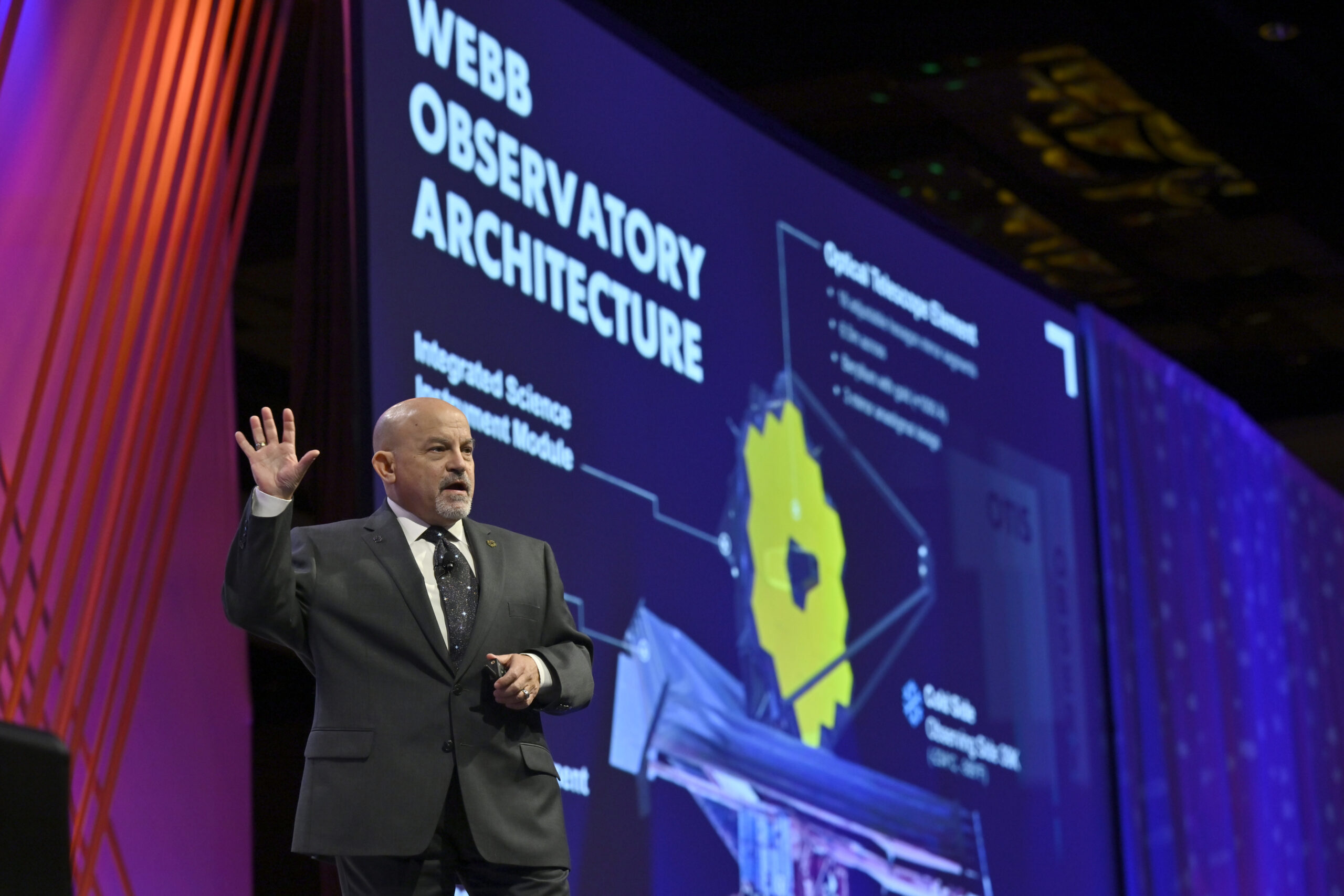
ORLANDO – The James Webb Space Telescope (JWST), the largest telescope ever designed, built, and still operating in space, was designed over the course of 20 years to accomplish one thing: take the universe’s baby pictures.
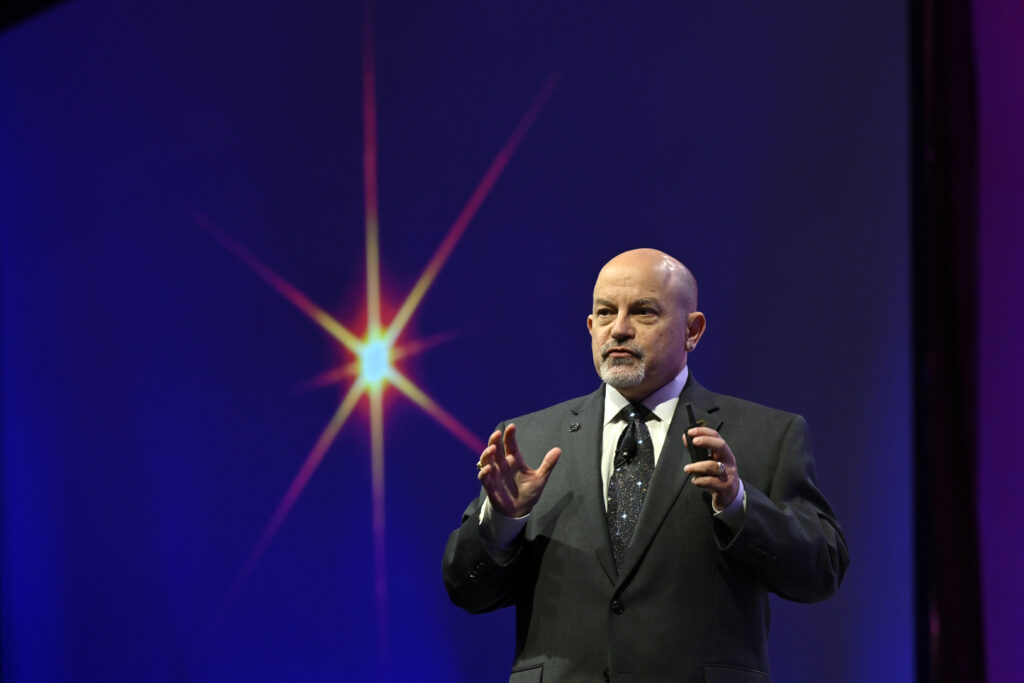
It has done that and more. Jonathan Arenberg, Fellow and Chief Mission Architect for Science and Robotic Exploration at Northrop Grumman, took the audience at AIAA SciTech Forum on a tour of the origins, specifications, and accomplishments of the 7-ton, 6.6-meter-wide eye that can snap the first photos of the universe’s newborn galaxies, starforming nurseries, and alien worlds, all just as the universe was learning to shine. “It’s a journey to the beginning of time,” he said.
During Arenberg’s plenary address on “NASA’s James Webb Space Telescope: Origins, Development, Operation and Lessons Learned,” he described a tale of ambition, ingenuity, and collective resolve that spanned continents, decades, and perhaps the very fabric of the cosmos.
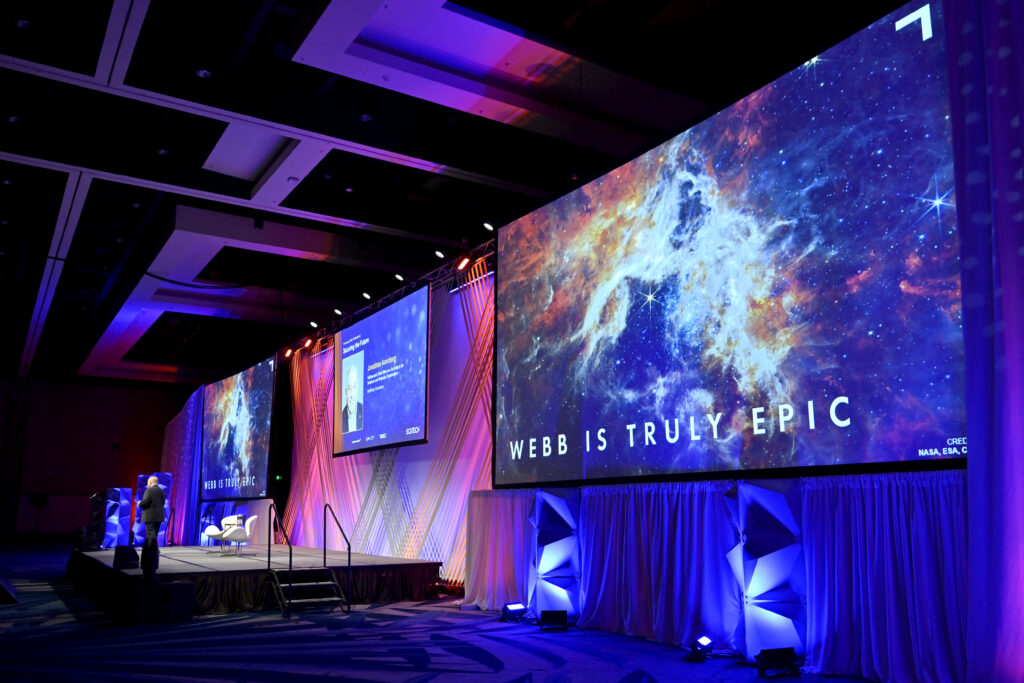
“The James Webb Space Telescope is not epic,” he started. “It is truly epic.”
It began with a simple premise, Arenberg said, build a telescope destined for orbit that is so large and sensitive that it could look farther back in time than any instrument before it.
The Webb would not be a simple upgrade of its predecessor the Hubble Space Telescope. At the heart of the house-sized instrument is a 6.6-meter primary mirror composed of 18 meticulously polished beryllium segments covered in gold meant to capture faint infrared whispers from the first galaxies that formed after the Big Bang. Thus, it was poised to answer the deepest questions about the birth of stars, the chemistry of alien worlds, and the evolution of the universe itself, Arenberg explained.
Turning that vision into reality demanded technology that didn’t yet exist. Engineers at Northrop Grumman led the industrial team, and NASA, ESA, and CSA had to invent it. This included structures that could hold the massive optical assembly together without warping under the stress of launch; mirror phasing algorithms capable of aligning each hexagonal segment to within a few nanometers, essentially stitching a perfect mirror out of many tiny pieces; a five-layer Kapton sunshield that would create a shadow to keep the optics colder than liquid nitrogen while the sun-facing side baked at more than 120°C; cryogenic detectors quiet enough to hear the faint glow of distant galaxies; and micro-shutters that could open and close in the vacuum of space to allow scientists to isolate individual celestial objects.
Each innovation was a gamble, Arenberg noted. Yet the team pressed forward, driven by the conviction that the payoff would be worth the risk. “No one ever said we’re not going to be successful,” he told the standing-room-only audience.
Arenberg painted a vivid picture of the observatory’s anatomy. The Optical Telescope Element cradled the primary and secondary mirrors and the Integrated Science Instrument Module (ISM), which housed the cameras and spectrographs. The Spacecraft Element provided power, propulsion, and communication. Encircling all of it, the colossal sunshield stretched 21-by-14 meters, casting an enveloping shadow that kept the cold side at a bone chilling –235°C.
The primary mirror, truly a marvel of material science, was a thin sheet of beryllium coated with a nanometer thin layer of gold – perfect for reflecting infrared light. Arenberg described the sunshield’s five layers of Kapton, each coated with reflective aluminum, acted like a cosmic parasol, shielding the delicate instruments from the sun’s relentless heat.
The team refused to rely on theory alone, so they built full‑scale replicas, ran parallel thermal and structural models, and subjected every component to the harshest conditions imaginable. Small‑scale sunshield demos, cryogenic chamber runs, and vibration tests mimicked the launch’s brutal forces. By the time the telescope was ready for launch, every bolt, sensor, and algorithm had been exercised in a setting that left no room for surprise, Arenberg said.
He emphasized that verification began long before the spacecraft left the ground. Early papers from the 2000s outlined a verification roadmap that treated each subsystem as a flight‑ready unit. Redundant models ran side by side, constantly cross‑checking each other’s predictions. This layered approach gave engineers confidence that the telescope would behave exactly as expected when it floated in the void of space.
Once launched and the Ariane 5 rocket cleared of Earth’s atmosphere, the Webb began its ballet: Over 14 days, 178 devices and 50 deployable structures unfurled in synchronous precision. The sunshield blossomed like a metallic flower, the mirror segments unfolded and began their painstaking alignment, and the ISIM slipped into place.
Within a month, the telescope had sailed to its destination – the Sun–Earth L₂ halo orbit around the sun, almost 1 million miles from Earth. About 55 days after launch the observatory cooled, allowing the wavefront sensors to finetune the mirror alignment. Arenberg explained how when the adjustments were complete, the telescope boasted a wavefront error of just 70 nanometers, a level of precision that would have seemed impossible a decade earlier.
The moment the first images streamed back, the world gasped. He described when the telescope’s near infrared camera captured the silhouette of a hot gas giant, WASP96 b, revealing water vapor in its atmosphere. Deepfield shots of galaxies hidden behind the massive gravitational lens SMACS 0723 pushed the observable horizon farther than ever before. It could detect the composition of galaxies and, in this solar system, the telescope delivered breathtaking views of Neptune’s storms, the icy plumes of water of one of Saturn’s many moons, Enceladus, and the enigmatic rings of the centaur Chariklo orbiting the sun. He showed the audience its very first image that revealed galaxies where scientists assumed there would be nothing.
Arenberg was astonished when the telescope revealed the spectra of stars in galaxies far, far away. Completely unexpected, the spectra revealed signatures that should not have been possible in the early universe. He asked his scientist colleagues what they thought, and they replied simply that they would have to rethink stellar evolution.
Interwoven throughout his talk were intimate glimpses of the people behind the undertaking. He reminded the audience that families and personal sacrifices powered the mission. The motivational slogan “Practice, practice, practice!” captured the relentless rehearsal that kept the team prepared for any contingency.
Among the lessons learned:
- Modeling early on was critical. It was the only way to get accurate predictions on thermal, structural, and optical performance that guided every design decision.
- Verification was considered from the very earliest days, so that the team would be assured Webb would perform as intended.
- Operational flexibility was absolutely necessary. Training and rehearsals allowed the team to respond to unexpected shifts without jeopardizing the mission.
These insights, he said, will shape the next generation of space telescopes, such as the Habitable Worlds Observatory (HWO) scheduled to launch in the 2040s, which he is already attending conferences on. Arenberg reported that the observatory has full redundancy with Webb’s lifetime estimates from 2035 to 2063 depending on assumptions.
As Webb continues to return data new questions emerge. Each new spectrum and deeper image adds a chapter to the story of the cosmos that began with a willingness to push technology beyond known limits, Arenberg argued. The Webb is a beacon of scientific discovery, but also of what humanity can achieve when we pool our intellect, resources, and imagination, a true act of collective will and genius.