

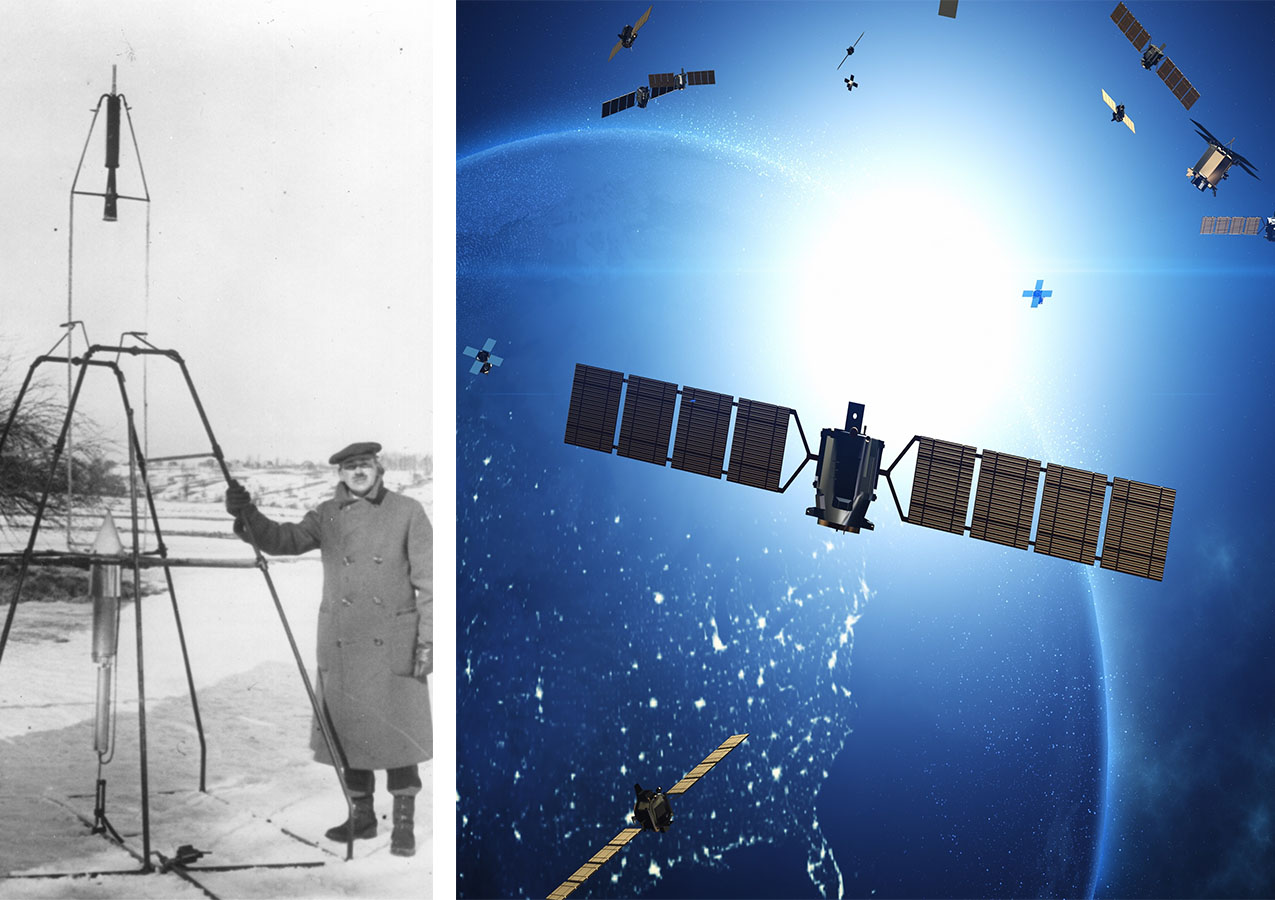
This March 16th will mark the 100th anniversary of Dr. Robert Goddard’s historic first flight of a liquid propulsion rocket, back in 1926. That flight is rocketry’s closest equivalent of the Wright Brothers’ first flight of an airplane at Kitty Hawk in 1903. And just like the similarly historic Kitty Hawk flight, Goddard’s pioneering first liquid propulsion flight opened the way to a world-changing future that all of humankind benefits from today.
The advances in rocket propulsion, guidance, and control that Dr. Goddard pioneered from the 1920s to the 1940s led to virtually every modern launch vehicle and in-space propulsion system flying today. Most of what we have as a spacefaring species today would not have been possible without liquid propulsion. That includes communications satellites, human spaceflight, Apollo’s historic exploration of the Moon, and the robotic exploration of our solar system; it also includes space astronomy as we know it, the Space Shuttle, the widespread surveillance and Earth monitoring satellite systems we have, as well as space stations, orbital space tourism, GPS, and more.

It is profoundly regrettable that the import of Dr. Goddard’s pioneering efforts in rocket propulsion was largely unappreciated before his passing in 1945, and also that he didn’t live to see rocketry’s rapid advancement in the 1950s and 1960s, leading to satellites, to human space travel, and even to humans landing on the Moon comparatively soon after his passing.
Today, however, with a full century of progress and perspective since his first rocket flight, we now have the perspective to see the incredibly pivotal and profound contributions that Dr. Goddard made, and so in turn, to see his historic and pioneering legacy.
Let us widely celebrate Dr. Goddard’s achievements this month, at every space company, at every government agency that benefits from space, in every professional society and industry association of engineers and scientists and businesspeople who benefit from space, in the financial industry that both profits from and makes so much of today’s space economy possible, and across the globe.
As engineers, technologists, teachers, leaders, and mentors in aerospace, let us all also share the significance of Dr. Goddard’s game changing contributions to the public, to students, to journalists, to leaders across the world, and to future generations.
Hail Dr. Goddard, and thank you! Your courage against naysayers, your inventiveness, your technical prowess, your perseverance, and your legacy are an inspiration to those of us, a century after you, who walk in your footsteps.
And let us hope that our time’s contributions to rocketry and spaceflight can be looked upon as similarly impactful, a century from now, in 2126.
Get Involved in the Goddard 100th Year Celebration!
Students, rocket enthusiasts, and historians are planning events across the country during March to celebrate modern rocketry. On Monday, 16 March, rocket clubs all over the United States, including NAR, TRA, ARC, and ESRA, plus schools and science centers will fire off small, medium, and large rockets (even stomp rockets) to celebrate Goddard’s achievements. Order your own 1/5-scale Goddard rocket model from Estes Rockets.
Throughout the week of 16 March, be part of an event at the original site of Goddard’s launch in Auburn, Mass. Attend a special space‑themed event at the Hanover Theatre & Conservatory, Worcester, Mass., culminating the week-long series of events in Goddard’s hometown. Tickets are free. RSVP required. Sunday, March 22, 4:30–6 p.m.
Learn more about the Goddard Centennial Celebrations: firstlaunchcentennial.org.