


ORLANDO — In today’s race with China for AI superiority, the United States must use quality data, lean into the right use cases, and keep humans front and center when validating results, urged Craig Martell, vice president and chief technology officer at Lockheed Martin, at AIAA SciTech Forum on Wednesday.
“The Department [of Defense] is right in pushing hard for AI,” said Martell, referring to the latest memos calling for Pentagon-wide adoption of AI.
Lockheed Martin’s CTO understands the pressure facing the Department well, having previously served as the first Chief Digital and AI Officer (CDAO) in the Department of Defense. At the time Martell was tapped to be CDAO, he ran machine learning at Lyft. The rideshare startup used a highly optimized learning algorithm designed to optimize maps and rider pickups for the American riding public nationally.
“The work was cutting edge, and it was really high compute, but not quite as high compute as large language models,” he recalled.
Data Imperative
For Martell, the AI push is about a hierarchy of needs centered on high-quality data, with the technology only as good as the data that feeds it. “If you don’t have high-quality data, your AI is not going to be meaningful,” stressed Martell, who defines AI as simply statistics at scale: “You gather data from the past to build a model to predict the future. There is no thinking, there is no cognition, there is no magic,” he added.
Joining Martell on AIAA SciTech’s stage was Ylli Bajraktari, president of the Special Competitive Studies Project (SCSP), a non-partisan and non-profit project that provides recommendations for how America can strengthen its long-term competitiveness as emerging technologies reshape the country’s national security, economy and society.
Back in 2018, long before Generative AI (GenAI) took the world by storm, Congress heard from the private sector that a big technology was coming and the United States wasn’t prepared, recalled Bajraktari.
China’s Early AI Move
“China already had a strategy, they were investing and they had a top-down infrastructure for how they were going after making China the world-dominant AI player,” explained Bajraktari, who worked for 12 years in the Pentagon when he was asked to help organize a congressional commission to determine how the DoD and the intelligence community could do more with AI. The resulting 750-page report spurred the decision to launch SCSP in 2021.
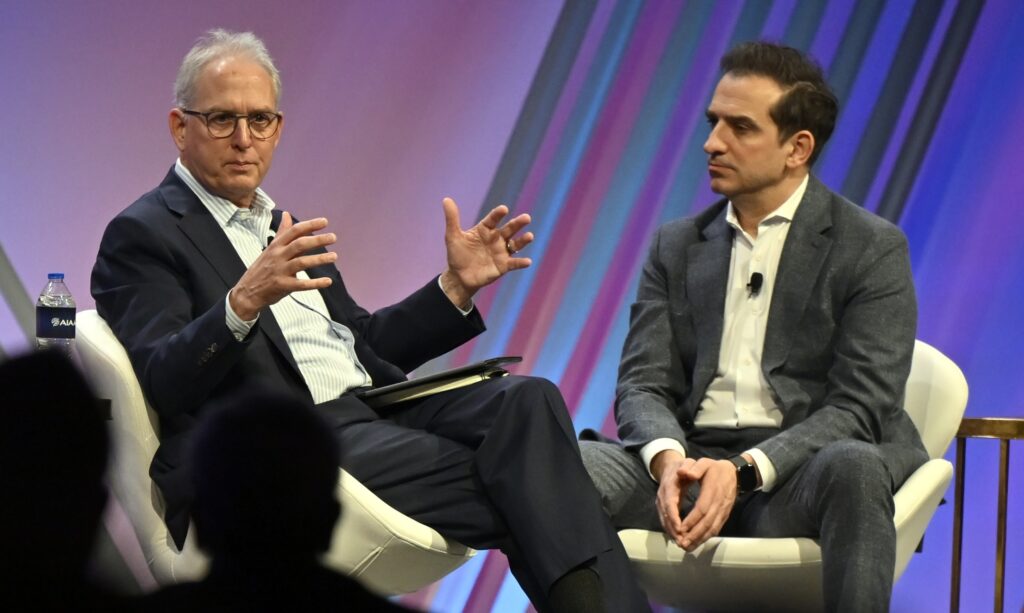
Both Martell and Bajraktari agreed on many aspects of AI adoption, which tends to be slower in the government than in commercial industry because of regulations. That works to the government’s advantage, observed Martell, when it comes to validating models.
He advised companies to wrap or integrate validation into their AI systems. “Be a good engineer about everything: what are you trying to achieve? How do you measure that you’ve achieved it? Do these tools achieve it?”
When looking at where to apply AI in defense, Bajraktari sees four major areas: back-office applications, indications and warning (I&W), high-level decision-making, and lethal autonomous weapons systems.
“It’s really important as we’re learning these tools, the onus of the output is still our responsibility,” cautioned Martell.
The two AI experts also looked ahead to the future, with Bajraktari predicting, “In the next five years, we will be neck in neck competition with China.”
“We’re there now,” Martell quipped back, with Bajraktari responding that this constant dynamic competition may never end.
Lessons from 5G Race
Bajraktari observed that the United States could wake up in 2030 and find that all its AI data is being routed through Beijing if the country doesn’t take the AI race seriously. He cited how China came to dominate the 5G market globally by heavily subsidizing its domestic 5G provider, Huawei, so it could deploy the broadband service globally.
“I remember in 2017 seeing this map of the world was all red – [showing] the digital 5G infrastructure built by China.”
Martell contended that the competition may not be about foundational models, algorithms, or even AI chips. “It’s really going to be about leveraging the capabilities we have on particular use cases,” he said. “What are the things we must have to be great? Let’s double down on those use cases, regardless of the tools or the chips.”
One thing is clear: AI adoption is critical.
Overcoming Fear of AI
A key hurdle is changing American mindsets about AI since many people equate AI to losing their job. Martell believes the opposite is true: “AI is just going to make you more efficient and better at your job,” he said, pointing out that the rise of the Internet created similar fears that didn’t come to fruition. He reiterated the need for skilled and knowledgeable workers to evaluate AI’s output.
However, Bajraktari stood firm that the fear is real in both the private and public sector, and it’s extended to college students who aren’t sure if they should study computer science because of AI’s potential to replace computational work.
“We need programs to retrain and reskill our people,” both speakers agreed, calling for universities to adapt to the new job skills an AI workforce will need.

“I thought the discussion about our race with China was very interesting when it came to China building out their 5G network and achieving dominance internationally. I thought it was very smart how Craig said we should focus on what we’re good at instead of trying to be a jack of all trades,” said AIAA SciTech attendee Srivishnu Addala, a mechanical engineering student at the University of California in Merced, Calif.
“I found the session very interesting, too, especially how AI has been around for quite some time. Even with what’s new, generative AI, it predicts the past to protect the future,” commented Benjamin Smit, a junior in aerospace engineering at the University of Kansas.
“There’s a lot of promise to AI. We just need to be careful about making sure we have the right data, which Craig emphasized, and the proper evaluation of it,” said Chris Reynolds, power and propulsion tech domain PM at Lockheed Martin.