

ORLANDO — A tiny plasma device may hold the key to a long‑standing problem in aviation: skin‑friction drag.
A thin strip of electrodes that ionizes the air (plasma) on an aircraft’s skin could make the aircraft more efficient, while using a minimum amount of energy. Thomas Corke, Clark Chair Professor of Engineering at the University of Notre Dame and the founding director of the university’s Flow Physics and Control Institute, explained that such a device can help a plane glide through the sky with less effort – without spending any more energy – by reducing drag, a long-standing challenge in aviation.
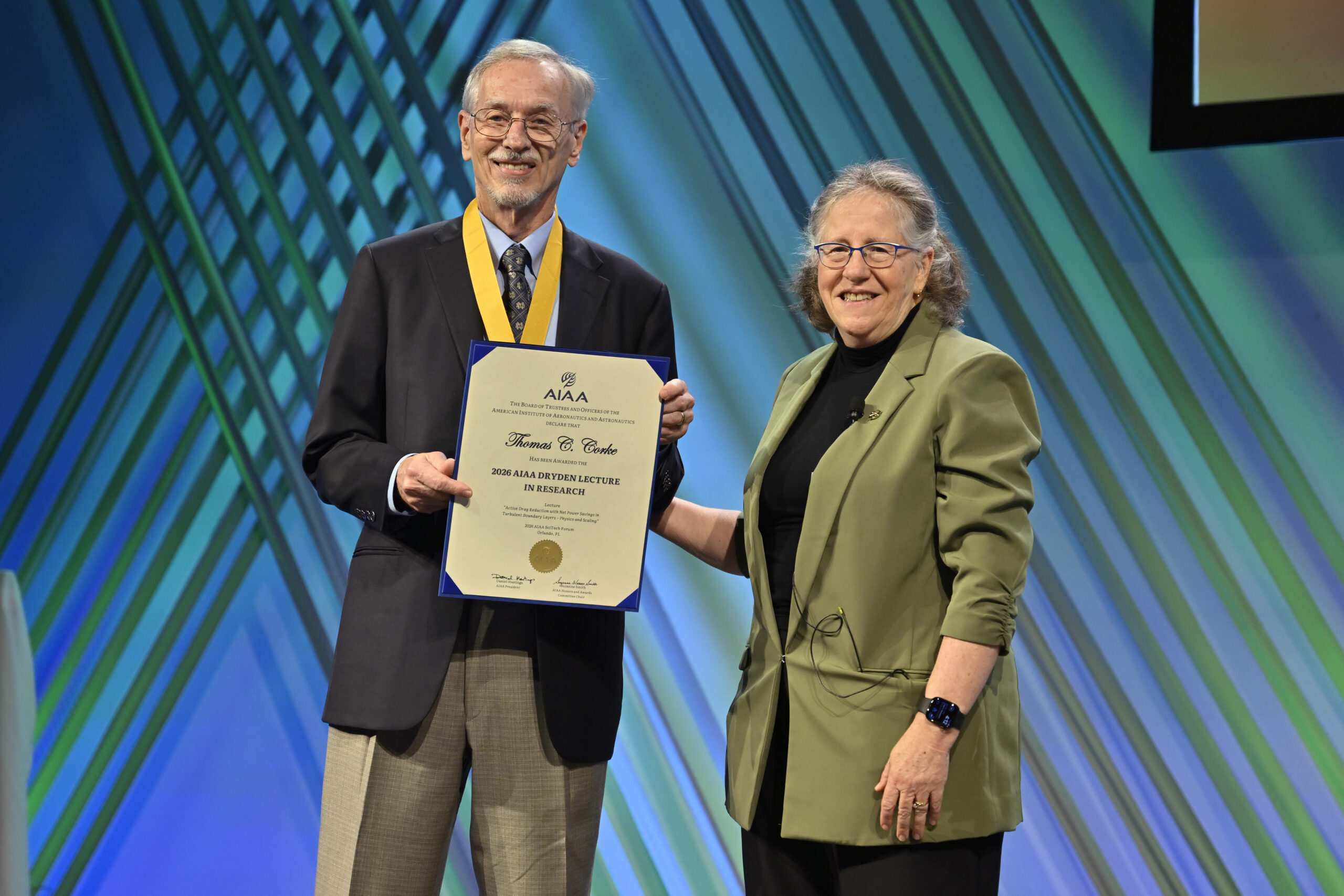
Corke presented his research on “Active Drag Reduction with Net Power Savings in Turbulent Boundary Layers – Physics and Scaling” during the Dryden Lecture in Research at AIAA SciTech Forum 2026 on 13 January.
All aircraft push air out of their way as they move forward. The thin layer of air that sticks to the surface – called the boundary layer – creates friction that resists motion, known as viscous drag. About half of the total drag on a cruising airplane comes from this source. If one could reduce the viscous drag, aircraft would burn less fuel, emit fewer emissions, and lower operating costs.
Trim just 10 percent off that friction drag, Corke said, and a typical 4,000‑nautical‑mile flight would burn about 9 percent less fuel. For a supersonic aircraft, where fuel can weigh as much as the payload, a 1% drag reduction could free up 5–10% more cargo or passengers. Reducing drag is a Holy Grail to aviation.
Corke, who has been working on this problem for 40 years, focuses on the tiny “streaks” that hug the aircraft’s skin. These microscopic vortices, only a few millimeters thick, are the primary generators of skin‑friction drag. Engineers have tried different active approaches toward reducing viscous drag in boundary layers. However, Corke pointed out that the power needed to implement them exceeded the energy (fuel) savings by a wide margin, rendering the concepts impractical for real‑world flight.
The beauty of this, Corke noted, is that the actuator draws only a few milliwatts per square meter of power – so little that it would not even light a small LED. Yet, in the laboratory, that tiny sideways push to the air is enough to disrupt the formation of the near-wall turbulent streaks, resulting in a dramatic reduction of skin‑friction drag.

Corke described his breakthrough: His team found a way to intervene the near-wall turbulence production mechanism of turbulent boundary layers without the energy penalty of other methods by using plasma actuators. Think of a thin strip of metal electrodes embedded beneath a protective coating on the aircraft’s surface. When a brief, high‑voltage pulse is applied, the air right above the strip becomes ionized, referred to as a plasma, the fourth state of matter. The process uses a dielectric barrier preventing arcing, so that the plasma is cool. This ionized layer, coupled with an electric field produced by staggering the electrodes, results in a force that gently pushes the air near the surface sideways. The steady, sideways-directed flow disrupts the turbulence production that is directly correlated with the viscous drag.
“For 40 years, people have tried various active approaches toward reducing turbulent boundary-layer drag,” Corke said. “Although there are numerous methods, none of these was capable of producing a `net drag reduction,’ where the energy saved by the drag reduction was more than the energy supplied to the actuator. We were able to accomplish this. The approach, if implemented, would lessen the weight of an aircraft by almost 5,000 pounds by reducing one drag count. What we accomplished would be capable of reducing 100 drag counts. It’s impressive and completely scaleable with Mach number.”
Corke explained how his research team built arrays of plasma strips and tested them in a Mach‑0.6 wind tunnel at Notre Dame. They first placed the actuators on a flat plate mounted on an air‑bearing sled, measuring drag directly with a sensitive load cell. By varying the spacing between the electrodes and the applied voltage, they discovered a clear pattern: closer spacing produced larger drag reductions, with the closest configuration reducing the turbulent skin‑friction component by as much as 80%.
As a means of testing the scaling, they applied the drag reduction approach on a half‑meter chord airfoil that spanned the entire tunnel. Across a speed range from Mach 0.3 to 0.5, the airfoil experienced a 44% drop in the viscous drag. Even more striking, at Mach 0.5, the energy saved by reducing the drag was 11 times that of the energy supplied to the actuator. Moreover, the experiments revealed that the faster the aircraft, the greater the energy savings payoff.
Using delicate sensors that detect tiny fluctuations in air velocity and placed just downstream of the actuators, the team confirmed that the plasma actuator array was impeding turbulent coherent motions. Corke said that when the plasma was active, three key observations emerged:
- The plasma was affecting the fundamental turbulence production mechanism.
- The frequency of short bursts that inject energy into the turbulent flow dropped proportionally to the drag reduction.
- The wall-directed vorticity associated with the wall “streaks,” a critical parameter in the control, decreased by roughly 58%, which confirmed the mechanism of control.
Corke pointed out that these observations reinforced the central hypothesis that a modest sideway near-surface air push can interrupt the cycle that creates turbulent streaks, thereby impeding the turbulence production, lowering the turbulence fluctuations levels, and producing less viscous drag.
He enumerated some of the advantages:
- Power efficiency – The electrical draw is minuscule. At Mach 0.5, the net power gain was 1,100%, meaning the aircraft saves far more energy than the plasma actuator consumes.
- Partial coverage works – The plasma actuators’ effect propagates downstream over a surprisingly long distance (equivalent to many dozens of boundary‑layer thicknesses). Thus, it isn’t necessary to blanket an entire wing or fuselage. Rather, strategically-placed actuator patches could deliver most of the benefit, keeping weight and cost low, while providing even larger net power savings.
- No laminarization risk – The plasma reduces turbulence intensity without converting the flow to laminar, thereby avoiding the danger of sudden laminar flow separation.
- Robust, lightweight design – The actuators are essentially flat electrode strips that can be applied onto the aircraft skin, with no moving parts to wear out.
But would it work on a full‑scale aircraft? Corke and his team can now design plasma‑actuator skins for anything from a business jet to a hypersonic vehicle without having to reinvent the physics each time. He described a case study on the MQ‑1 Predator drone. This indicated that applying the plasma actuator technology could extend the drone’s endurance up to 36 hours – a 50% increase – simply by burning less fuel. Similar calculations for larger aircraft suggest payload gains of several thousand pounds or range extensions of 5–10%, depending on the platform.
Corke noted that, beyond military applications, the implications for commercial aviation are equally compelling. A typical long‑haul flight burns tens of thousands of gallons of jet fuel, so even a modest drag reduction translates to millions of dollars saved per year and a significant reduction in greenhouse‑gas emissions. For supersonic or hypersonic concepts, where fuel can constitute half the vehicle’s take‑off weight, the benefits become even more pronounced.
With results showing a 50 percent drag reduction at Mach 0.5 and convincing evidence that the effect scales to higher speeds, Corke and his team have published their findings in the Journal of Fluid Mechanics (Volume 1016, 10 August 2025, A26 DOI: https://doi.org/10.1017/jfm.2025.10288). A research group in China also recently replicated the Notre Dame experiments and produced matching data, he told the audience.
As a next step in the development, the Notre Dame team members recently won a DARPA competition in which they will conduct a full‑scale flight test on a specially designed test article flown on a Gulfstream III aircraft operated by Calspan.
The aircraft will operate over a range of Mach numbers up to 0.8. Corke pointed out that if successful, this will be the first demonstration of active drag reduction in actual flight conditions. It would validate a new class of active flow‑control devices that deliver net energy savings, a rarity in aerospace where most active systems consume more power than they save. Further, the demonstration would provide a real‑world data set for computational modelers, accelerating the integration of plasma actuators into design tools.
The result of 40 years of research and his own fascination with drag reduction is a deep appreciation that even a tiny reduction in drag can translate into thousands of pounds of weight saved or significant extensions of range and payload, and a reduction in the carbon footprint, with the potential to improve future aircraft design and performance.