

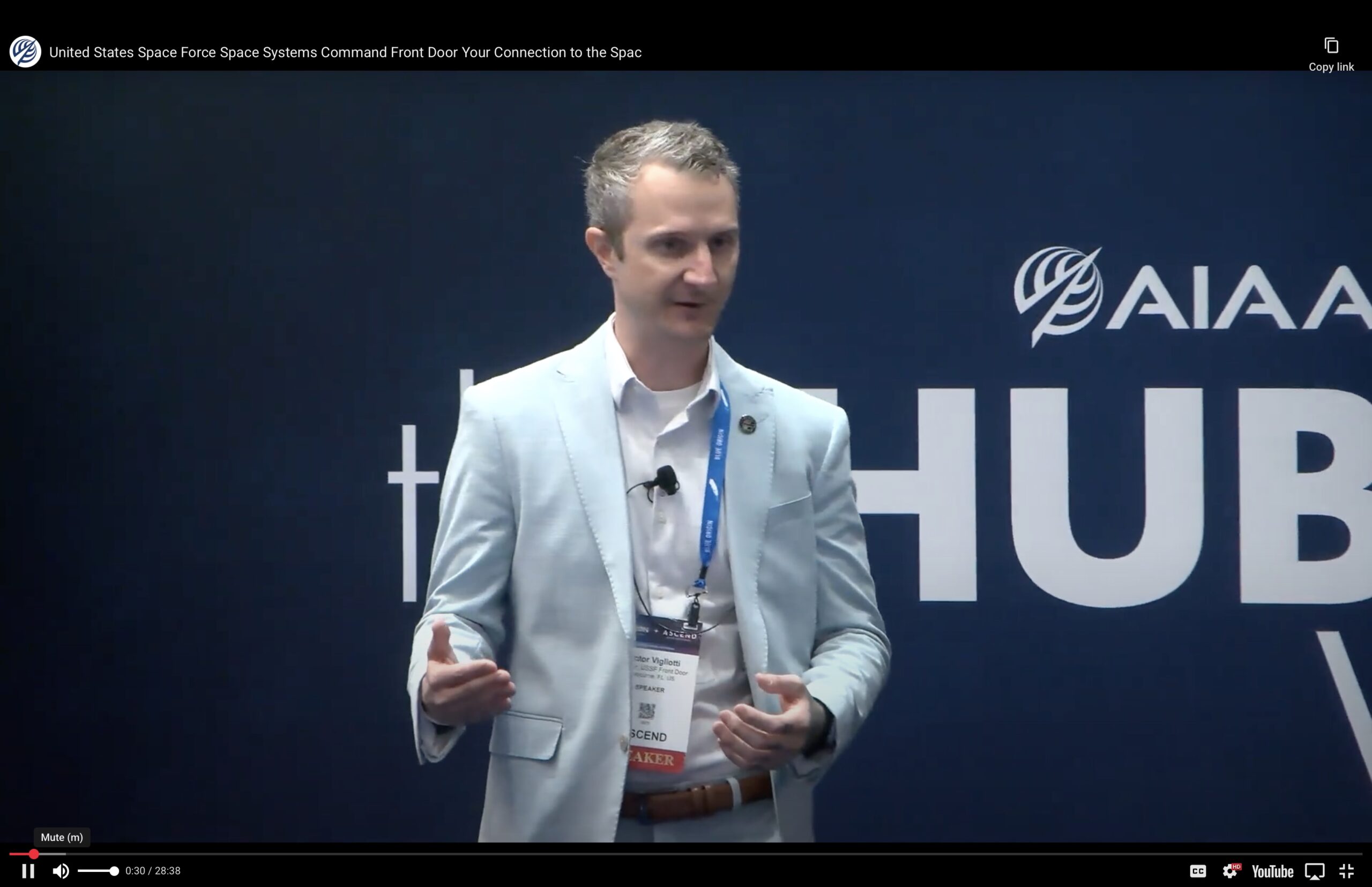
Companies that have a product suitable for space or defense often have a problem – “who ya gonna call”? There is no “Ghostbusters”-like hotline for engaging with the U.S. government procurement apparatus – but there may be an answer. Victor Vigliotti, director of the U.S. Space Force’s Front Door initiative, described a new effort to streamline doing business with the government during a Hub session at AIAA AVIATION Forum and ASCEND in July.
At its core, Front Door is a way to simplify the industry engagement process between government users and commercial companies in the space domain, Vigliotti said. Right now, a company with a novel antenna or a cutting-edge payload has to know exactly which person in which organization to call. And if you don’t know someone, you might miss out, even if your technology is exactly what the mission owner needs, he remarked.
“How does the DoD know about your capability if you only went to (NASA)? So that’s what we’re working to develop and again to simplify that process for you. We’re also trying to add you to what we’re considering an enhanced commercial space catalog.”
Instead of requiring vendors to become experts on every Space Force or Department of Defense (DoD) office, Front Door allows vendors to simply submit their capabilities—technology readiness level, capability briefs, and so forth, into a single unified portal.
Vigliotti’s team then performs a due diligence check (i.e., is the company real, are the founders legitimate, does the claim hold up to a quick technical review?), and then routes that submission to the right stakeholders—whether that’s Space Operations Command, Space Training and Readiness Command, NASA, the National Reconnaissance Office, or even international partners like the UK, Canada, and NATO.
One of Front Door’s most exciting spin-offs is the Orbital Watch initiative. Currently, Orbital Watch pushes unclassified, space-domain threat intelligence to commercial operators so they know when someone’s experimenting with jamming or suspicious rendezvous operations on orbit. The next phase goal is a secure, real-time portal, where vetted vendors can converse directly with Space Force operators – both during R&D and during active conflicts – to build more resilient satellites and ground stations, or even propose urgent new solutions.
Vigliotti emphasized that Front Door is not a magic ticket to an immediate contract award. Instead, it’s a market-research tool for acquisition professionals. Government buyers will be able to browse a growing Commercial Space Catalog – populated by vendor submissions – to find capabilities aligned with requirements. And because the Front Door team keeps a full trace record in a commercial customer relationship management system, nothing falls through the cracks, even when personnel rotate out of their jobs – a common complaint in the space industry.
Internationally, Canadian and British colleagues are already working on compatible portals, with NATO headquarters joining soon. Service firms and consultancies, not just hardware makers, are also welcome. The Front Door crew hopes that one day acquirers will consult this portal first, rather than Googling space innovation and reaching only the biggest primes.
Vigliotti noted that the Front Door team is constantly pushing updates – organizational charts, upcoming Space WERX challenge notices, threat alerts—through its public portal (search “USSF SSC Front Door”). And although lunar surface systems currently sit squarely within NASA’s domain, Front Door can immediately connect moon-bound vendors to the Artemis mission offices. By consolidating everything into one transparent gateway, the Space Force hopes to accelerate the pace of innovation, widen the supplier base, and ultimately strengthen U.S. and allied space capabilities.