

Forum Attendees Thrill at Motorsports and Aerospace Converging
ORLANDO — “You’re driving a car on adrenaline and playing a chess game at the same time. That’s what wins most of these races.”
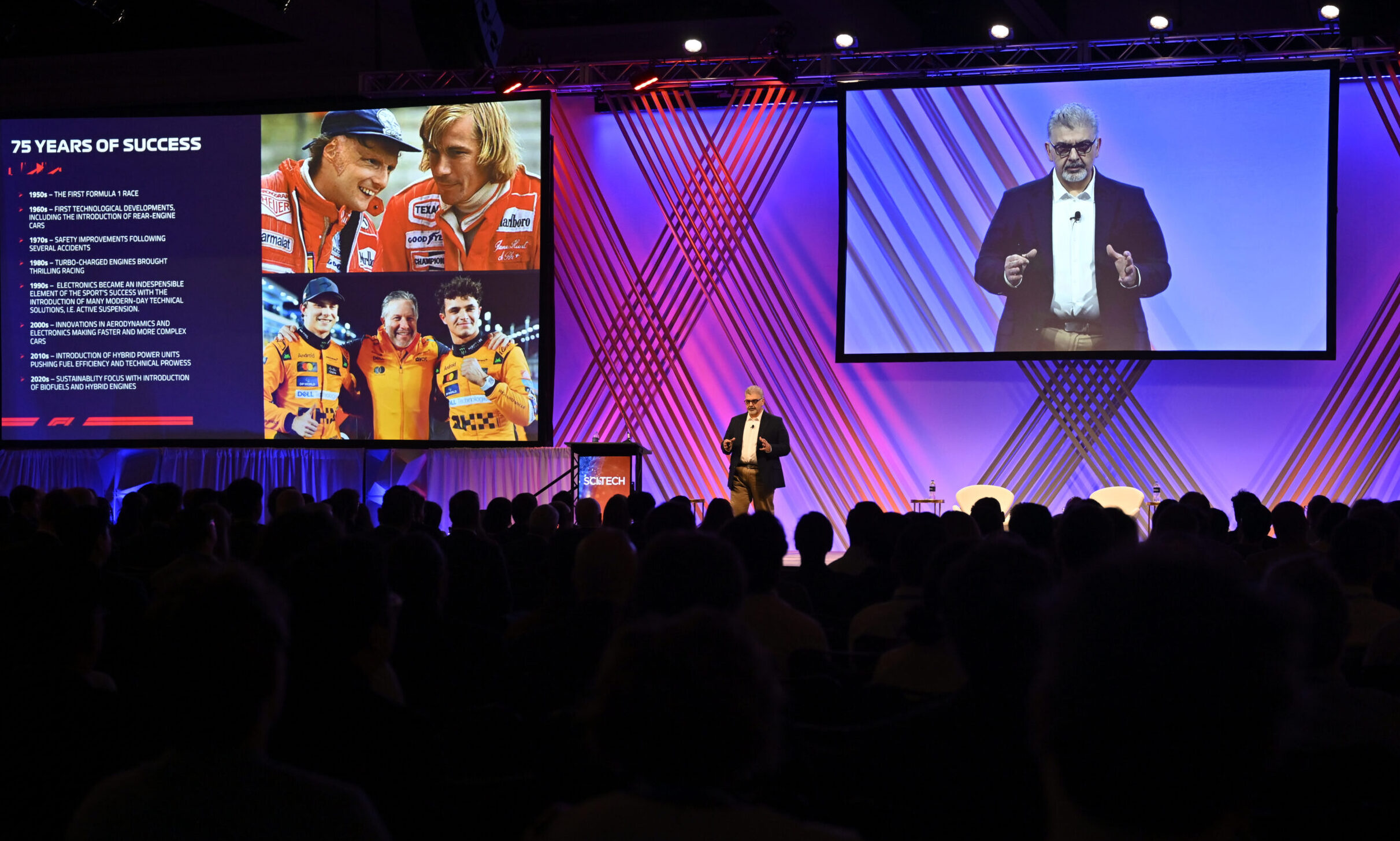
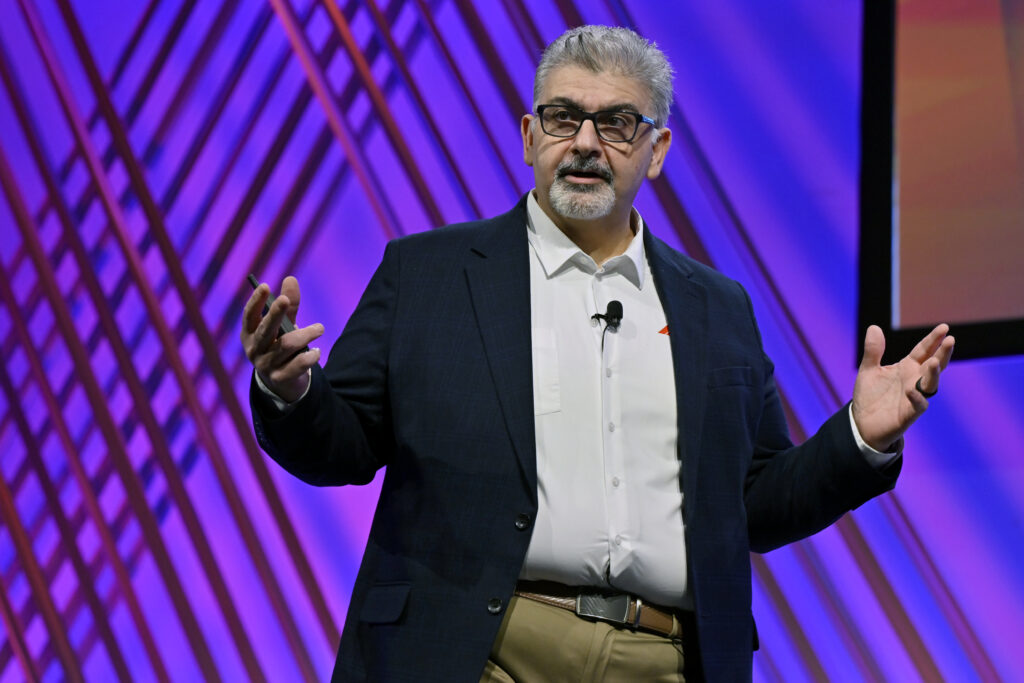
That’s how Arbi Karapetian, Formula 1’s new director of Innovation & Technology, described the highly competitive, tech-driven world of F1 racing on the second day of AIAA SciTech Forum.
“Most people think that Formula 1 is a sport of daredevils – high-profile drivers hurtling down the circuit at breakneck speeds, defying death at every corner,” stated Karapetian during the morning plenary. From the beginning, F1 embraced technology advances to give teams a competitive edge. At the same time, it’s also a race for technology development. “It’s the Super Bowl for tech with a competition every week,” he explained.
He joined F1 last April after nearly 25 years at NASA Jet Propulsion Laboratory (JPL). Karapetian’s transition from developing flight electronics and mission-critical systems for space missions to leading innovation at the world’s most-watched motorsports series may seem unconventional, but the underlying engineering challenges are strikingly similar.
Similarities to Space Sector
As a fan of F1 and a space expert, Karapetian has always considered motorsports “one of the few industries that has a lot of interesting similarities to space.”
For instance, both sectors work on fixed times: “There are planetary launch windows and there are race starts,” Karapetian said. “You either show up with a car on race day and [compete]; you either launch to Mars in that window, or you’ve got to wait 26 months.”
Also, once a race or a mission starts, there’s very few [physical] changes to be made to the car or spacecraft. “It pushes you to understand reliability and design and just attention to detail,” he said.
According to F1’s new innovation director, the most important factor in F1 and other industries’ success is adaptability to change. Since its founding 76 years ago, F1 has adapted, improving the performance and capabilities of race cars every decade: In the 1970s, it introduced rear engines and safety features; the 1980s brought carbon composites and turbocharged engines while the 1990s ushered in electronic controls and active suspension systems. Aerodynamics and hybrid power were focal points in the first decade of the 2000s, followed by fuel efficiency in the 2010s, said Karapetian.
Building on the sustainability and biofuel focus of the 2020s, F1 has ensured that all team cars this year will run on 50% electric power and 50% internal combustion, which will make managing battery recharging “a very complex thing.” They also will be smaller to be more competitive on different racetracks.
Karapetian added that other key technologies being developed and fused include modeling and simulation, digital twins, and applications of AI.
A Data‑Driven Sport with Aerospace‑Level Complexity
F1, he noted, is a massive data and telecommunications enterprise, with data generated from the cars, the track, and over 100 cameras around the circuit.
In addition, most of the 11 F1 teams have between 700 and 1,200 people working behind the scenes. For example, it’s not unusual for well over 100 engineers working around the clock just to produce composite carbon fiber.
Karapetian has seen a mutual camaraderie between F1 and aerospace engineers. That sentiment was reflected when Karapetian toured an F1 team’s control room and the tour guide asked him if the room resembled NASA’s Mission Control Center.
Since joining F1, Karapetian also has gained an in-depth appreciation for the company’s status as a cultural phenomenon. To date, F1 has attracted a global audience of 827 million, with 43% of its fan base under the age of 35 and over 4 in 10 fans being female. F1’s popularity has spurred both a 2025 motion picture, F1: The Movie, and a hit Netflix documentary series, Formula 1: Drive to Survive, that begins its eighth season in March.
Shared Technology
Karapetian highlighted several examples of common technology in aerospace and motorsports – sometimes originating in one sector, advancing in the other, and ultimately returning in improved form. The move to lightweight composite materials is one example. In addition, Moog aerospace hydraulic servo values have been adapted to be used in F1 active hydraulic suspension systems.
Both aerospace and F1 have contributed considerably in the development and advancement of digital twin applications. F1 teams now run digital twins of their cars during races, using live telemetry to simulate performance. Karapetian added that AI is currently being deployed in a number of F1 functions to increase reliability and accuracy.
Karapetian sees no end to innovation – it infuses every aspect of F1 operations. “F1 is a formula for worldwide innovation,” he concluded.
Fans Weigh In
The popularity of F1 was evident at AIAA SciTech with mega-fans like Taylor Fazzini, a doctoral candidate in systems engineering at Colorado State University and also in her fourth year as a member of the AIAA SciTech Guiding Coalition. “To see something that everyone thinks is a super cool, nerdy sport and push that into aerospace here is a breath of fresh air,” said Fazzini, who got into F1 racing when she and her husband were undergrads.
She described seeing her favorite sport on AIAA SciTech’s main stage as “a really weird collision of two worlds that are both so technical.”
“It makes sense that Arbi was at JPL for 25 years and then went to work at F1. All the aerodynamics and all the engineering are perfect matches for each other,” concluded Fazzini, who plans to travel with her husband to Belgium this summer to celebrate his birthday at an F1 race.
Another fan, Amanda Simpson, founder and CEO of Third Segment, shared fond memories attending F1 races in Long Beach, California, in the late 1970s. In one unforgettable episode, Simpson drove her 30-foot-long motor home around the course.
“F1 is like aerospace on steroids,” she said. “The opportunity for innovation and quick, rapid improvement is something that we can only dream about. I mean our projects are decades and theirs are weeks.”
Judi See, a systems analyst and human factors engineer with Sandia National Labs, enjoyed F1’s focus on innovation and how the company is constantly innovating. “What works today may not be what works tomorrow.”
See came to appreciate the brand’s efficiency and innovation after studying F1’s pit crew performance as part of her systems engineering master’s coursework. “Everyone knew exactly what they had to do to get the car out the door as quick as possible,” she said.
“I love the whole concept – it’s pretty much planes on wheels,” added attendee Peter Smith, an F-22 pilot who recently completed his master’s degree in systems engineering from the University of Arizona.
He said he found F1’s commitment to attract and train a new generation of female drivers through the F1 Academy inspiring. “I have a 14-month-old daughter, Sofia, and the idea of her being able to do something like that one day is just really cool.”