

The aviation industry is characterized by its agility and optimism. Every decade is more dynamic than the one before, as aerospace engineers design and test novel aircraft and optimize solutions to ground-based problems. The eVTOL Integration Pilot Program (eIPP) awardees, announced on 9 March 2026, mark an incredible example of coalition building for the future of aerospace.
We want to mark this occasion by noting how the technology fueling advanced air mobility (AAM) has developed in recent years. AIAA supports the community in many ways as they explore how best to implement AAM operations and connecting multimodal transportation to novel aircraft use cases.
AAM Momentum
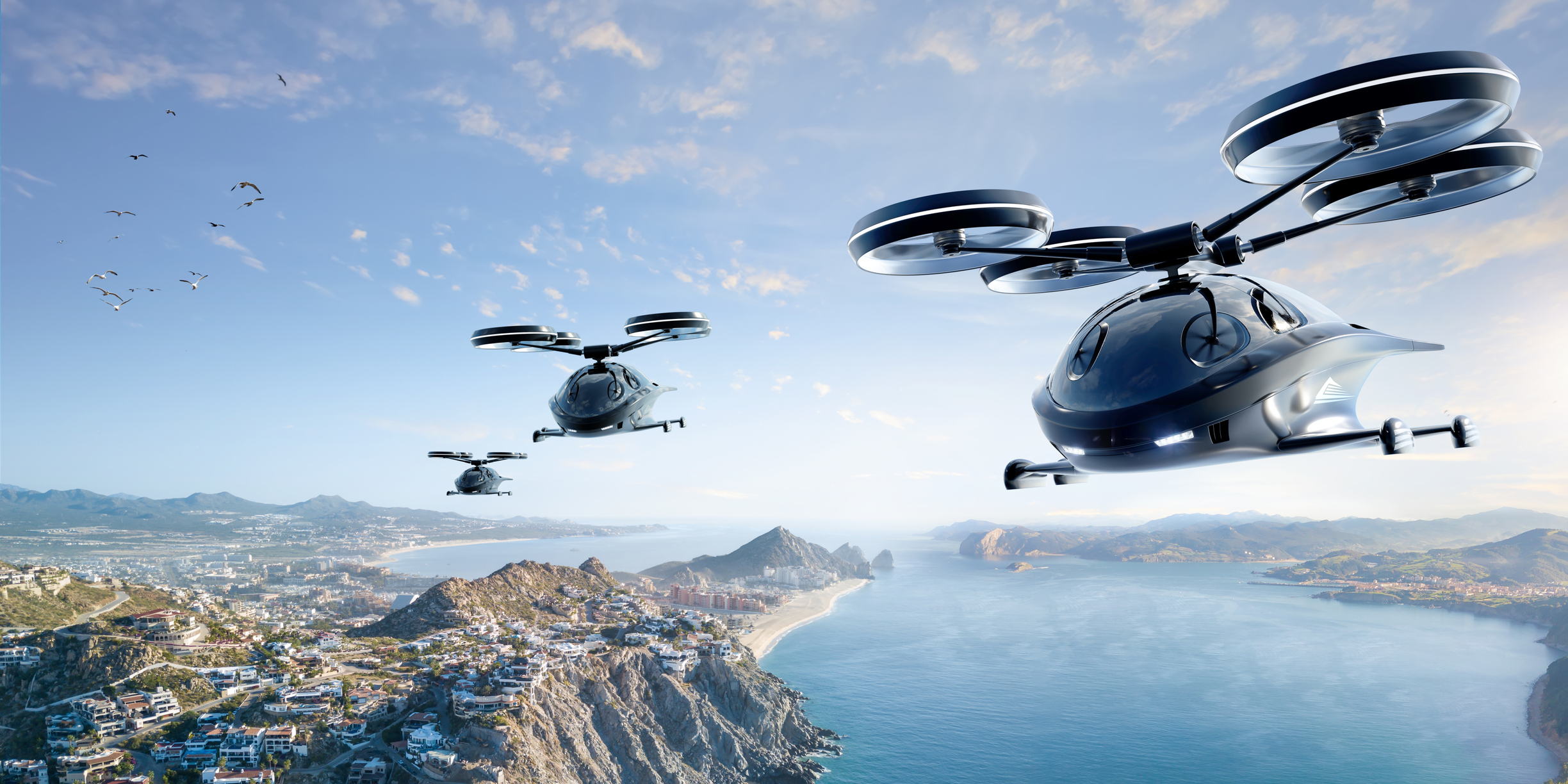
From 2010 onward, momentum has been building around advanced air mobility (AAM), an umbrella term referring to novel aircraft including uncrewed aerial vehicles and electric vertical take-off and landing (eVTOL), also called “air taxis.”
The establishment of this nascent industry started in the United States with the NASA Puffin concept and establishment of Joby Aviation in 2009. In Europe, it launched with the first uncrewed flight of what would become Volocopter in 2011. One of the most viral moments for eVTOL was the release of a German video featuring a “flying bathtub” (not to be confused with the NASA M2-F1). This was one of the first times the general public was exposed to the possibility of personal electric flight.
Serious development and competition ramped up with the establishment of BETA Technologies in 2017. Many other aircraft were designed in the intervening years with functional applications such as personal transport, cargo transport, agriculture, emergency response, and more. By 2022, even the U.S. government recognized the importance of electric flight and established an inter-agency working group (IAWG) composed of nearly every department in the administration, and AIAA was invited to aid in establishing the scope of work.
AIAA Focuses on AAM
AAM enthusiasts have contributed to the AIAA community in parallel to these milestones. In 2018, the AIAA community formally responded by jointly establishing the Electric Aircraft Technologies Symposium (EATS) with IEEE, recently renamed the AIAA Electric Propulsion and Advanced Technologies Symposium (EPATS).
A few years ago, AIAA committed strategic resources to expand its support of AAM, exploring and supporting visions of the certification and integration of novel aircraft including uncrewed aerial systems (UAS) and air taxis and resulting in the creation of a more complex airspace. An internal team of subject matter experts and program developers energetically got to work finding ways where AIAA could join the conversation and enable progress through program and resource development, training, and policy efforts.
This commitment led to many of the following efforts:
| 2018 | Established Electric Aircraft Technologies Symposium (EATS) with IEEE (renamed AIAA Electric Propulsion Aircraft Technologies Symposium or EPATS) |
| 2022 | Launched AAM Task Force Created eVTOL Infrastructure Considerations for Advanced Air Mobility on-demand short course |
| 2023 | Launched Certification Task Force Held AIAA-VFS panel at AUVSI’s Xponential, Skies for All: A Universal Approach to Future Airspace Integration |
| 2024 | Delivered presentations by AIAA Certification Task Force at VFS 8th Workshop on Advanced Air Mobility (AAM) Infrastructure |
| 2025 | Released “Challenges to the Commercialization of Advanced Air Mobility” (AIAA Certification Task Force recommendations) Briefed Congress on AAM Workforce Development Briefed Congress on Airspace Priorities for Novel Aircraft Certification Held webinar with ITS America on Advanced Air Mobility’s Contributions to Multimodal Solutions |
| January 2026 | Established Aviation in Multimodal Transportation Integration and Outreach Committee (AiMT IOC) |
The AAM Task Force emphasized the need to expand awareness of Takeoff and Landing (TOL) infrastructure, with a focus on propulsion design, charging facilities, and energy storage. Collaborative support for multimodal activities would help the aerospace community better understand how novel aircraft could respond to technical and data requirements across transportation modes.
Last week’s announcement of the eVTOL Integration Pilot Program (eIPP) awardees was the culmination of over five years of work across the federal government’s IAWG in conjunction with industry and academia. Furthermore, the Working Group’s recommendation of a pilot program built on more than 15 years of engagement with local communities and state-level departments of aviation, including the National Association of State Aviation Officials’ AAM Multistate Collaborative.
As the world’s largest aerospace technical society, our members are intimately involved with research, design, and testing of novel aircraft. The future is now. AIAA looks forward to the exciting developments to come in this area.