Inside preparations for X-59’s first supersonic flight
 By Paul Marks
 By Paul Marks
As impediments to technological progress go, cable-chewing foxes and noisy dirt bikers in California’s Mojave Desert are not insuperable obstacles — but they were nevertheless among the unexpected problems NASA faced in late 2025 as engineers and technicians attempted to deploy the extensive acoustic sensing network required to measure the noise generated by the X-59 research aircraft.
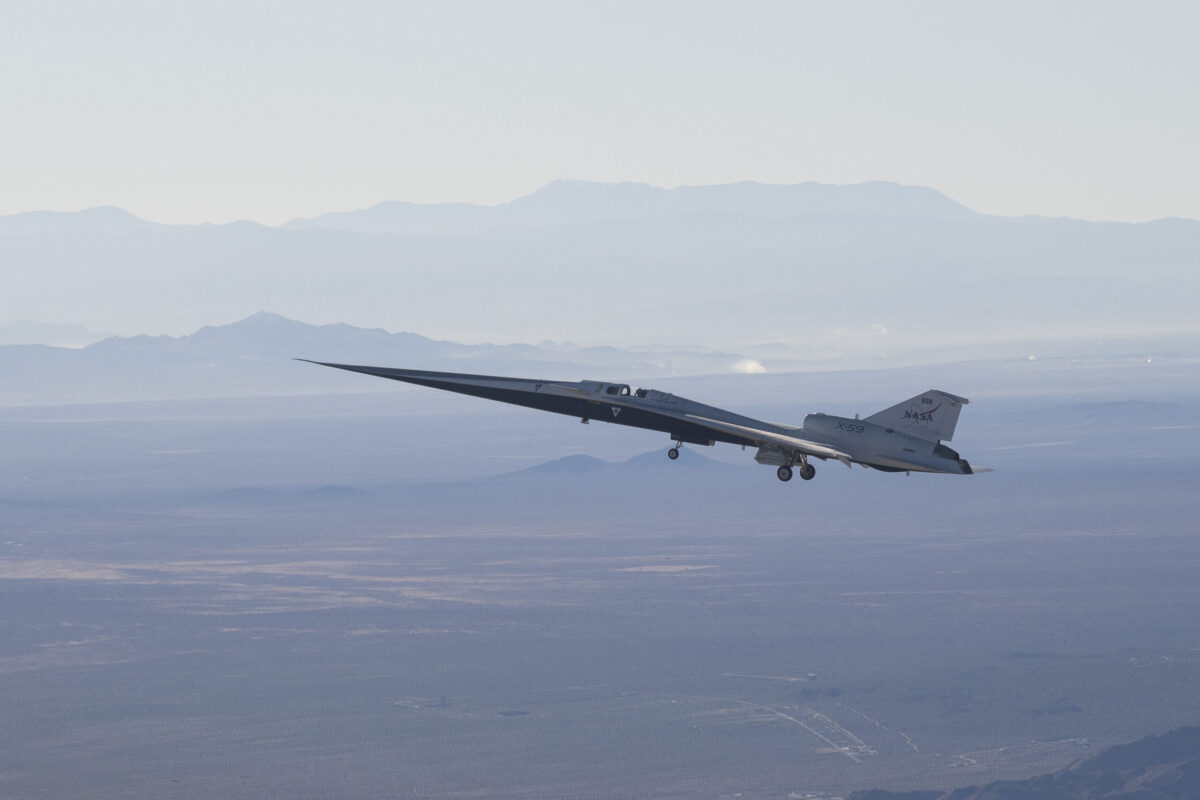
Built by Lockheed Martin Skunk Works, this needle-nosed testbed is at the center of a decade-long program that NASA hopes will culminate in the creation of updated noise regulations for future commercial supersonic aircraft. The idea is that through clever shaping of its airframe, X-59 will not generate ear-splitting sonic booms when it exceeds Mach 1, but rather “sonic thumps” comparable to the sound of a car door being closed 6 meters (20 feet) away.
So far, X-59 has only flown subsonically, reaching a top speed of 200 knots (370 kph) during its debut flight in October from Skunk Works’ facility in Palmdale, California to the nearby NASA Armstrong Flight Research Center.
The flight campaign is due to resume in March, starting with 10 “envelope expansion” flights, a spokesperson at NASA Langley told me by email. Test pilots will gradually fly the aircraft “higher and faster, reaching the mission test point of 55,000ft and Mach 1.5.”
If all goes as planned, that will set the stage for flights in various communities across the U.S. to measure the community response to X-59’s noise.
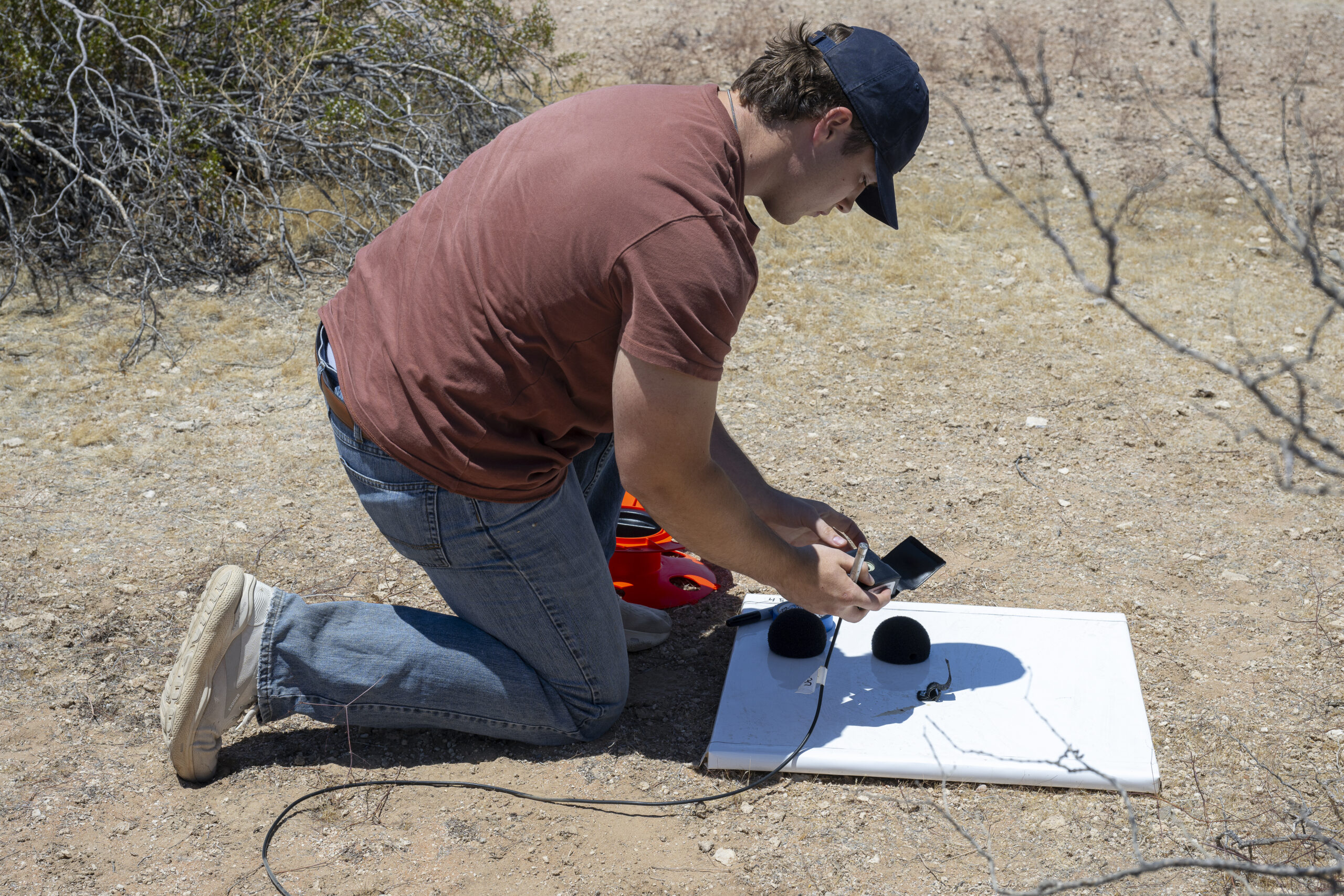
As preparations for the flight tests unfold, so does a parallel effort: the acoustic validation phase, led by Larry Cliatt, an aerospace project manager at NASA Armstrong. The aim is to install a 48-kilometer-long line of 125 sonic boom recorders in the Mojave Desert, where the initial supersonic flights are to occur. Based on the results of those early flights, Cliatt and his team will calibrate the devices so they can be reused for the community flights.
Each of these ground recording system (GRS) units comprises a solar panel and a high-end measurement microphone, plus a secure electronics box containing a data acquisition computer that records audio, waveform and spectral data onto arrays of solid-state memory cards. All of this is housed in a robust plastic enclosure that is latched, chained and locked.
“I call it our stormtrooper box,” Cliatt said — because there is no way anyone can interfere with its contents.
The GRS units are to be semi-autonomous, triggered to begin recording when X-59 approaches. “The ADSB signal from the X-59 gives the GRS the airplane’s latitude, longitude, speed and altitude,” said Cliatt. “The GRS reads that in real time to estimate when the sonic boom will arrive and records it automatically.”
The GRS units are to be used in two acoustic measurement phases: first, in ongoing and growing “dry run” tests in Mojave, to perfect the recording technology and setup; and second, in the community test phase, in which the X-59’s noise levels will be measured and comments from residents assessed. NASA has not announced the specific locations for these flights, but Cliatt said the agency plans to select “less than 10” cities.
There’s still several months to iron things out before the Mojave flights, but an early 2024 dry run that utilized an F-15 did not quite go as planned — despite the use of those highly-secure ‘stormtrooper’ boxes.
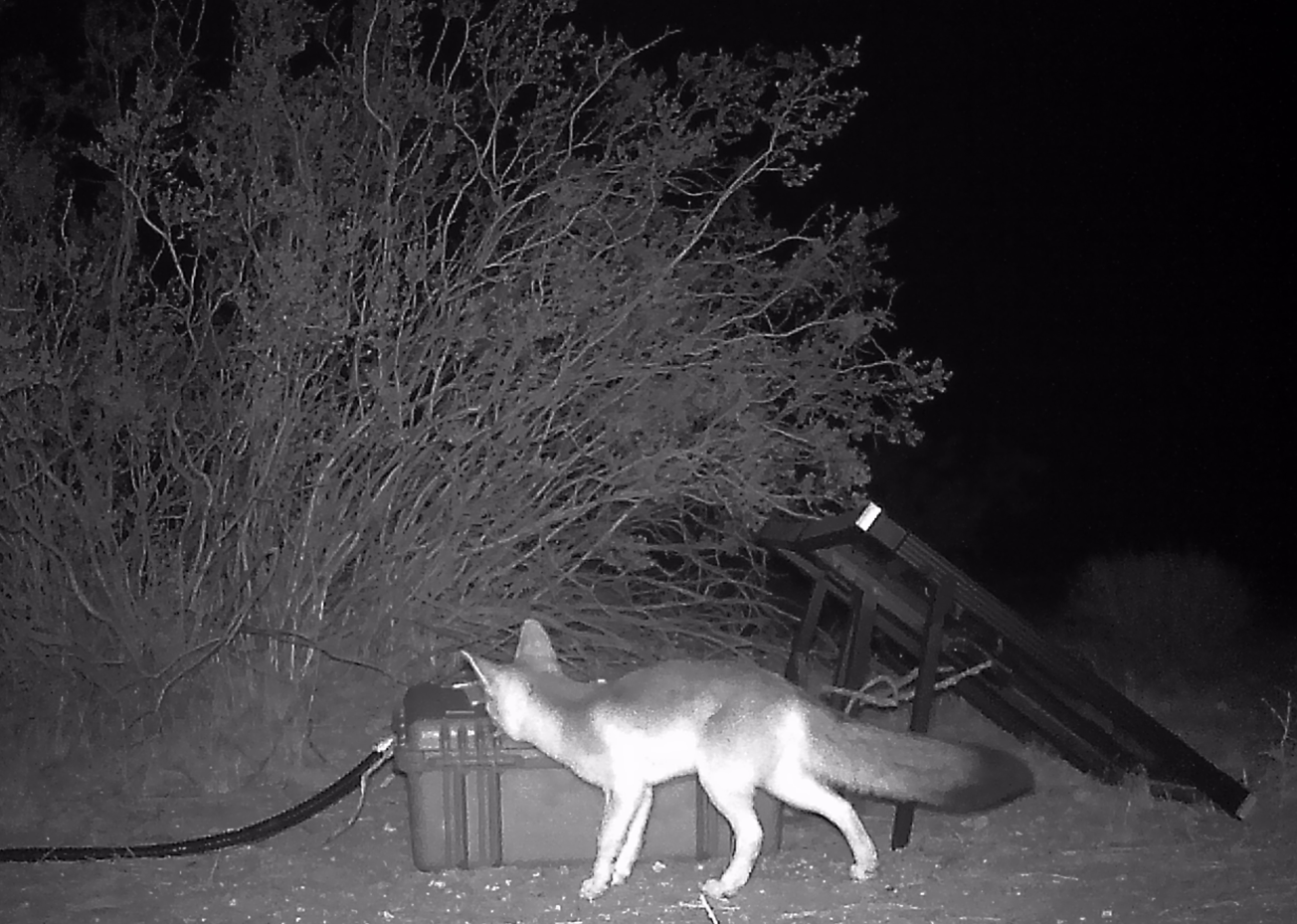
“We’ve had foxes bite through our cables, and urinate and defecate on our sound sensors,” Cliatt said. “It’s become a huge problem. The microphone windscreen would sometimes be soaked with fox urine. So battling the elements has been a huge part of this.”
That wasn’t the only challenge encountered. Though the engineers and technicians were testing in a remote area of the desert some 80 km from NASA Armstrong and Edwards Air Force Base, they were not alone.
“We’ve had dirt bikers riding right by our sensors,” Cliatt said, which posed multiple problems. The bike noise might interfere with sound sensing, and the dirt thrown up could cover the GRS solar panel.
“It’s really turned out to be a more complicated problem than we envisioned,” added Cliatt, whose team is trying to solve the issues by better hiding the GRS units — in particular, moving them away from well-trodden desert paths so curious dirt bikers can’t see them so easily.
Assuming wandering dirt bikers, wildlife and weather can be dealt with — and no showstoppers are expected — the X-59 is expected to return to the air in March. As of early December, though, the aircraft was “in the shop” at NASA Armstrong, test pilot Nils Larson said.
“The airplane is down for some maintenance, but mostly inspections,” said Larson, who was at the controls for the inaugural flight. “There’s a couple of things that we already knew about before the first flight for which we have a redesign in place — just small subsystem things. But we do need some time on the airplane.”
X-59 was designed to use many parts from other airplanes to keep costs down. For instance, its engine hails from the FA-18 Super Hornet, its canopy and ejection seat are from the T-38 supersonic trainer, its undercarriage from the F-16 fighter, and even its control stick is from the F-117 stealth fighter. The engine and canopy are among systems removed for the inspections Larson referred to, NASA said.
Despite this construction, X-59 did not fly like a contraption made from the parts of other airplanes, Larson told me. “Frankly, it flew just like the sim,” he said, attributing that to the engineering teams who strove to integrate the plane’s components.
“When we got into taxi, you could just tell the airplane was ready. She wanted to fly, because everybody had managed to make sure that all the parts were talking together like they were supposed to, and fit together like they were supposed to,” Larson said. “So it wasn’t really a surprise when we got the X-59 airborne and it didn’t have any issues.”
What particularly impressed Larson was the visual advantage the aircraft’s external vision system (XVS) lent him. X-59’s needle-shaped, low-boom nose is too narrow for windows, so all forward vision comes from its high-definition nose and belly cameras, feeding a cockpit HD screen.
“When we took off very early in the morning on that first flight, the sun was really low on the horizon and right off the end of the runway,” Larson said. “Now normally, I’d just be squinting into the sun and unable to see very well. But the interesting thing about the XVS system was that it doesn’t hurt to look at the screen, and I didn’t have to squint.”
Indeed, Larson thinks XVS could play a role in future subsonic airliner designs. “A synthetic vision system could allow you to change the shape of a nose on a commercial subsonic airplane, redesigning the nose to decrease drag. The researchers at Langley have had a lot of interest in this from the FAA,” he said.