
The company is positioning its reusable Neutron medium-lift rocket as an alternative to SpaceX’s Falcon 9, particularly for the coming wave of satellite constellations. Jonathan O’Callaghan examines how Neutron stacks up and the road to launch.
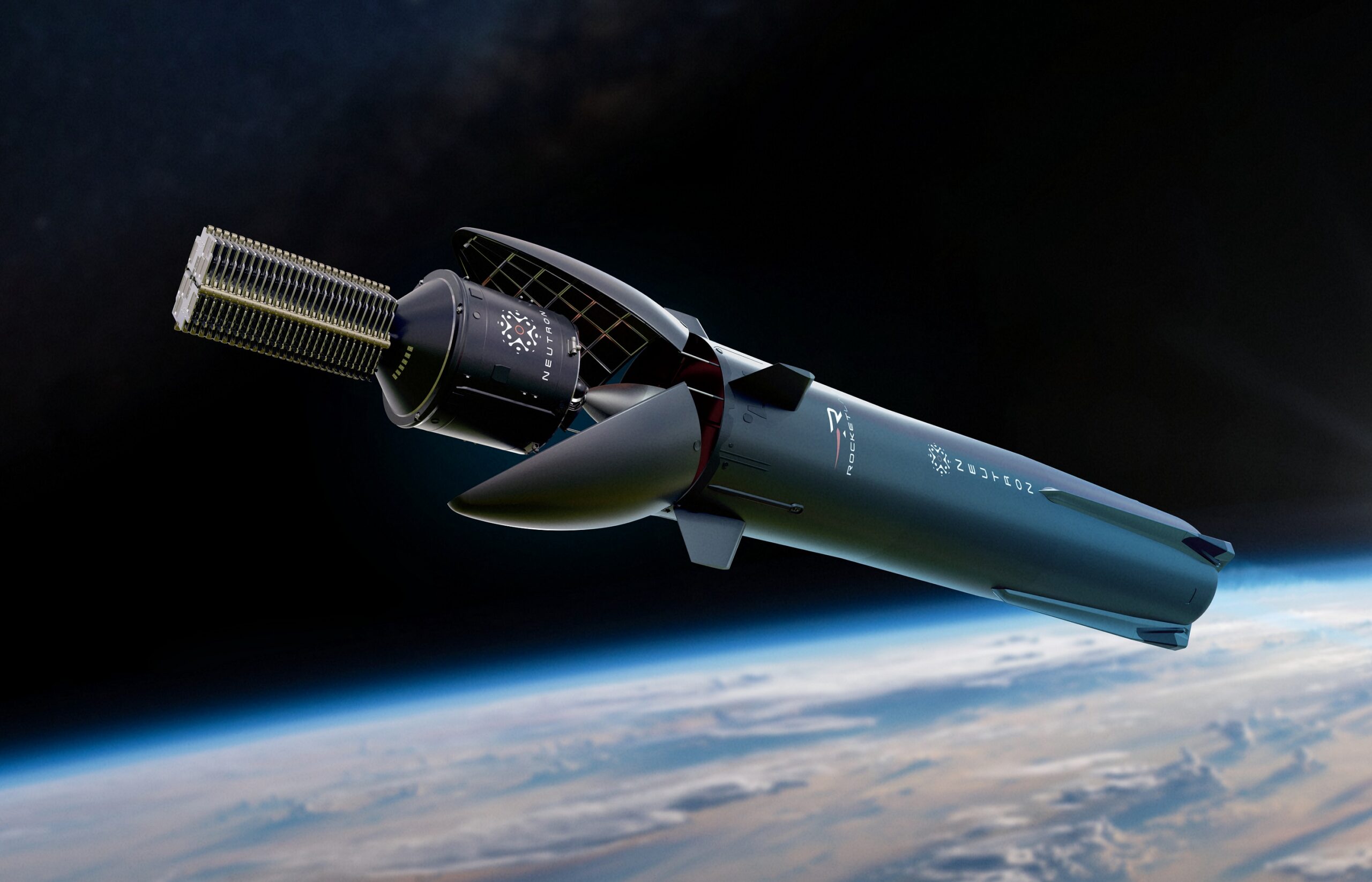
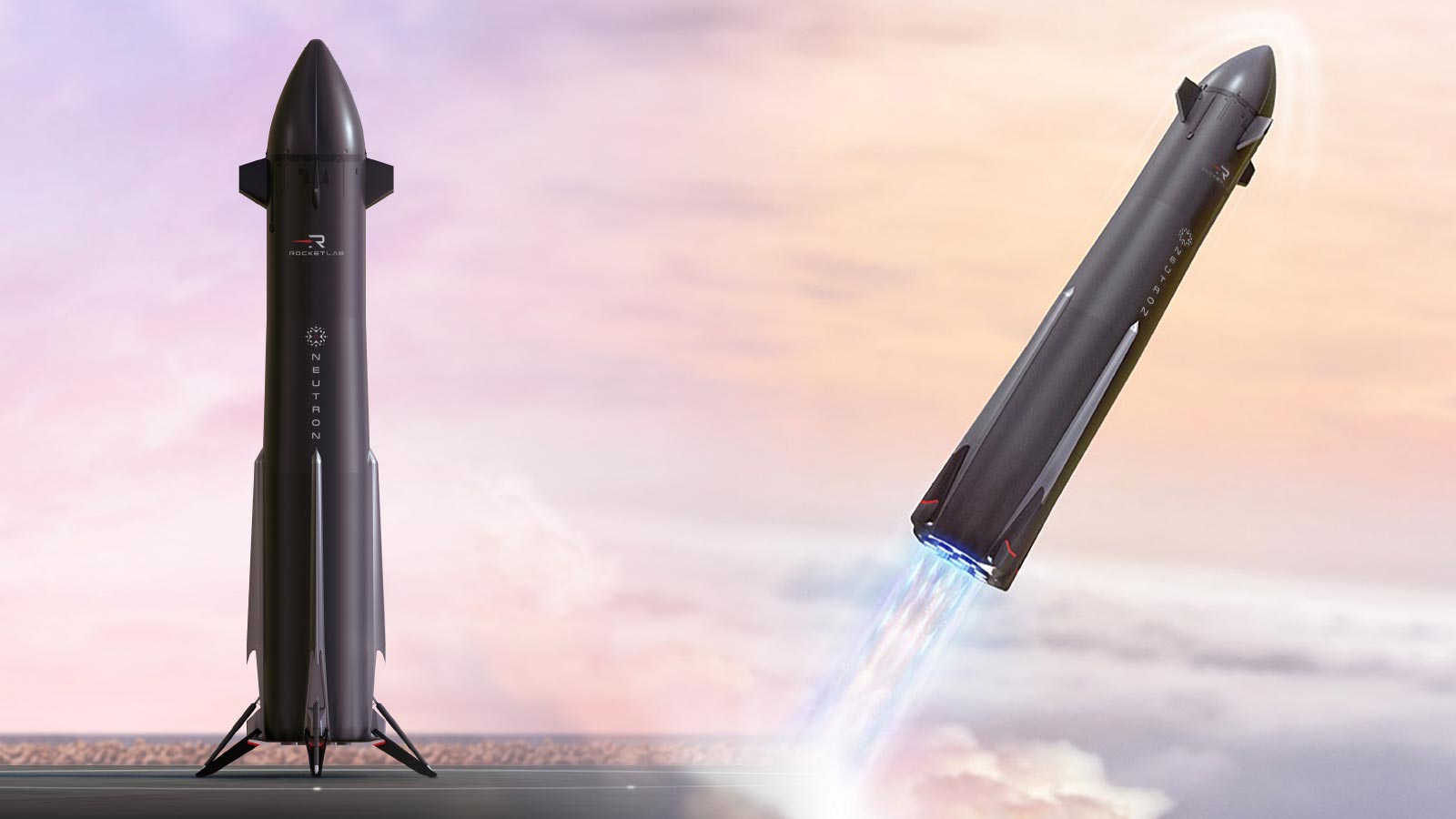
Rocket Lab’s Neutron does not look like other rockets — short and squat with a wide base, plus a nose cone that unhinges like a Hungry Hungry Hippo and looks like it could have been plucked from a James Bond movie.
Yet the California-based launch provider chose all of these features with a clear purpose in mind: deploying the many satellites required for the vast constellations taking shape around Earth to provide internet, imaging and other services.
“We didn’t really have to stew too much about the configuration,” says Adam Spice, Rocket Lab’s chief financial officer, of when executives began envisioning Neutron a decade ago. “We were going toward where the market was going to be.”
Most of the satellites launched since 2019 have been aboard SpaceX Falcon 9s for the company’s Starlink broadband constellation — which currently numbers more than 10,000 — but governments and companies around the world are proceeding with plans to establish their own networks in the coming years.
Rocket Lab tailored Neutron, now scheduled to debut at the end of 2026, for such launches. Its “Hungry Hippo” fairing is wide enough to accommodate the large, flat buses popular among megaconstellation builders in particular, with rails to deploy many at a time, like a stack of pancakes.
The rocket’s shape is also meant to lend itself to another key goal: reusability. A booster with a wider base creates more drag during its plunge back through the atmosphere in preparation for a vertical landing, as Rocket Lab plans to do for nearly every launch. To date, only SpaceX and Blue Origin have achieved that feat.
“Our goal is to get to orbit on the first attempt,” says Shaun D’Mello, Rocket Lab’s vice president for Neutron. For that debut flight, he says, teams “won’t have a landing platform in position, but we intend to exercise a glide of the rocket and then attempt to reignite the engines for a soft water landing.”
Rocket Lab is positioning Neutron as an alternative to the Falcon 9, which launched a whopping 165 times in 2025 — six times more than all the other U.S. providers combined. But can Neutron challenge such a dominant force?
“Neutron is competing with arguably the most successful launch vehicle ever,” says Carissa Christensen, founder and CEO of BryceTech, the Virginia space analysis firm. “It’s going to have to find some definitive niches to settle into.”
Rocket Lab has already announced half a dozen contracts. These include a multi-launch contract for an unnamed commercial satellite constellation and an agreement with U.S. Transportation Command to use Neutron to ferry cargo around the world. Rocket Lab hasn’t shared dollar amounts for most of the contracts, but the most lucrative customer could be the U.S. Space Force, which last year added Neutron to the pool of vehicles eligible to compete for a subset of national security launches — valued at a combined $5.6 billion.
An open market
Founded by New Zealand entrepreneur Peter Beck in 2006, Rocket Lab is now the leading player in the small-launch market. Its Electron rockets have flown 83 times as of mid-March, mostly from the Mahia Peninsula in New Zealand, but also twice from Wallops Island off the coast of Virginia in the U.S.
At 18 meters tall, Electron is about one-fourth the height of Falcon 9. It’s also expendable, the first stage dropping into the ocean once it’s propelled its payload to orbit. In the past few years, however, Rocket Lab has begun to toy with reusability, recovering some Electron boosters from the ocean and even catching one midair via helicopter in 2022.
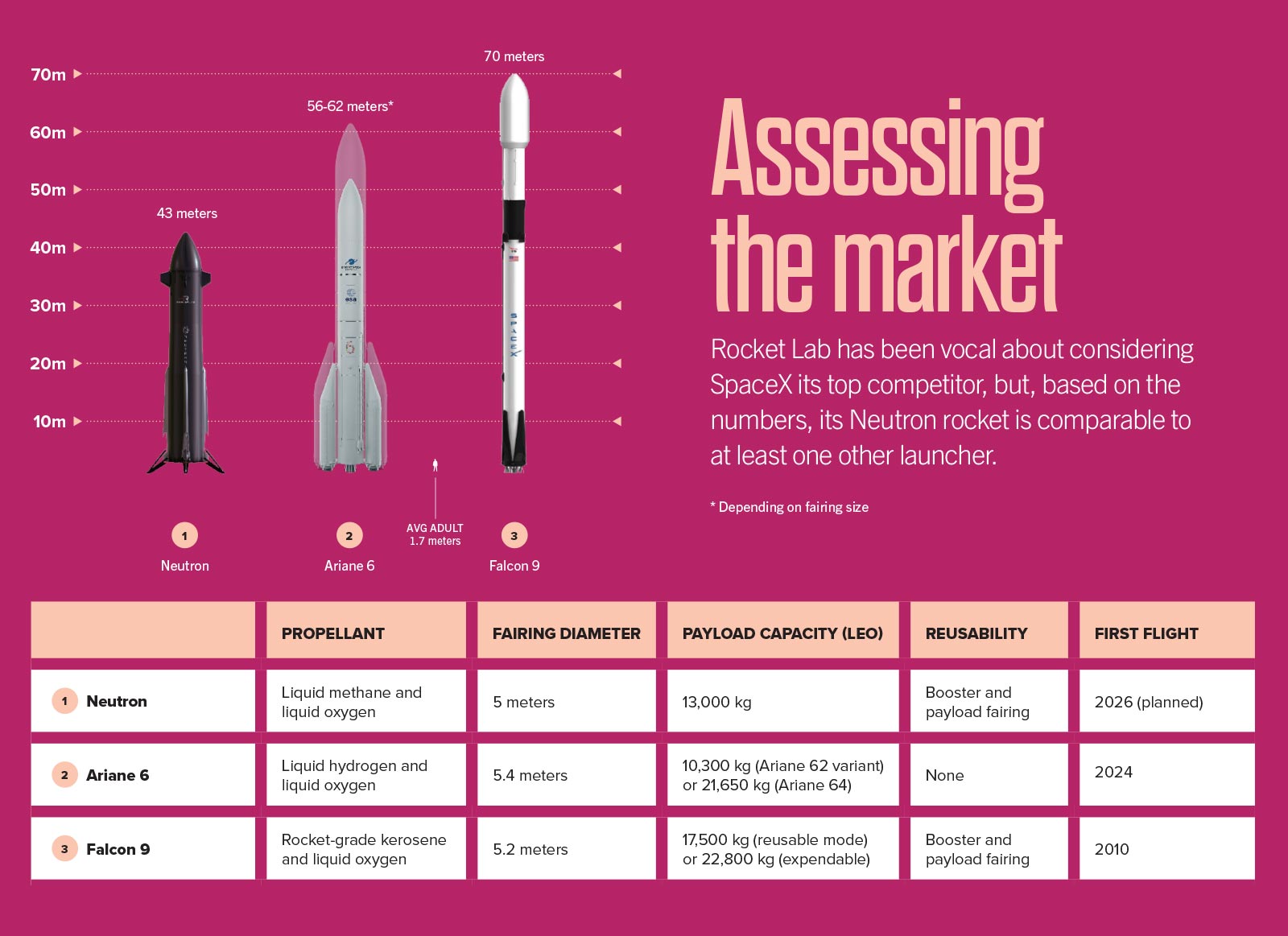
Neutron marks a step forward for the company. At twice the height of Electron, Neutron was designed to lift 13,000 kilograms to orbit — far more than Electron’s 300 kg and close to Falcon 9’s maximum of 23,000 kg. That puts it in the medium-lift category, comparable to the variant of Europe’s Ariane 6 that flies with two solid rocket boosters.
“There is a gap in the U.S. market for a medium-class vehicle right now,” says Caleb Henry, director of research at analysis firm Quilty Space, after United Launch Alliance retired its Delta II in 2018.
Based on the numbers, Ariane 6 is the launcher “Neutron will most closely compete with,” says Henry. The design has flown six times since its 2024 debut.
However, Ariane was not designed for reusability as Neutron was. “We set a very ambitious goal to make sure there’s nothing on the rocket that takes more than 24 hours to recycle,” says D’Mello.
SpaceX’s record for reusing a Falcon booster is nine days, though the company is averaging well under 30 days, Spice notes. “Ultimately, there’s no reason why Neutron can’t get there as well.”
He’s also confident Rocket Lab’s design strategy will allow it to achieve a booster landing much earlier than SpaceX, which recovered its first Falcon booster five years after the design’s inaugural flight.
SpaceX did not respond to a request for comment on competition with Neutron.
Designing for reusability
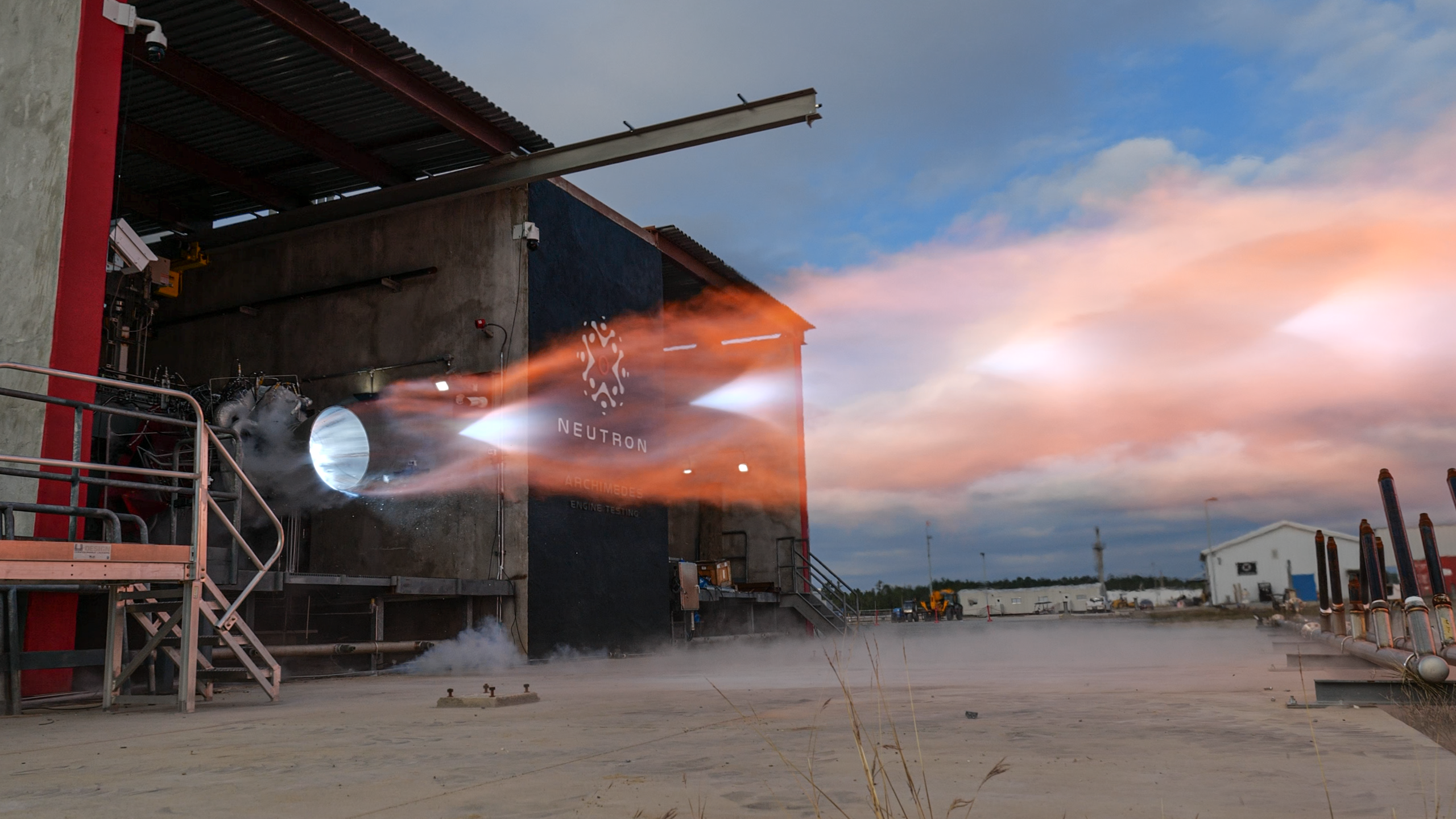
The desire to land and refly influenced various aspects of Neutron’s design. First, the fuel. The first stage will be powered by nine of the company’s new Archimedes engines, fed by a mixture of liquid oxygen and methane.
That combination burns cleaner than fuels like kerosene, leaving less soot on the vehicle to clean after each flight and potentially reducing the time it takes to refurbish each rocket, says Chad Anderson, founder and managing partner of the venture capital firm Space Capital, an investor in Rocket Lab.
“It’s becoming standard industry knowledge that that is a better way to build a reusable rocket,” says Anderson. Blue Origin, for instance, selected liquified natural gas for the first stage of its New Glenn with a similar goal in mind. That design is firmly in the heavy-lift class, with a 7-meter-diameter payload fairing and lifting capability of 45,000 kg to low-Earth orbit.
Then there’s the overall configuration. Like most rockets, Neutron has two stages, but they aren’t stacked on top of each other. Instead, the first stage comprises the entire outer body. The second stage is completely enveloped within the first stage and would be released in orbit once the payload fairing opens.
Neutron is to fly at a steeper trajectory than other rockets so it can release that second stage at a higher altitude, where it will encounter less drag. Once deployment is complete, the rocket will descend back through the atmosphere. Neutron’s 7 meter-diameter-base — twice as wide as Falcon 9’s — should create more aerodynamic drag and slow the rocket’s rate of descent.
That means Neutron only needs to fire its engines once to make it back to Earth, just before landing. “We don’t need to burn through reentry,” says D’Mello. “Having a big diameter allows us to skip that part of the mission and glide all the way back.”
For the landing, Neutron has wing-like aerodynamic surfaces on top, rather than the grate-like grid fins that Falcon deploys, to guide it down to a floating barge in the ocean.
For those landings, “the only burn that takes place is just before touchdown,” says D’Mello, using three of the rocket’s engines. For the ground landings Rocket Lab hopes to achieve in the future, an additional boost-back burn will be required.
Then there’s the Hungry Hippo fairing from which the second stage and any payloads will exit. In a first for a rocket, this fairing won’t detach. Instead, it will open like the jaws of a Hungry Hungry Hippo — a reference to the popular children’s game that inspired its name. The move is also reminiscent of the rocket in the 1967 James Bond film, “You Only Live Twice.”
Rocket Lab believes fairing recovery is an important cost-saving measure. Falcon 9 fairings, for instance, reportedly cost $6 million each. SpaceX took years to perfect its technique of gliding fairings via parachute onto floating barges.
“One of the things we looked at is: Can we have the fairing stay attached to the first stage?” says D’Mello. “We did the math and it was in theory possible.”
No one has done this before because “it frankly didn’t matter until reuse,” says Henry. “If the whole rocket is expendable, who cares if the fairing comes off? We’re in the early learning curve stages of an industry that is just barely starting to normalize reuse.”
That desire also prompted Rocket Lab to construct the fairing and Neutron’s primary structure out of carbon fiber, a much lighter material than the aluminum or stainless steel used on Falcon and the majority of other rockets.
“If we used another material, it would make virtually no sense to carry a fairing to space and bring it back,” says D’Mello. “The idea behind Hungry Hippo is to reduce the number of operations to get hardware back. Your plane lands with the doors on it. It’s the same sort of architecture here.”
The company is betting on this reusability yielding cost savings, so has set Neutron launches at $55 million. In comparison, SpaceX in February raised the price of the more capable Falcon 9 from $70 million to $74 million.
“SpaceX has set the bar for affordable launch,” says Henry. “If you are not at least in the vicinity of that launch price, it’s very hard to compete with them.”
Several of the analysts I spoke to believe that prices could decrease in the future if Neutron can be a true competitor to Falcon 9 or Ariane, requiring the other launch providers to lower costs to attract customers.
“I’m incredibly happy that there’s competition coming online,” says Anderson. “There has been a lack of competition for a long time. If you want cost savings to be passed along to customers, you need competition.”
Mind on megaconstellations
The other driving force for Neutron’s design was ensuring it could deploy dozens of satellites at once, as many of the constellation operators desire so they can quickly build out their networks.
Neutron’s wide width is intended to accommodate stacks of flat satellites, similar to the flat panels of SpaceX’s Starlink. And to ease deployment, there’s a guided rail mechanism, with four pneumatic cylinders to push out the satellites.
“The whole second stage is suspended inside this Hungry Hippo fairing,” says D’Mello. “When the fairing is open, like cargo doors on a plane, the second stage is deployed.”
Henry sees the constellation market as particularly lucrative. “We’re seeing more constellations come online or demand launch,” he says.
These include multiple private and government efforts in the U.S. and U.K., including Europe’s planned constellation of 300 IRIS² satellites. The U.S. Space Development Agency also plans a 500-satellite constellation.
“Everywhere you look, you see more demand for constellations,” says Henry.
Rocket Lab even has plans for its own constellation, but executives are tight-lipped about what purpose that might serve. “We’re holding our cards close to our chest on that one,” says Spice, although he indicated the plan is not to compete with Starlink in deploying such a large broadband network.
“It’s very likely what Rocket Lab goes after is something that’s much more achievable when you don’t have the world’s richest man’s capital behind you,” he adds, referring to SpaceX founder Elon Musk.
Outside of megaconstellations, Anderson expects Neutron to have plenty of customers.
“There’s clearly a ton of demand” with Falcon 9 “booked out years in advance,” he says. “The market desperately needs additional capacity.”
There are potentially broader ambitions for the design, as well. Beck has spoken about it one day launching humans to low-Earth orbit — possibly to one of the several commercial space stations in development. Neutron is also capable of launching 1,500 kg worth of satellites to the moon or Mars, according to the company.
If all goes to plan, Rocket Lab could win a sizeable slice of the launch market, Spice says. However, he acknowledges this will take at least a few years and that SpaceX has an ample head start.
Neutron “won’t be initially as proven, because Falcon 9 is a phenomenal vehicle,” he says. “But ultimately, we don’t enter a market to be No. 2.”