Predicting heat shield performance
 By Keith Button
 By Keith Button
Varda Space Industries’ latest capsule could help verify a streamlined approach to designing hypersonic missiles.
Researchers at Sandia National Laboratories in September culminated a three-year project, developing a computer model to predict how different heat shield materials will hold up during hypersonic flight based on their ingredients and shape. If the calculations prove accurate, the model could save designers time and money that would be spent on flight- and ground-testing every thermal protection iteration under consideration. That benefit would extend to Sandia’s customers, including the U.S. Defense Department.
“Understanding the performance of heat shields can be an expensive and long process,” says Justin Wagner, Sandia’s lead researcher on the project. “By having this project, we developed the tools to be able to understand how that heat shield is going to perform in a quicker fashion.”
As of this writing in mid-March, Varda’s W-6 beach ball-size capsule was scheduled to carry the heat shield experiment to orbit by early April. As the capsule reaches hypersonic velocity during reentry, onboard sensors will record the temperature of the heat shield samples embedded in the vehicle’s nose, chosen to represent similar formulations but different manufacturing methods.
This would be the team’s first opportunity to compare the model’s prediction against real flight hardware, because previous flight tests were conducted with expendable rockets that broke up and fell into the ocean. “In getting the materials back, you can put your eyes on them, make measurements, see how they responded in that flight environment,” Wagner says.
They plan to examine the chemical structure of the postflight material under microscopes and with X-ray tomography, then compare it to the model’s predictions and adjust the software, if necessary. “We’re modeling how much material loss we might have in flight, and this allows us to directly compare to that flight and see how that material did,” Wagner says.
Heat shield materials are typically silicon- or carbon-based, designed to protect the leading edges of a hypersonic missile’s fins or nose from extreme heat while gradually ablating during flight. Designers need to know how quickly the material will erode and how well it will continue to protect the missile as this erosion progresses. Those answers help to determine how much and what types of material are best for a particular vehicle and to calculate how the receding surfaces will alter the aerodynamics of the missile.
To develop a computer model that could provide this information, the researchers knew an early step would be building a “full-physics model” that runs on a supercomputer to factor in the complex aerodynamics of hypersonic air flows and shock waves over the heat shield surface, plus the chemical interactions of the material with super-heated air molecules, Wagner says.
The plan was to then take the model and produce a streamlined “reduced-order” model that could be run on a desktop computer. Users would be able to input the shape and silicon and carbon makeup of a prospective heat shield material, along with the missile’s velocity, and the model would calculate the temperatures the material would reach and the ablation rate.
They kicked off the project in 2022 by evaluating previously developed advanced chemistry models that predict how silicon and carbon materials react with superheated air. They compared the models’ predictions to real-life material tests and selected the most accurate models for incorporation into the full-physics model.
“We could ingest many of those different models into the project workflow and compare them all to the experiment and see which one might be the best,” Wagner says.
Sandia enlisted about 40 researchers in the project, along with teams at the University of Colorado Boulder, General Atomics, the University of Illinois Urbana–Champaign, Kratos Defense & Security Solutions, the University of Minnesota Twin Cities, Oak Ridge National Laboratory, PSE Technology, Purdue University, the Stevens Institute of Technology and the University of Texas at Austin, to help with the materials testing and computer models.
Over the first 18 months, they made hundreds of samples of carbon heat shield materials for tests of thermal conductivity, tensile strength and other thermal and mechanical properties as compared to model predictions. Starting in the second year of the project, hundreds of silicon-carbide samples were made, with testing for both sets of materials conducted in hypersonic shock tunnels and plasma torches.
“A model is only as good as the experiment or the validation that goes with it. So a big hurdle here was developing methods to understand how well our models are doing,” Wagner says.
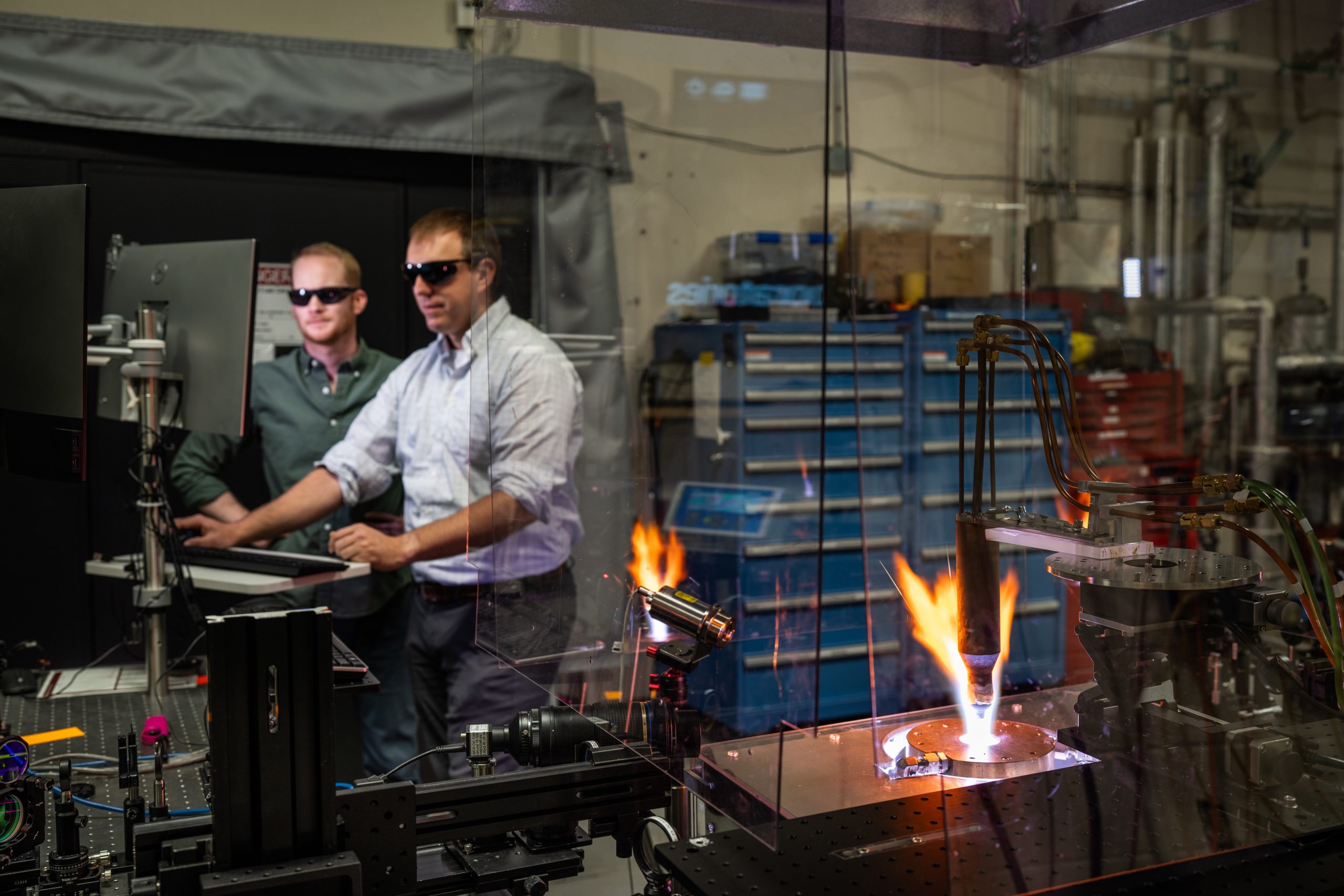
Starting in 2023, plasma torch tests were conducted on 30-50 thermal material samples at the University of Texas at Austin, simulating the heat that builds up on the blunt leading edges of a missile at hypersonic velocities.
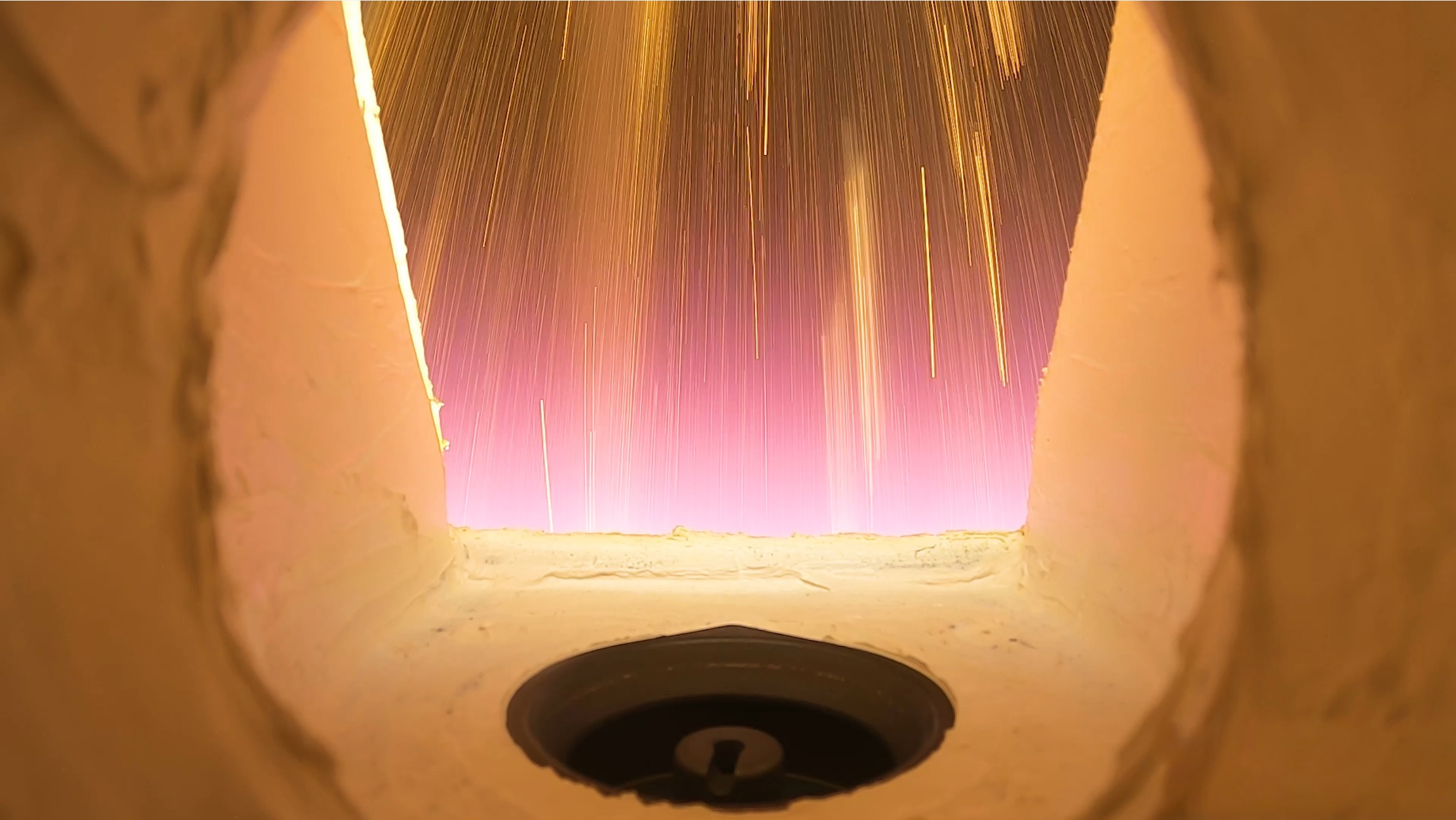
In those conditions, a shock wave is created in front of the nose, and the air between the wave and the missile decelerates from hypersonic to subsonic velocity, heating that air up to 5,700 degrees Celsius — roughly the same as the surface of the sun. That tears some of the nitrogen and oxygen molecules in the air into single atoms, and the changing air chemistry interacting with the surface of the heat shield material can make the material erode more quickly.
“What we are simulating is the gas composition: What is superhot air actually composed of?” says Noel Clemens, an aerospace engineering professor at UT Austin. “That’s what you see behind the shock.”
For these tests, researchers wore goggles to protect their eyes from the blindingly white light of the vertical plasma torch plume and heated 30 millimeter-diameter samples of the thermal material, shaped like oversized pencil erasers. They pointed pulsing lasers into the plume, each tuned to induce photons of light from a specific type of atom. They then measured the increase in the brightness of light produced by those specific atoms.
The lasers helped to identify both the gases created by the extreme heating and the gases coming off the surface of the material as it interacted with the super- heated air. They deployed another set of lasers to measure temperatures within the plume via a spectroscopy method.
Cameras pointed at the surface of the samples measured the rate of ablation. They also measured the weight, surface elevation and shape of each sample before and after the plume. “It might ablate more on the corners than it does on the central line, for example, just the way the flow accelerates around it,” Clemens says.
To compare their model to actual hypersonic flight conditions, the researchers tested heat shield materials in 2024 and 2025 aboard two rockets launched under the Pentagon’s Multi-Service Advanced Capability Hypersonics Test Bed program. Those samples weren’t recovered, but data on temperatures, surface pressure, internal vibration and shear stress were collected.
During the first flight, an onboard spectrometer also measured gases flowing over the material. For the second flight, they attempted to measure gases produced by the ablating material with a laser-shining instrument. That device failed to communicate its data to the ground, but researchers plan to try again after the Varda flight, Wagner says.
Once the full-physics model was developed, the team trained the reduced-order model to use only the most mathematically relevant parts of the more detailed model to predict the temperature and amount of ablation for a given material with 90% accuracy.
“The reduced-order model team has to learn: What information do I need from the full-physics team to actually get our model to work? And how little can I actually get away with and still retain accuracy?” Wagner says.
Today, Sandia uses the model for customer work, but Wagner says he would like to make it accessible to other researchers. “Potential future work is to make some of the capabilities that we’ve developed here more universally available,” he says. “There’s still some work to be done to make things more deployable.”