China’s space telescope aims to unlock cosmic mysteries. Will international science benefit?


In late September, some 100 Chinese researchers published a paper in the journal Science China Physics, Mechanics & Astronomy, introducing the world to the objectives and scope of the country’s first flagship space telescope.
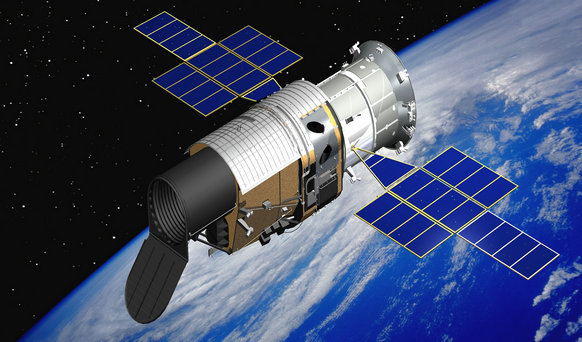
Designed for periodic docking with the Tiangong Space Station in low-Earth orbit, the Chinese Space Station Telescope (CSST) is poised to expand the country’s frontiers in space exploration. But despite assurances about plans to share data, international scientists have limited information about how that will happen, even as the project moves toward a 2027 launch date.
According to the paper, CSST — whose Chinese name, Xuntian, translates to “tour of heaven” — is intended to provide more details about the origins of the universe. Plans call for a three-mirror anastigmat construction — including a 2-meter-diameter primary mirror that’s only slightly smaller than that of the Hubble Space Telescope’s — “to probe the universe with extremely high levels of precision,” the paper reads. A multi-color photometry and slitless spectroscopy survey camera will help it cover 17,500 square degrees of sky. Estimated to capture more than a billion galaxy images and 100 million galaxy spectra, or light-based fingerprints of galaxy history, in its 10-year lifespan, the telescope will work to demystify dark matter and “measure the evolution history of the Universe,” researchers said.
Since the Chinese Academy of Sciences first announced the project in 2022, headlines in international science and space publications have described CSST as a challenger to Hubble. They tout CSST’s extreme deep-field observational capability in the near-ultraviolet and optical bands, with a reported field of view some 300 times that of Hubble. Another comparison, though, according to astronomer Jonathan McDowell, could be NASA’s forthcoming Nancy Grace Roman infrared space telescope, set to launch slightly ahead of CSST in late 2026. Roman and CSST, both designed for wide survey, would have similar ultra deep-field capabilities and a shared focus on dark energy and the ongoing expansion of the universe.
McDowell, recently retired from the Harvard-Smithsonian Center for Astrophysics, said Xuntian is positioned to be the widest-field space telescope. Its 2,500-megapixel main camera would be capable of seeing 42% of the sky in survey, compared to the 5% possible with Roman. However, he noted that Roman, because it’s equipped with a light-blocking coronagraph instrument, will be able to make out stars many times fainter than the dimmest ones Xuntian’s wide sweep can detect.
For scientists studying dark matter and dark energy, that would be a powerful combination. “Getting a wide area from Xuntian and a deep, deep set of images from Roman, we’re going to do better than either one would do alone,” McDowell said.
That’s provided, of course, that CSST works and its operators share data as promised. A series of delays have pushed the expected launch four years beyond the initial 2023 target, and one observer said critical information is still missing on the project.
Tom Brown, head of the James Webb Space Telescope Mission Office at the Space Telescope Science Institute in Baltimore, said he’s still awaiting clarity on how, or even if, data from CSST will be provided to scientists outside of China. The country’s space telescope program is operating according to a “different paradigm” than the data-forward approaches of NASA and the European Space Agency, he said.
The recently published paper, he added, suggests ways that CSST, operating in bluer wavelengths, could complement Roman’s surveys. Both telescopes aim to map large swaths of sky, offering opportunities for astronomers and scientists to mark points of interest for further observation with more targeted instruments.
“If you’re a scientist somewhere in the world that’s outside of China, and you say, ‘I’m going to have these Roman data, and maybe I’ll use those data to ask for time on Hubble and Webb for the most interesting objects; what is the CSST going to tell me?’” Brown said. “I don’t know, because I don’t even know if I’ll have access to the data.”
The lead author on the CSST paper describes the two telescopes as complementary and told me that details about data release will be made available prior to launch. Yan Gong, an astrophysics professor at the National Astronomical Observatories of the Chinese Academy of Sciences, said in response to emailed questions that CSST’s larger survey area and two near-UV bands will provide information that will help Roman more accurately capture photometric redshift, which he described as “crucial” in its exploration of dark energy. Likewise, he said, near-infrared data from Roman would also be “very valuable” for CSST’s exploration.
Brown was skeptical, noting CSST’s shorter UV wavelengths would limit how far it could see back in time, and its value to the scientific community would depend on the ability to know in advance where and how it would be operating.
As far as information sharing, Gong emphasized that information on planned CSST operations was forthcoming, although he did not provide a timeframe.
“The data policy of CSST will be similar to that commonly used in the international astronomical community,” Gong said. “We are working on it and hopefully it will be announced soon. We welcome international cooperation to jointly use the data.”
The paper itself offers some caveats, saying “immediate products” from the telescope will be provided for the CSST scientific team for data quality verification; that “official data product” will be released to domestic and foreign scientific teams every two years; and that collected data in general are “subject to a certain applicant-exclusive research protection period.”
McDowell noted that this data-sharing plan is “not inconsistent” with those of Western telescopes. He specifically pointed to ESA’s Gaia spacecraft, retired last March, data from which was released in large batches every few years after initial analysis. Another potential concern with CSST, he said, is whether the information will be in a usable and decipherable format once it’s made public.
Another unknown, he said, is the effective calibration of CSST and its ability to produce sharp images from low-Earth orbit with the kind of light control and location reporting accuracy that would benefit scientific investigation. Other spacecraft have experienced issues with this, most famously Hubble, which was launched in 1990 with a flawed primary mirror that required correction.
“This is a huge, huge, huge step up from anything [China has] done before, scientifically speaking,” he said. “And so the number of ways to screw that up are innumerable.”