
Blended wing goes supersize as Natilus eyes twin-deck model


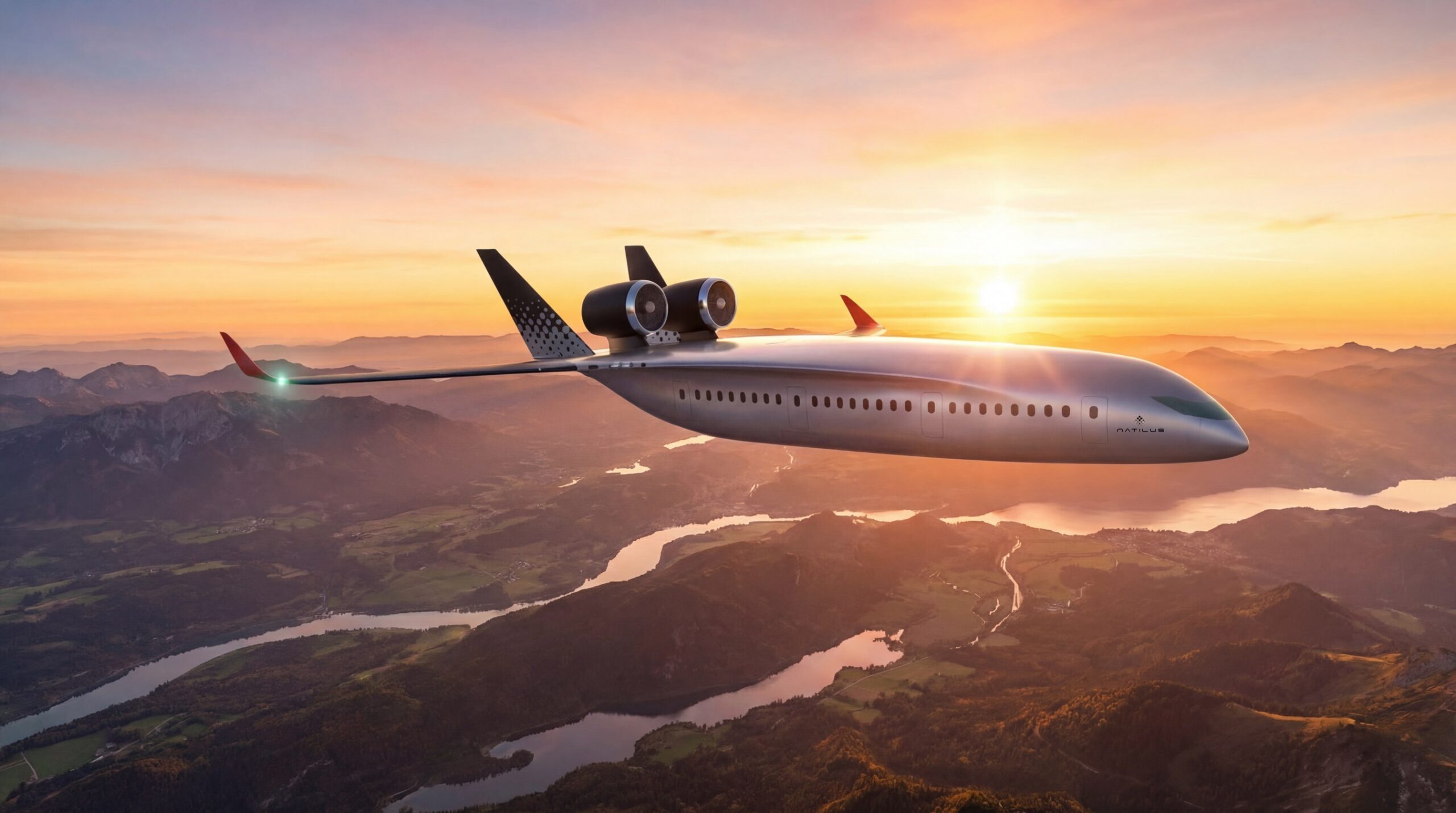
The blended wing is already an unusual airframe choice, but San Diego startup Natilus wants to go one step further.
The company in February announced its planned Horizon Evo passenger airliner would feature a twin deck, a decision largely meant to ease the certification pathway and make the design more attractive to prospective customers. The new design also addresses issues with pressurization, bringing the fuselage closer to the traditional cylindrical shape, which distributes stress evenly and helps planes to withstand pressurization at high altitudes.
“We made the decision that it’s going to be more of a traditional layout, and when we did that, a couple of things magically happened,” said co-founder and CEO Aleksey Matyushev. “The width of the fuselage got narrower, and so we can actually fit into existing seaport parking spaces. The visualization stresses went down quite a bit, because it looks like a traditional circle almost. And then we were able to get aisles and windows almost down the entire length of the airplane, so egress became less of an issue.”
Natilus aims to launch its Horizon Evo jet in the early 2030s, with room for 150-250 passengers depending on the configuration. Matyushev said the design tweaks take its range closer to that of the Airbus A321XLR, which can fly up to 4,700 nautical miles.
The blended wing, so called for its seamless merging between the fuselage and wings, has been on the minds of airplane designers since the early 20th century, but has never entered commercial service. Studies and flights with subscale craft point to the potential for reduced drag and the promise of being up to 30% more fuel efficient than today’s tube-and-wing aircraft. But with the advantages also come new challenges, from ensuring enough headroom to getting passengers out in the required 90 seconds in an emergency.
Matyushev said the double-decker configuration largely addresses those concerns, along with allowing Natilus to increase cargo space on the lower deck. The design also adds more space for fuel in the body of the jet, extending the range. All of the changes have been positively received by FAA, according to Matyushev. The agency declined to comment on ongoing certification work.
“Essentially, we look like a widebody in the narrowbody space and so, for them, that was easier to understand” from a certification perspective, Matyushev said.
The new design marks a divergence from Natilus’ closest competitor, JetZero, which is developing a larger single-deck blended wing it plans to launch for both commercial and military service. While Natilus is squarely aiming at the narrowbody market currently served by Airbus’ A320 and Boeing’s 737 MAX, JetZero target is more middle of the market. It plans to seat 200-250 passengers and target the 5,000 nautical-mile range.
Matyushev said he sees room in the market for both designs, given their different strategies. A JetZero spokeswoman said the company also plans to launch its jet in the early 2030s, and that, like Natilus, it will have belly space for cargo containers.
The first blended wing took to the skies in May 1924, when British manufacturer Westland flew the Dreadnought. This experimental single-engine design was meant to try out the ideas of Russian inventor Nicolas Woyevodsky. It proved too unstable and crashed on its first flight, badly injuring the test pilot, and the design was abandoned.
Since then, a number of companies, including McDonnell Douglas, have investigated blended wings of their own. Research in the 1980s by aerodynamicist Robert Liebeck led to a blended-wing-body concept, which progressed slowly over the next few decades after Boeing acquired the company. Two experimental X-48 craft were built and flight tested before the project was halted in 2013.
Matyushev said past concepts have relied heavily on the McDonnell Douglas studies done in the 1990s and early 2000s. JetZero’s design is certainly influenced by these earlier efforts, the company’s spokeswoman confirmed, as one of its founders was previously at McDonnell Douglas and responsible for developing the blended wing body.
But Natilus’ double-decker approach may bring its own challenges, according to industry analyst Bill Sweetman. The larger aircraft body could require a thicker wing that in turn increases drag, particularly at high speeds. This could take away some of the efficiency gains from the shape — a concern for airlines who want the option to fly faster as needed, he noted.
“It’s a lifting surface, and you’re concerned with the depth of that wing and making sure that you aren’t producing a wing that’s too thick in relationship to it,” he said.
Natilus doesn’t expect the design change to add any extra weight to the aircraft and anticipates a 30% efficiency improvement over existing jets. Matyushev said the company is “on track” to launch in 2033 or 2034, giving it seven or eight years to get through testing and certification. He acknowledged the challenge ahead, but said it’s possible to go faster than traditional programs, pointing to SpaceX as an example.
“You do need companies such as ours to really push the envelope and create new innovation,” he said.