BETA gives details on planned hybrid-electric military plane


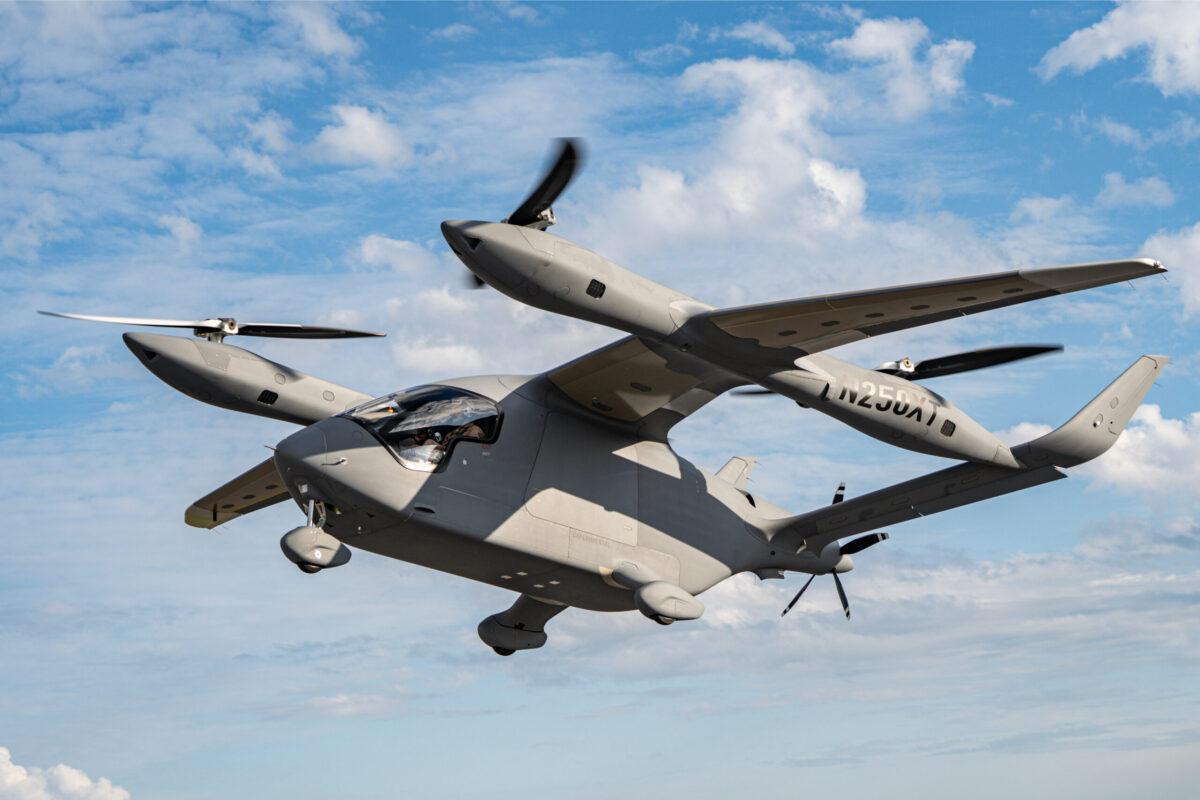
The autonomous hybrid-electric aircraft BETA Technologies is developing for the U.S. military will be able to go “farther and faster” than some traditional helicopters, founder and CEO Kyle Clark said during a Thursday earnings call, the first since BETA went public last month.
BETA has been developing multiple variants of its ALIA electric aircraft for commercial use, but has also reportedly received at least $100 million in support from the U.S. Air Force, through its AFWERX Agility Prime program, for flight testing and development. The company said in public filings in September that “we expect multiple military branches to use ALIA defense VTOLs,” meaning vertical-takeoff-and-landing aircraft, in their operations. In those filings, the company also described this planned military variant, the ALIA MV250.
The MV250 will have all the benefits of battery-only electric aircraft, Clark said, with an onboard gas turbine generator to augment power, and will have reduced weight because there won’t be a pilot or pilot safety systems on board.
Also in September, BETA announced a partnership with GE Aerospace to codevelop the turbogenerator needed for the MV250, and that GE would invest $300 million in BETA.
BETA began trading publicly Nov. 4. On Wednesday, the company reported a loss of $437 milion for the quarter spanning July through September, while revenue for the quarter totaled $8.9 million.
BETA isn’t the only advanced air mobility developer pursuing military contracts. California companies Archer Aviation and Joby Aviation, for example, are also developing military variants of their aircraft.
“DARPA and GE got wind of what we were doing, and we hosted them here,” Clark said during Thursday’s call. “I toured them personally around the business, showed them all the technologies. What really triggered this was BETA’s ownership of the software, the hardware, the control electronics, the electromagnetics — putting that all together into something that could meet the national security needs because of that full ownership.”
BETA is also partnering with General Dynamics to develop electric propulsion systems for undersea use in DARPA’s Manta Ray program to create autonomous, uncrewed underwater vehicles. That work is classified, but it serves as a “powerful validation of our core technologies,” Clark said.
These undersea technologies he said, would be similar to ALIA aircraft systems. “Of course, the cooling systems are different, but the requirements are actually remarkably similar.”
“I think you will see us expand into more marine applications, specifically the safety critical and mission critical undersea work,” Clark added.