
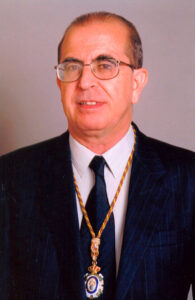
Juan R. Sanmartin died on 3 November 2025 at the age of 84.
After earning degrees in Aerospace Engineering from the Universidad Politécnica de Madrid (UPM) and in Physics from the Universidad Complutense de Madrid, both in 1965, Sanmartín obtained a Ph.D. in Aerospace Engineering Sciences from the University of Colorado in 1967, followed by a second Ph.D. in Aerospace Engineering from UPM in 1972. These achievements marked the beginning of a distinguished and influential career.
He served as a Research Associate at Princeton University (1967–1969) and the Massachusetts Institute of Technology (1969–1971), at Spain’s National Institute of Aerospace Technology (1971–1974), and later as Full Professor (1974–2011) and Emeritus Professor at the School of Aeronautical and Space Engineering of UPM.
Sanmartín was a pioneering researcher whose work spanned a wide range of topics, all approached with remarkable creativity, intellect, and originality. His research in plasma physics focused on plasma–conductor interactions, parametric instabilities, and nonlinear waves. In 1975, he initiated a research program on inertial confinement fusion, which evolved into UPM’s Plasma Research Group. He also explored dissipative chaos and other physical phenomena of historical and pedagogical importance.
However, his name will remain most closely associated with space engineering through his groundbreaking contributions to tether technology. In 1991, he introduced the revolutionary “bare tether” concept, which eliminated the need for large anodic contactors used in earlier missions such as TSS-1 and TSS-1R. This innovation transformed the field—every electrodynamic tether mission of the 21st century has employed bare tethers. He later proposed using a low–work-function coating on the tether to remove the need for a cathodic contactor as well.
Sanmartín’s visionary work laid the foundation for numerous applications of tethers, including propellantless propulsion, onboard power generation, planetary exploration, artificial aurora creation, and nonlinear wavefront excitation in plasmas. He published seminal papers on optimal tether sizing, survivability, radiation impedance, and electron collection, accounting for effects such as magnetic fields, plasma flow, and multi-tether interference.
His ideas were central to many ESA, NASA, and European Commission projects. NASA’s ProSEDS experiment, designed to test a bare tether in space, was ready to fly in 2003 but was ultimately canceled after the Shuttle Columbia accident. He also led the European Commission-funded BETs project, aimed at advancing the technology’s readiness level in Europe.
Elected to the Royal Academy of Engineering of Spain in 1998, Sanmartín received numerous honors, including awards from the UPM Foundation, the Royal Academy of Sciences, and Spain’s National Institute of Aerospace Technology.
His legacy endures in the countless researchers and engineers inspired by his work, and in the many technologies that continue to build upon his remarkable vision.