
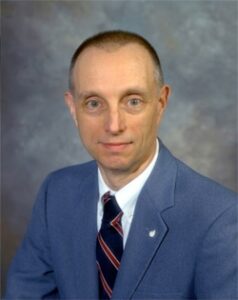
Dennis M. Bushnell, NAE, died on 20 October 2025.
Bushnell graduated from the University of Connecticut in 1963 with an M.E degree and an M.S. from the University of Virginia in 1967, both in the field of Mechanical Engineering.
He retired from NASA Langley Research Center in 2023, after 60 years of service, the last 28 as its Chief Scientist. During his first 30 years at NASA, he conducted groundbreaking research in a wide range of areas, including viscous flow modeling and control, turbulent drag reduction, and hypersonic flight. He contributed to the Gemini, Apollo and Space Shuttle programs, oversaw technology for the National Aero-Space Plane, and conducted experiments and analysis of shock impingement interference heating on swept leading edges, which was applied to X-15 design modification. The Viscous Flow Branch that he led pioneered the development of supersonic and hypersonic quiet tunnels, laminar-turbulent transition prediction methods, laminar flow control technology, and riblets for turbulent drag reduction – a technology that was later used to win the America’s Cup. He also analyzed and published an extensive collection of the many initial disturbance fields that provide the initial conditions for and dictate the location of laminar-turbulent transition.
His expertise was highly sought after by the industry and other government agencies, and he served as a consultant to about 90 different organizations, including the Pentagon and intelligence agencies where he provided technical consultation. He engaged with the national security community concerning identification and quantification of both future technologies and their impacts upon threat and vulnerability and future warfare. He also served on a Naval Research Advisory Committee, Biological Terrorism Advisory Committee, and Navy/DARPA Submarine Technology Working Group. He had an unparalleled reach to the international research community, which even included funding research activities in Russia.
Bushnell inspired many to push the technological boundaries. In1988, he asked the following question of leading aerodynamicists and invited them to a workshop in spring 1989: “Is there a renaissance for the long-haul transport?” Bushnell’s challenge was aimed at revolutionary advances in aircraft design. The workshop was attended by leading experts from industry, government, and academia and from it came the blended wing body and the truss-braced wing concepts; both these technologies are now being pursued by the industry. In his 60-year career at NASA, he had about 300 publications, 500 invited lectures, and 16 patents. He was passionate about addressing futuristic technologies and their impact on the society, including personal air vehicles, in-situ resource utilization on Mars, Halophytes (salt plants grown on wastelands using seawater irrigation to solve land, water, food, energy and climate grand challenges), quantum computing, and low energy nuclear reactions to solve the global energy problem.
For his distinguished services to the aerospace community, Bushnell was recognized with many awards including the 1975 AIAA Lawrence Sperry Award, 1991 AIAA Fluid and Plasma Dynamics Award, and several NASA awards including the Exceptional Scientific Achievement Medal and Outstanding Leadership Medal. He also received several lecture awards including the 1998 AIAA Dryden Lecture, 1998 RAeS Wilbur and Orville Wright Lecture, 1994 ICAS Guggenheim Lecture, and Israel’s 2006 Von Karman Lecture. He was a Class of 1993 ASME Fellow, and 1995 Royal Aeronautics Society Fellow. He was elected a member of the U.S. National Academy of Engineering in 1998.
Bushnell served AIAA in many capacities, including as a member of the AIAA Journal Editorial Advisory Board, Fluid Dynamics Technical Committee, and Chair of the Technical Program Committee and Session Chair for over 20 AIAA conferences. He was elected AIAA Fellow in 1988. He was elevated to the prestigious AIAA Honorary Fellow status in 2016, for his seminal contributions to the advancement of aeronautical and space technologies and life-long services to promote the national agenda on the technological front.