
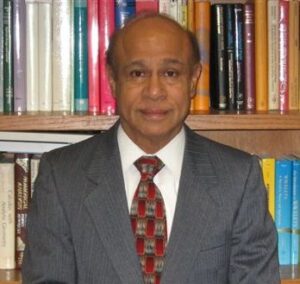
Mohammad Yousuff Hussaini, Ph.D., died on 16 February 2026.
Yousuff Hussaini was a renowned applied mathematician and computational engineer with a strong interest in the education and training of young scientists. He graduated from the University of Madaras, India, where he received his bachelor’s and master’s degrees. In 1970, he earned his Ph.D. from the University of California, Berkley, after which he returned to India, where he joined the Indian Space Research Organisation (ISRO) and held several positions over a six-year period, ultimately serving as Acting Division Head for Aerodynamics.
In 1976, he returned to the United States as a Senior Research Fellow at NASA Ames Research Center. In 1978, he joined the Institute of Computer Applications in Science and Engineering (ICASE) at NASA Langley Research Center, where he eventually served as its director from 1992 to 1996. After ICASE, he joined Florida State University (FSU) where he held the Thinking Machines Corporation Eminent Scholar Chair in High Performance Computing and the Sir James Lighthill Professor of Mathematics and Computational Science & Engineering. He retired from FSU in 2021.
At ICASE, he focused his research on developing spectral methods for accurate simulation of fluid dynamics phenomena including laminar-turbulent boundary layer transition. The book Spectral Methods in Fluid Dynamics (Springer, 1987) by Canuto, Hussaini, Quarteroni, and Zang grew out of this several-years effort to establish spectral methods solidly in computational fluid dynamics. This monograph became a standard reference in the field. Hussaini and collaborators also developed subgrid scale model for compressible turbulence, and performed large-eddy simulation (LES) of compressible homogeneous turbulence. They also performed large-scale direct numerical simulation (DNS) of compressible isotropic and homogeneous shear flows. As the director of ICASE, he dedicated his attention to several programs: combustion, aeroacoustics, interdisciplinary activities, and high-performance computing (HPC). Research in combustion involved fundamental studies of the ignition and structure of non-premixed flames in vortex dominated flows relevant to scramjets. Interdisciplinary studies included aerodynamic design optimization and fluid dynamic control. The HPC program included parallel numerical algorithms (e.g., parallel multigrid and domain decomposition), systems software, and performance and reliability analysis.
Hussaini had notable and prolific research accomplishments in numerous disciplines as evidenced by his impressive 400-plus publications. He mentored dozens of young researchers. His notable service contributions include numerous workshop proceedings that laid the foundation for new areas of research in transition, turbulence, and combustion. Through his recruiting at ICASE and his own collaborations, he forged a community of top visiting and career computational scientists and computer scientists at ICASE.
He was a Fellow of AIAA, American Physical Society, American Society of Mechanical Engineers, and the Institute of Physics. He received several NASA awards, including the NASA Medal for Exceptional Scientific Achievement for his many pioneering studies of boundary layer transition physics and development of highly accurate computational methods for conducting such studies.