Simulators poised to play key role in air taxi pilot training


Along with certification and large-scale manufacturing, the nascent air taxi industry faces at least one other major challenge to get dozens or even hundreds of these electric aircraft flying in the coming years: training vast numbers of pilots.
Designers of fossil-fueled aircraft have long relied on simulators as one way to manage the cost of training. Now, these machines are poised to play an even larger role in preparing pilots to fly aboard or remotely control future air taxis, thanks to the rapid increase in computing power and use of artificial intelligence models that allow simulators to replicate real-life flight environments with greater fidelity.
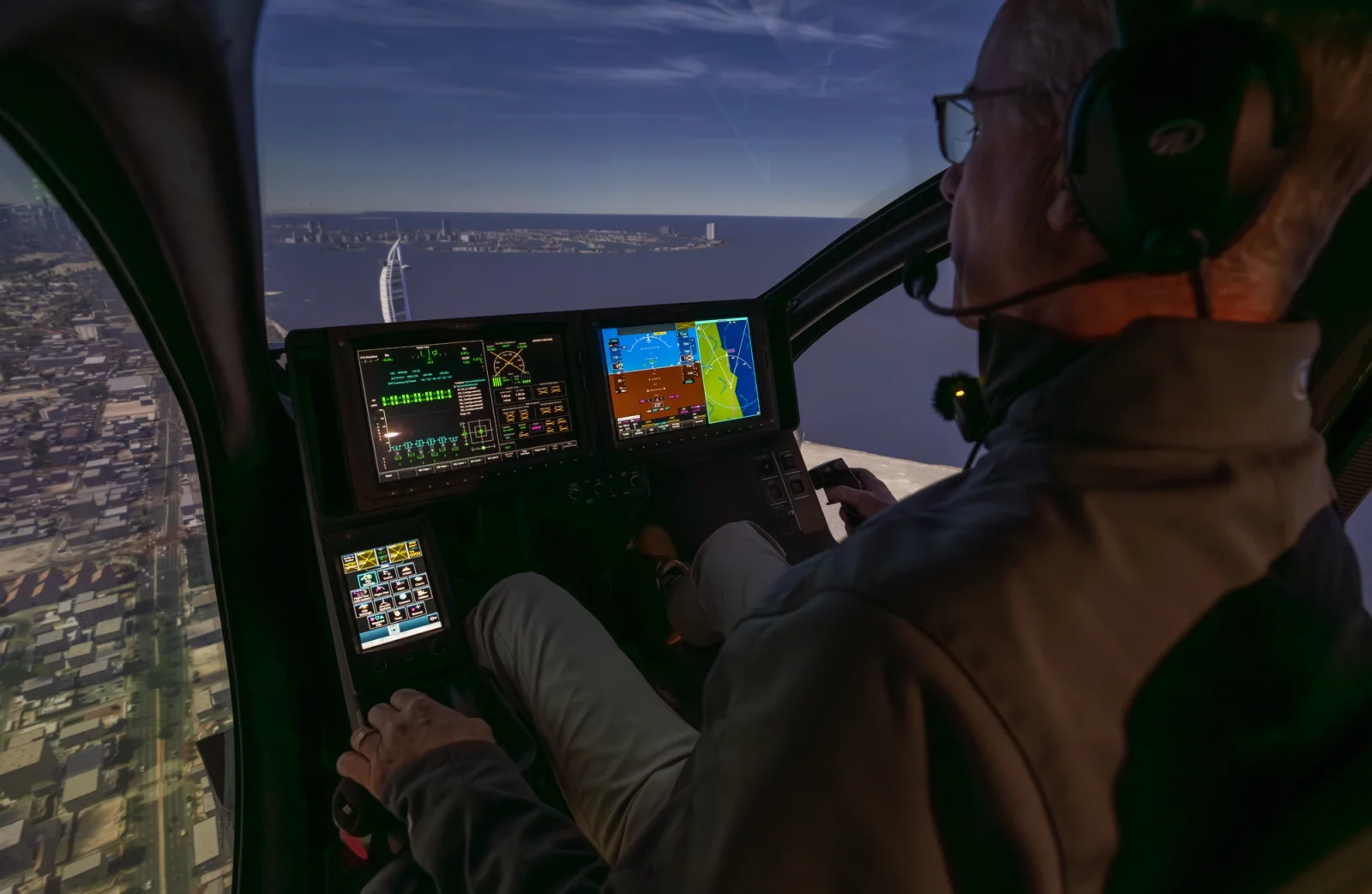
“The reason why there’s a pilot shortage is because it costs so much to become a pilot, and so we can tackle that” partly with the use of simulators, said Bonny Simi, head of operations and people at air taxi developer Joby Aviation, in an interview. The California company opened its Joby Academy pilot training school two years ago and in January received the first of two training simulators it ordered from Montreal-based CAE.
Joby’s academy costs about $60,000 per pilot, which Simi said is about half of what many other pilot schools charge. While timelines for completion vary, the company has said trainees can achieve certification in as little as six months.
In addition to the cost benefits, there are practical reasons for air taxi developers to embrace more simulator training, especially in the early stages. Most of their aircraft — the majority of which are classified as eVTOLs — only seat a single pilot, meaning there’s no place for a flight instructor to ride along during training flights.
Joby’s first CAE simulator is an FAA Level 7 unit, which means it has a fixed base but conveys a high-fidelity representation of the performance of a specific aircraft. The second simulator is to have a moving base to simulate aircraft motion.
“We’re all about optimizing cost while enhancing safety, so we’ve started with the more cost-effective simulator with a fixed base because we can do 95% of the training through that,” Simi said.
When the second simulator arrives, Joby estimates the company will be able to train up to 250 pilots per year.
“These simulators are central to the FAA certification process and are being delivered on time to support pilot training ahead of Joby’s first commercial flights planned for this year,” Simi said.
CAE announced in February it sold a full-motion, full-flight simulator to Eve Air Mobility, the Brazil-based air taxi developer that is targeting 2027 to begin deliveries of its four-passenger aircraft. CAE told me by email that “the arrival of eVTOLs is accelerating interest” in simulators that can provide credits toward a pilot license. The company has programmed the Joby and Eve simulators with data from the companies on how their aircraft perform or are expected to perform.
Using real aircraft data to drive simulators gives them more fidelity and value, said Ken Byrnes, professor of aeronautical science and flight department chair at Embry-Riddle Aeronautical University’s campus in Daytona Beach, Florida. The ever-rising speed and power of computer processing and artificial intelligence also contribute to that fidelity, he added.
Boeing subsidiary Wisk is pursuing yet another training approach, tailored to its specific concept of operations. Unlike other designs, Wisk’s Gen 6 aircraft is to have no pilot at all on board. Instead, the aircraft will be steered via automated controls and monitored remotely by a “multi-vehicle supervisor.”
The company hasn’t yet decided how many aircraft each supervisor will be tracking at a time, said Mark Shikerman, Wisk’s manager of human factors engineering. But he anticipates simulators will be the primary training method for those supervisors.
“One of the things my team is doing is designing, prototyping and testing that system, that flight deck that our multi-vehicle supervisors will be using to supervise multiple missions,” Shikerman told me in an interview. “So in a way, in our case, it’s even more straightforward than a traditional simulator with a moving seat, because nothing is changing from the simulation to the actual flight supervision. Either way, you’re not inside the aircraft, you’re watching it, watching the data, from multiple screens.”
While simulator technology is advancing, the regulations governing pilot training haven’t changed much. FAA still requires the majority of training to be done aboard real aircraft, though the agency now allows a portion of pilot-in-command training for eVTOLs to be done in a simulator.
FAA did not respond to questions about this, but Byrnes said the agency has been “steadily evaluating the role of high-fidelity simulation for some time.” The U.S. military and commercial airlines already routinely conduct advanced training in simulators for existing pilots learning to fly larger or more complex aircraft types.
In parallel, the forthcoming air taxis — many of which fall under FAA’s powered-lift category — “are expected to be complex, often type-rated, and heavily simulator-supported from the outset,” Byrnes said. He added that “FAA appears to have recognized that a portion of command-level training in a high-fidelity simulator can be appropriate” in its powered-lift Special Federal Aviation Regulation, or SFAR. The 800-page SFAR, which went into effect in January 2025, established the training, certification and operational requirements for eVTOLs.
In the meantime, Brynes said, FAA is also considering revisions to regulations governing flight schools, such as Joby’s, regarding the appropriate role of simulation and data-driven training models — some of which are classified as artificial intelligence.
The broader aviation industry has also explored how virtual reality could lower the costs of simulators with in-goggle imagery rather than giant display screens surrounding a cockpit. A few such designs were on display at the I/ITSEC convention in Orlando in December. In contrast to the full-flight simulators — the most elaborate of which have dome-shaped structures with multiple large screens to emulate cockpit views — the slimmer VR designs consist of just a seat with a joystick and goggles.
This goggle technology costs less than a traditional full flight simulator, but hasn’t been widely adopted by pilot trainers. Among the reasons is the goggles can cause a small percentage of users to experience disorientation or even headaches, said Sean Buck, president of the National Training and Simulation Association, a trade group based in Orlando.
Despite the challenges, VR and related technologies represent the biggest leap in simulator tech in years, Buck told me in an interview.
“What’s drastically changing every day is the realism — artificial intelligence and computing power continues to get more powerful, so we can inject more data and create a more realistic flight and mission scenarios, which leads to better training and better safety records,” he said.