
This shape-shifting wheel could allow swarms of lunar rovers to seek out water ice


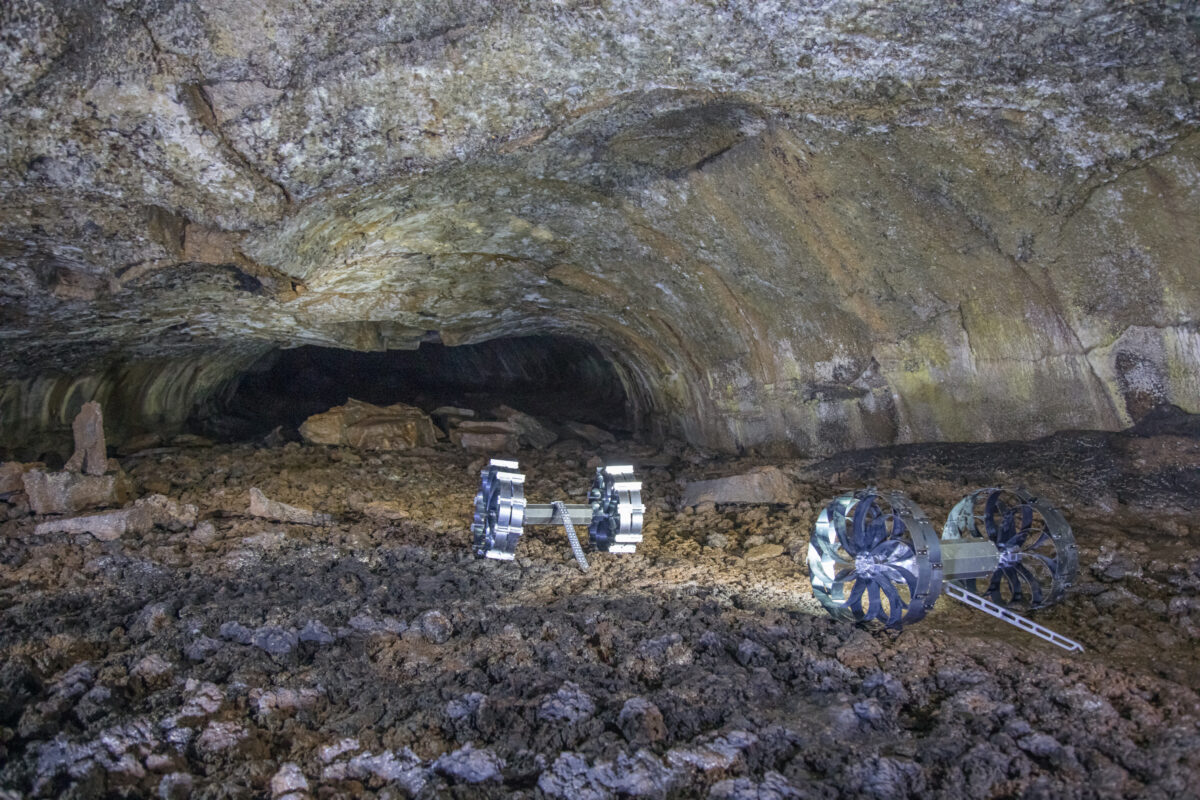
A design for a soft, lightweight, high-impact-resistance wheel, which can expand and contract to allow robotic lunar rovers to ease their way around rocky obstacles, could allow swarms of these vehicles to explore the steeply sloped lava tubes and permanently shadowed craters in the upcoming hunt for water ice on the moon.
So say researchers in South Korea, in a paper published Dec. 17 in the autonomous systems journal Science Robotics. Led by Dae-Young Lee, director of Aerospace Robotics at the Korea Advanced Institute of Science and Technology (KAIST) in Seoul, the researchers in their paper assert that this smart wheel technology could help space agencies de-risk expensive lunar surface mission plans.
“Most rover missions adopt an ‘all-in’ approach, relying on a single, large rover. But if that rover gets trapped in regolith, or stuck on a rock, the entire mission can fail,” Lee told me by email. “Our concept is to operate multiple small rovers to significantly mitigate that risk.”
This approach “would allow for much bolder exploration of unknown and rugged terrain, such as the permanently shadowed regions where water ice is known to exist,” Lee added. “Our wheel technology provides the high impact resistance and mobility needed for deploying multiple small rovers – so even if one or two units fail, the remaining ones can successfully complete a mission.”
A lightweight, low-volume wheel design is key, the KAIST team says, so that the rovers can be shipped to the moon affordably.
The wheels must also have high dexterity, in that they should be able to “shape-change” so the rovers squeeze through and around rocky obstacles unaided when deep in a cave or lava tube. And they must be pretty bulletproof in terms of impact resistance, so that they can recover from falls in the “challenging lunar terrain” of lava tubes, surface pits and craters.
KAIST’s wheel design, codeveloped with engineers at Korean startup Unmanned Exploration Laboratory (UEL), checks all those boxes, Lee said.
To make their wheel, they wove together steel strips in what the paper describes as a “crossed-helical” pattern, producing a flexible, elastic structure with high load bearing and shock resistance. And the wheel structure is collapsible, too. When stowed, it is 230 millimeters in diameter, but twisting the wheel’s hubs in opposite directions expands the wheel radially to its deployment diameter of 500 mm.
This trick can be used during surface operations, too: If a rover needs to momentarily slim down a wheel to negotiate a rock formation, one or both hubs can be spun back to the stowed size for a few moments.
In tests of this design on a two-wheeled rover, the team said the vehicle was adept at climbing over obstacles, driving on powdery regolith simulant and — crucially for the water ice quest — recovering and continuing on after being dropped down a 4-meter-deep lava tube on Earth. Their simulations show that in the moon’s reduced gravity, drops up to 100 meters should be survivable.
This design is very different than those on the Apollo Lunar Roving Vehicle. Those bouncy, meshed wheels were made from zinc-coated piano wire with titanium treads. And for good reason, the researchers say in their paper: “Soft wheels utilized previously in the Apollo Lunar Roving Vehicle aimed to enhance traversability in regolith terrain by distributing the vehicle’s weight and preventing sinkage. However, achieving enough displacement for large contact areas typically requires oversized wheel diameters, which are unsuitable for compact or lightweight robotic platforms.”
KAIST’s wheel has yet to find a mission to fly on, but Lee is optimistic that will soon change.
“We hope that the project will help raise public interest and support for lunar exploration in Korea,” he said.