


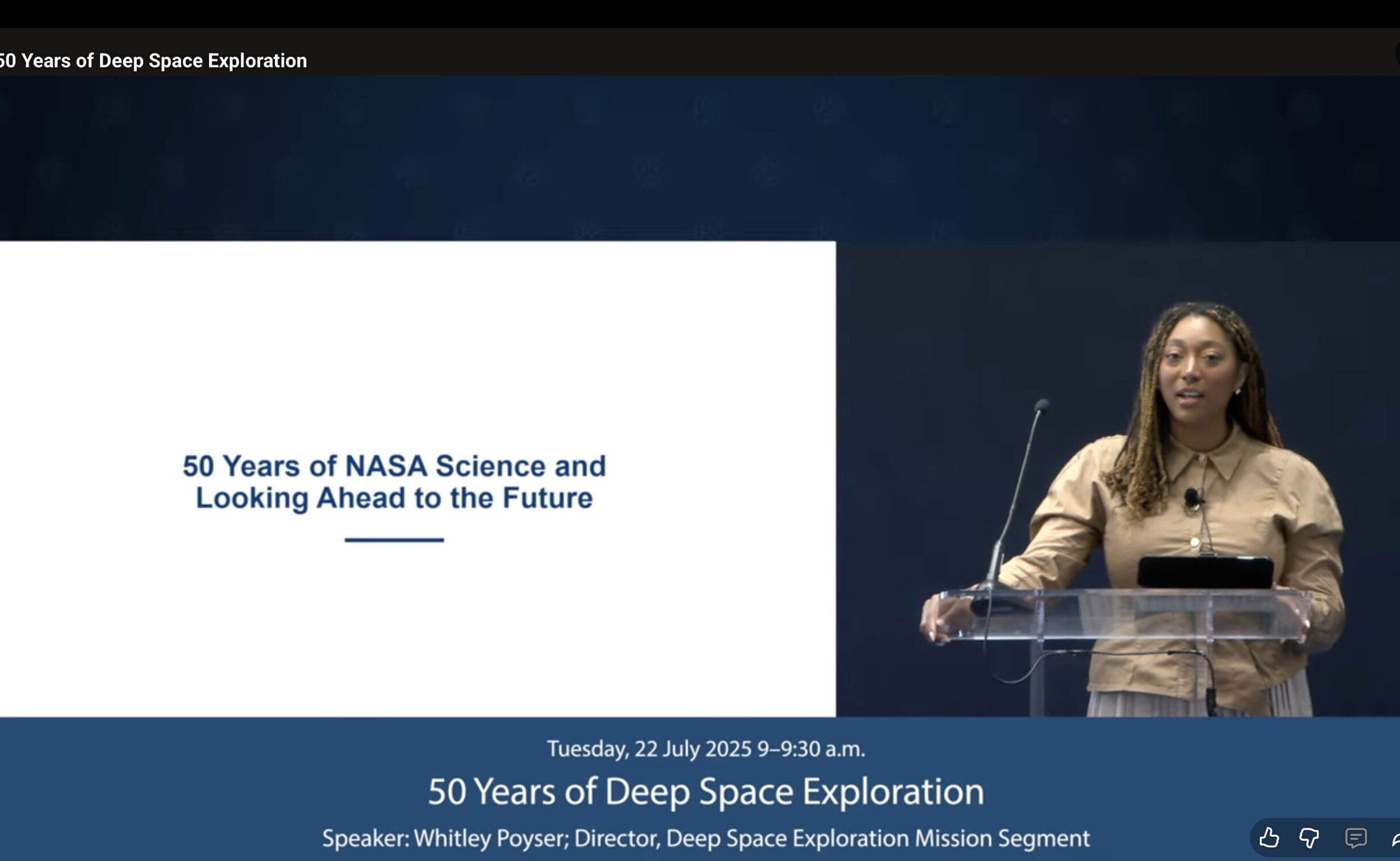
For 50 years, Lockheed Martin and NASA have collaborated to advance understanding of the solar system, designing, building, and operating the spacecraft and instruments that transformed planetary science into precise, data‐driven exploration. During the “50 Years of Deep Space Exploration” session at the HUB during AIAA AVIATION Forum and ASCEND in July, Whitley Poyser, Lockheed Martin’s Director of Deep Space Exploration Mission Segment, traced this partnership from its origins in 1975 through today’s ambitious missions – and offered a glimpse of what lies ahead.
It began in August 1975, when Viking 1 lifted off on a journey that culminated the following July with the first soft landing on Mars. That launched a new era of planetary exploration with the first surface images of the Red Planet and a wealth of information about its geology, climate history, and the possibility of past liquid water. Lockheed Martin’s contributions extended beyond the lander’s scientific instruments: the company developed the critical heatshield and entry-descent-landing systems that guaranteed mission success, Poyser described.
The company has played a central role in every facet of Mars exploration – supporting all 22 of NASA’s missions to Mars, Poyser noted. From the Mars Odyssey orbiter to the Mars Reconnaissance Orbiter, now approaching 90,000 orbits and holding the interplanetary record for data return, these spacecraft have revealed an evolving planet. MAVEN, which has spent more than a decade quantifying atmospheric loss, and the Mars rovers—each equipped with Lockheed Martin-engineered landing systems—deepen our understanding of the Red Planet.
Lockheed Martin also has contributed to studies of every planet, including Pluto. Poyser highlighted Lockheed Martin’s heritage of “firsts” throughout the solar system. The company built the spacecraft that first probed Venus’ atmosphere and delivered close‐ups of Jupiter’s swirling storms aboard the Juno mission. Juno stands out as the first solar-powered craft to operate so far from the sun, demonstrating innovative energy solutions for deep-space distances.
Sample-return missions have become one of the partnership’s most compelling triumphs, Poyser explained. In 2020, OSIRIS-REx collected a sample from asteroid Bennu and returned it to Earth in 2023. Lucy, launched in 2021, is on a 12-year, 4-billion-mile odyssey to study Jupiter’s asteroids, regarded as “fossils” of the early solar system.
Looking forward, Lockheed Martin is the prime contractor for the design, fabrication and testing of the cruise stage and the aeroshell, backshell, and thermal protection systems of the Dragonfly mission — an innovative rotorcraft lander scheduled for launch in 2028 to explore Saturn’s largest moon, Titan. And there are also Venus follow-ups planned to help unravel that planet’s runaway greenhouse atmosphere.
Perhaps the most ambitious undertaking on the horizon is Mars Sample Return. Perseverance has collected 30 sealed rock cores, and Poyser described how Lockheed Martin and NASA aim to launch new spacecraft that will rendezvous with those samples, launch them from the Martian surface, and deliver them to Earth for detailed analysis. She estimated that a government‐industry partnership can achieve this for less than $3 billion, unlocking precious insights into Martian history and perhaps requirements for sustained human presence.
Critical infrastructure underpins these accomplishments. A multi-mission operations center near Denver has logged more than 1 million flight hours in more than 35 years of continuous service, supporting everything from ground command to real-time navigation, Poyser noted. The company’s teams of engineers, scientists and mission planners collaborate closely with academic institutions and entrepreneurs, accelerating the pace of emerging technologies that will be required for continued exploration.
Poyser also underscored that each mission does more than advance science; it cultivates the next generation of explorers and engineers. The partnership with NASA is a testament to past accomplishments but also a roadmap for future research. This presentation offers a comprehensive overview of the missions, technologies, and vision driving the journey throughout the solar system, and is a must-watch for anyone interested in how engineers and scientists collaborate to probe other worlds.